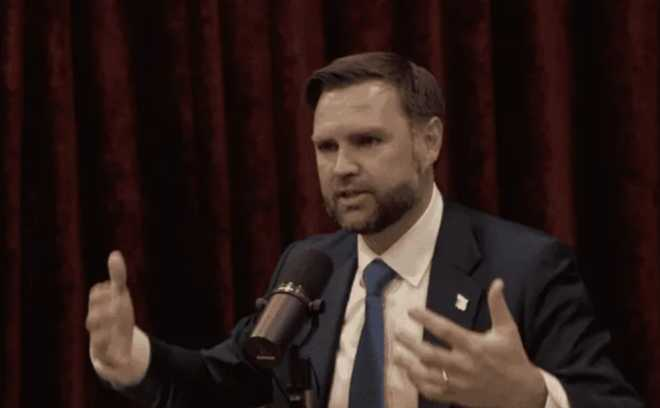
Vice President JD Vance was unsparing during an appearance on the Joe Rogan Experience(JRE) podcast published Wednesday, defending Donald Trump administration's negotiations and ceasefire proposal with Iran, and slammed critics who have aggressively attacked his diplomatic efforts. "Many of the people who were receiving that money were actually attacking me in completely dishonest ways... my response to that is, well, go to hell. I'm going to do what I have to do for the American people. I represent Americans first," he said.
The nearly 3-hour conversation on JRE came at a highly strategic moment as the Trump administration worked to manage divisions in the ruling Republican party over the ongoing war with Iran and lingering public frustration regarding transparency over the Jeffrey Epstein files. Throughout the conversation, Vance delivered some of his most candid and combative remarks to date on foreign influence, the economy, and the administration’s own communication missteps.
Vance cited a Time magazine investigation alleging that a former Trump campaign operative, Brad Parscale had been funded by the Israeli government to orchestrate a covert campaign to derail the Iran peace negotiations. He accused elements within the Jewish state of trying to manipulate U.S. public opinion to keep the war going indefinitely without a clear, defined strategic endpoint.
While the vice president noted that foreign lobbying is simply "the nature of the beast" and expected from countries like Israel, he expressed intense frustration with Americans who allowed foreign interests to dictate their positions.
Addressing another persistent point of criticism from both the left and right of American politics, Vance conceded that the administration severely mishandled the public rollout of federal documents related to Jeffrey Epstein.
Vance admitted, "We absolutely screwed up the comms of the Epstein files. Like, we just did." He pointed to former Attorney General Pam Bondi's handling of the release. Bondi had famously claimed a definitive "client list" was sitting on her desk, and later released "declassified" binders to influencers that mostly contained already public information.
"I think Pam was trying to respond to the political moment," Vance said, arguing there was no malicious cover-up but that she had significantly "overstated what we had."
When Rogan noted that many believe Epstein was connected to Mossad (Israeli intelligence), Vance agreed, saying that Epstein "clearly had connections to the highest levels of American intelligence" and "the highest levels of Israeli intelligence." He claimed that Epstein’s ties in Israel were mostly concentrated within "left of center" elements of the Israeli political establishment.
During a discussion focusing on domestic policy, Rogan expressed his concern about the rising popularity of democratic socialism among young Americans.
Vance blamed four decades of bipartisan economic policies that favored offshoring, outsourcing, and relying on low-wage foreign labor. He argued this turned the U.S. into "a kind of shell corporation" that no longer manufactures its own goods or supports worker bargaining power.
The vice president criticized Wall Street firms for buying up single-family homes and turning them into "investable, 'line goes up' assets," which has locked young people out of homeownership.
Vance warned his conservative colleagues that simply shouting "socialism is bad" is not enough. "I think that unless you go down that pathway of allowing young Americans to own something, socialism is the inevitable outcome... and if we don't [fix this], we are going to end up with a socialist president in this country."
The vice president's remarks on JRE drew praise from across the political spectrum. Many of the low-propensity voters who were crucial to the Trump's election victory, had grown disillusioned by the administration's active military campaign in Iran and perceived foot-dragging on the Epstein files.
Political analysts noted that by directly addressing Rogan's own criticisms on these fronts, Vance sought to act as the administration's primary diplomat to anti-war and anti-establishment skeptics.
Pro-war commentators, Zionists and neoconservative critics slammed the appearance, branding Vance an "antisemite," with some declaring they will "never" vote for him if he runs for president in 2028.