keneci Network
News • Comedy • Science & Tech
Spacewalk 96: Astronauts Prep ISS Power Infrastructure For Solar Array Upgrade
August 06, 2026
post photo preview

Anil Menon and Jessica Meir completed a 6 hours 27 minutes U.S. Spacewalk 96 or extravehicular activity (EVA) on Thursday (Aug. 6). The NASA astronauts exited the International Space Station (ISS)’s Quest airlock to modify the 3B power channel on the Starboard 6 truss, preparing the station for the installation of a seventh ISS Roll-Out Solar Array (IROSA) later in the year.

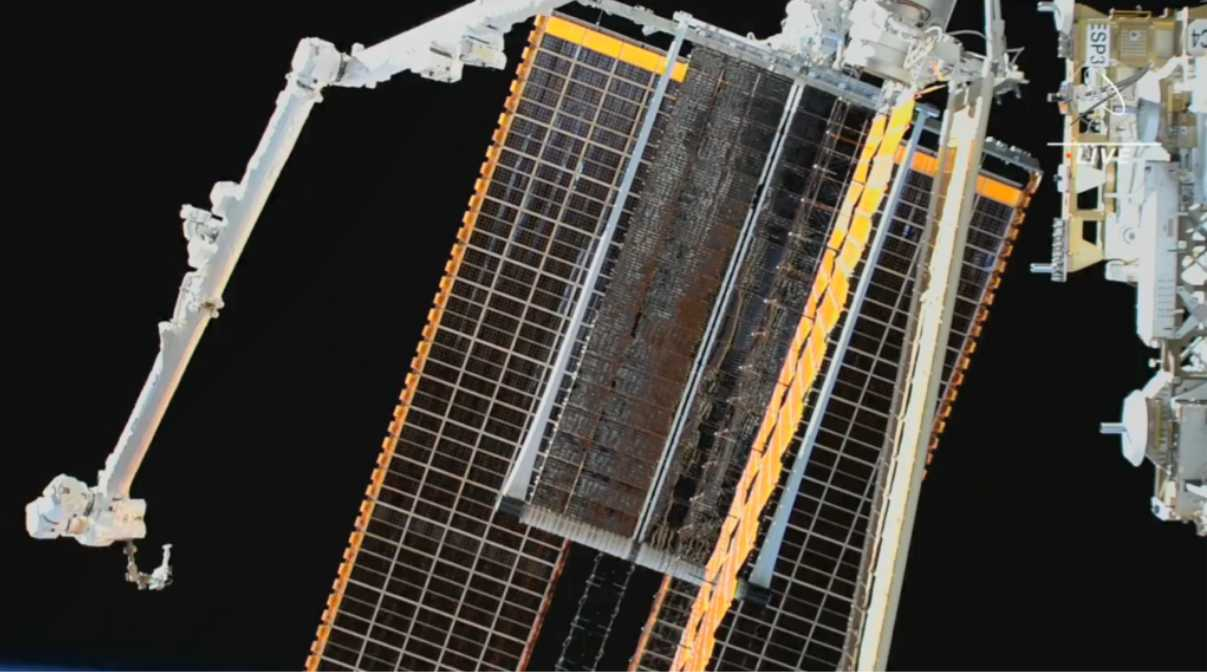
Since 2021, astronauts on prior spacewalks have deployed six of the iROSA assemblies, leaving now just two awaiting delivery to the station later this year. The ISS relies on eight individual power channels fed by primary solar array wings deployed between 2000 and 2009. Over decades in low Earth orbit, radiation and thermal cycling gradually reduced the efficiency of these original arrays.

Thursday's spacewalk began at 1233 UTC when the astronauts switched their spacesuits to internal battery power. A veteran astronaut, Meir served as EV-1 and wore a spacesuit with red stripes; this is her sixth spacewalk since her first ISS mission between 2019 and 2020. Menon, a U.S. Space Force colonel and physician, is on his first mission to space and wore an unmarked spacesuit as EV-2.

Meir and Menon assembled the modification kit for one of the space station's eight power channels, which will allow for the future addition of a new iROSA. They worked to assemble and bolt together the triangular brackets on the 3B power channel, located on the far right, or starboard (S6) segment of the station's backbone truss.

Menon was positioned on an articulating portable foot restraint (APFR) atop a worksite interface (WIFEX), providing a stable angle to work from the truss.

Once the modification kit structure was built and secured to the 3B mast canister, the two spacewalkers routed cabling that will carry the electricity from the future iROSA into the 3B power channel and then covered the struts with multi-layer insulation to protect them from micrometeoroid strikes.

The iROSA wings sit forward of the legacy solar arrays, augmenting their electricity generation rather than replacing it. The station's eight original arrays began showing degraded power output as they exceeded their 15-year design life. When used in tandem with the new iROSA wings, the upgraded system will increase the station's electricity supply by 20% to 30%.

The other power channel currently without an iROSA deployed is 2A on the left, or port side, of the station.

"Anil, you can see the moon to the — well, I am not sure what way you're facing, but…," said Meir, taking a short break during the spacewalk to notice NASA's next destination for astronauts under its Artemis program.

"To my right. Yeah, I see it — thanks for the heads-up," said Menon. "I can see a future moon base there."

"I can see it, too!" Meir said.

Meir later turned her attention to Mars with her closing words of the day.

"On this day in 2012, NASA's robotic rover Curiosity successfully landed on the surface of Mars with the goal of understanding if the planet could have fostered life. Curiosity achieved that goal within a year," she said. "One day, humans will visit Curiosity, propelled by the groundbreaking science, technology demonstrations and operations conducted here on the International Space Station for almost 26 years now."

"Today, we made one more step toward expanding the ISS power system, further sustaining our human presence in low Earth orbit, as we prepare to take those next steps," said Meir.

Meir and Menon upgraded the ISS power infrastructure to support critical operations, including life support and scientific experiments, as the station ages. This upgrade is critical for sustaining the station’s power margin through its planned controlled deorbit in late 2030, requiring additional energy for attitude control and avionics during reentry.

After collecting their tools and reentering the Quest airlock, the spacewalk concluded at 1900 UTC.

This was the first spacewalk for the space station's Expedition 75 crew; the 96th U.S. EVA and 281st spacewalk overall in support of the space station's assembly, maintenance and enhancement.

There are two more U.S. spacewalks scheduled for this month: EVA 97 will work to replace a space-to-ground antenna on Aug. 13, and EVA 98 will connect power channel cables and data relay systems as part of ongoing maintenance, including preparations for the station's future deorbit, as well as replace a navigational aid used for spacecraft docking on Aug. 25.


community logo
Join the keneci Network Community
To read more articles like this, sign up and join my community today
0
What else you may like…
Videos
Posts
Articles
SpaceX Starlink Internet Satellites

With Starlink internet, data is continuously being sent between a ground dish and a Starlink satellite orbiting 550km above. Furthermore, the Starlink satellite zooms across the sky at 27,000 km/hr! MORE VIDEOS ON KENECI NETWORK RUMBLE CHANNEL: https://rumble.com/c/Keneci

00:28:08
Elon Musk, DOGE Speak On Waste And Fraud

US Department of Government Efficiency Services (USDS) led by Elon Musk speak on the "mind-boggling" fraud and waste in UInited States federal government

00:00:45
January 17, 2025
SpaceX Launches Starship 7th Test Flight

SpaceX successfully executed its second-ever “chopsticks” catch of a Super Heavy booster (or Booster 14) using the “Mechazilla” launch tower on Thursday(Jan. 16), during the seventh uncrewed test flight of the company's 123-meter Starship rocket. However, the megarocket's upper stage(or Ship 33) was lost approximately 8.5 minutes into the flight in a “rapid unscheduled disassembly(RUD)” or explosion

00:10:30
Welcome to Keneci Network!

Join the conversations!

December 09, 2025
Bitcoin White Paper By Satoshi Nakamoto

Bitcoin white paper

Bitcoin_White_Paper.pdf
September 17, 2024
Charges Against Sean 'Diddy' Combs In Grand Jury Indictment

The rapper was charged with racketeering conspiracy, sex trafficking by force, fraud or coercion, and transportation to engage in prostitution in the indictment unsealed Tuesday(Sept. 17)

Combs-Indictment-24-Cr.-542.pdf
September 03, 2026
post photo preview
China, US Developing Military 'Hunter' Satellites: Leaked Report

The United States and China are rapidly developing military space capabilities, including "hunter" satellites and orbital weapons, signaling a shift toward potential space warfare.

Recently leaked documents and space-tracking data from early September 2026, reportedly show both nations are creating spacecraft capable of maneuvering near, inspecting, or potentially disabling other satellites.

Unlike traditional satellites that follow fixed, predictable orbital paths, hunter satellites—also called co-orbital threat systems or inspector satellites—possess high maneuverability. They are equipped with advanced propulsion, autonomous navigation, and physical or directional payloads designed to interact with other spacecraft.

China and the US are aggressively pursuing on-orbit refueling technologies. Because maneuvering in space consumes significant fuel, refueling capabilities allow hunter satellites to remain operational indefinitely rather than becoming dead weight after a few maneuvers.

China’s advancements include orbital "dogfighting" and refueling technologies. Chinese military-linked researchers are pursuing satellites designed to pursue and capture other spacecraft, with patents covering autonomous fuel-efficient maneuvers and net-based capture systems.

Officially referred to as "space debris removal," "in-orbit servicing," or "repair craft," the exact same robotic mechanisms (grappling arms, nets, lasers) used in systems can be weaponized to disable enemy satellites.

In June 2026, a Chinese spaceplane released a mini-satellite that circled another spacecraft, an act US officials described as a dress rehearsal for combat. Additionally, China likely conducted an on-orbit refueling attempt last year, a breakthrough that would allow satellites to extend their operational lives indefinitely.

Chinese military-linked patent filings reveal developments in autonomous, fuel-efficient pursuit calculations and multi-satellite netting systems designed to capture non-cooperative target spacecraft.

The US is countering with joint allied operations and electromagnetic weapons. The US Space Force has introduced ground-based electromagnetic weapons to disrupt satellite communications and operates a secret, crewless spaceplane similar to China’s.

Ground- and space-based lasers can blind satellite optics or permanently damage solar arrays. High-powered electromagnetic weapons are designed to sever satellite data links to ground stations.

In a significant strategic signal, US Space Command, alongside Five Eyes allies recently conducted their first joint military space operation in the path of a suspected Chinese spy satellite, demonstrating allied coordination. In one instance, a US military satellite executed a close-approach intercept vector near a Chinese Shiyan 12-01 satellite, signaling operational readiness to inspect and counter adversary craft.

Autonomous craft like the US X-37B and China's secretive Shenlong serve as mobile deployment platforms for covert payloads, anti-satellite surveillance, and maneuver warfare.

US Space Force leadership describes the Chinese threat as "substantial," noting rapid expansion in both the number and complexity of Beijing’s space missions.

Read full Article
September 02, 2026
post photo preview
Owl Around The World: Rocket Lab Electron Launches Japanese StriX Satellite

Rocket Lab successfully launched its 94th Electron mission, deploying the latest StriX synthetic aperture radar satellite for Japanese company Synspective. The "Owl Around The World," mission lifted off from Launch Complex 1 in New Zealand at 1201 UTC on Wed (Sept. 2).

The Electron's upper 'kick stage' deployed the Strix satellite 56 minutes after liftoff, into a 575 kilometer low Earth orbit to expand Synspective’s imaging constellation.

Synspective is building a constellation of approximately 30 StriX satellites to provide high-resolution Earth observation data for urban planning, infrastructure monitoring, and disaster response.

Named after the owl genus Strix, these satellites use radar to image Earth’s surface day and night, penetrating cloud cover and darkness.

The Strix constellation will "make it possible to quickly monitor and confirm on-the-ground changes during disasters such as earthquakes and floods at night, as well as in areas that are difficult to access," Synspective's website reads.

"In addition to disaster response, we will leverage our SAR satellite capabilities to promote efficient resource utilization," it adds. "For example, we can use our satellite data to monitor natural resources and urban development, ensuring sustainable and optimal use of land and water."

Rocket Lab has been the exclusive launch partner for Synspective since 2020, maintaining a 100% mission success record for all Synspective launches.

The company has 16 additional Electron missions booked to deploy the remainder of the constellation before 2030.

The StriX program began with StriX-α launched on December 15, 2020, followed by StriX-β in February 2022 and the first commercial satellite, StriX-1, in September 2022.

As of Wednesday's launch, 10 StriX satellites have reached orbit, including recent missions like "Viva La StriX" (May 2026) and "Ten Owl of Ten" (June 2026).

The Electron rocket is a two-stage, small-lift vehicle standing 18 meters tall, recognized as the world’s most frequently launched small-lift orbital rocket. Rocket Lab has also launched nine missions to date with HASTE, a suborbital version of Electron that allows customers to test sensors and instruments in a hypersonic flight environment. While Electron debuted in 2017, HASTE lifted off for the first time in June 2023.

Read full Article
September 02, 2026
post photo preview
US Strikes On Iranian Targets Kill At Least 4 Including Children At Wedding Celebration, Over 70 Injured

US Central Command (CENTCOM) on Tuesday at 1600 UTC began a wave of strikes against Iranian military targets, including sites in Bandar Abbas, Jask, Sirik, Minab, Qeshm, and Chabahar.

The operation, CENTCOM claimed, targeted Islamic Revolutionary Guard Corps (IRGC) infrastructure, specifically air defense sites, radar systems, maritime assets, mine-laying capabilities, and communications networks, in response to recent IRGC attempts to attack commercial shipping in the Strait of Hormuz and US service members in the region.

A US strike hit a residential home in Kuhestak, Sirik, where a wedding celebration was taking place. According to the Iranian Red Crescent and local officials, the attack resulted in at least four deaths, including a child, and over 68 injuries.

Iran’s Foreign Ministry condemned the event as a "savage crime," while CENTCOM stated its focus was strictly on military and strategic infrastructure to degrade Iran’s ability to threaten maritime traffic.

In retaliation, Iran launched ballistic missiles and drones at US-linked facilities across the region. The IRGC claimed successful strikes on 85 US military sites, including Camp Titin in Jordan and the Sheikh Isa Airbase in Bahrain. Jordan’s military reported intercepting 10 out of 13 incoming ballistic missiles, while Kuwait and Bahrain activated air defenses against hostile drone and missile attacks.

President Donald Trump warned in a Truth Social post, that Iran would face further, more severe escalation if it continued retaliatory actions.

Iran’s Khatam al-Anbiya Central Headquarters and the IRGC in a statement vowing a "crushing response," and continued retaliatory barrage operations involving ballistic missiles and strike drones aimed at U.S. assets and allied infrastructure across the Jordan, Iraq, Kuwait and Bahrain.

The six-month conflict has focused on control of the Strait of Hormuz, through which roughly 20% of global oil flows. Iran closed the waterway in response to U.S.-Israeli attack that started on February 28. U.S. naval forces claim to have conducted mine-clearing and escort operations which has come under Iranian attacks.

This tit-for-tat escalation marks the latest flare-up in a conflict that repeatedly disrupted global maritime trade. Prior to the September 1 strikes, a brief month-long lull broke down when U.S. forces struck missile sites on Larak Island. Iran answered with attacks on tankers and military outposts, directly leading to CENTCOM's massive September 1 military campaign.

Global energy markets responded immediately, with crude prices spiking over $4 a barrel to five-week highs. This comes as Iranian diplomatic efforts are underway at the Shanghai Cooperation Organization (SCO) to secure material and military assistance from partners like Russia and China.

Read full Article
See More
Available on mobile and TV devices
google store google store app store app store
google store google store app tv store app tv store amazon store amazon store roku store roku store
Powered by Locals