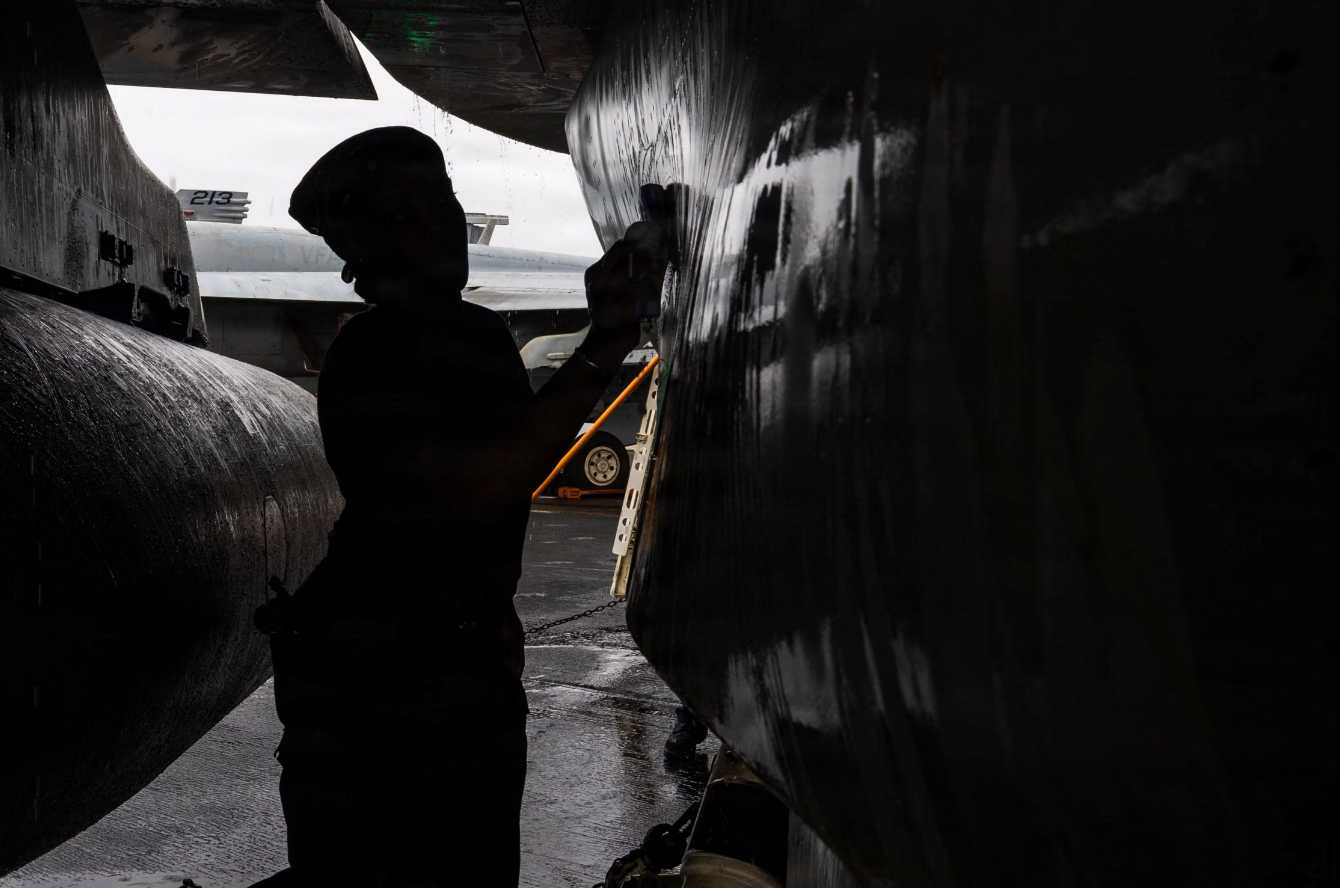
Sailors aboard the USS Abraham Lincoln (CVN-72) have reported severely deteriorating conditions to family members, including food shortages, broken plumbing, and mental health crises, following a record-breaking deployment of over 250 consecutive days at sea amid the Iran war.
There are unconfirmed reports of "low marale," sailors writing "anti-Israel and anti-war messages," using words like "goyims" and mocking President Donald Trump's repeated claims about iminent peace deals with Iran. Text messages published online and reported by military observers showed extreme frustration with the indefinite deployment. Some sailors reportedly wrote home that they felt trapped in an unclear mission, with messages such as "the Navy does not care" and questioning U.S. involvement in the wider Middle Eastern conflict.
Supply chain disruptions reportedly stemming from Iranian attacks on the Naval Support Activity in Bahrain forced the U.S. Navy to relocate its primary logistics hub to Diego Garcia, located roughly 3,540 kilometers from operational areas. This distance, combined with the "highly contested environment," have severely lengthened the carrier’s replenishment timelines.
Supplies that previously moved seamlessly via supply ships out of Bahrain began taking weeks to arrive, stalling shipments of mails, spare parts, fresh food, hygiene items (soap, toothpaste), and mails, while causing care packages to be lost or delayed for months.
Sailors reportedly described eating dry cereal due to a lack of milk, consuming rotten meat, and dealing with moldy showers and non-functional toilets, which family members argue has created unbearable living conditions for the 5,000 personnel on board.
Although the Navy acknowledged logistical challenges like clogged toilets and ventilation issues causing mildew, officials maintain that sailors have access to clean water and healthy meals, attributing the hardships to the necessities of combat operations against Iran.
While families and lawmakers cite reports of suicide attempts and overboard incidents linked to exhaustion and supply failures, the Navy and Defense Secretary Pete Hegseth have disputed these accounts as "completely misrepresented," saying there is no confirmed increase in suicidal ideation on the career. Acting Navy Secretary Hung Cao acknowledged that crew members were "pushed to their limits" and confirmed temporary meal adjustments, but maintained that no core operational capabilities or meals were dropped.
While opposition Democrat lawmakers demand investigations into the "unbearable" conditions and the mental health toll on the crew, Trump downplayed the concerns, remarking that the deployment was "not nearly long enough," even as the Navy announced plans to replace the USS Abraham Lincoln with the USS George Washington.
Meanwhile, frustration with the Trump administration has reached a critical point among U.S. allies in the Persian Gulf, driven by concerns that he lacks the diplomatic capability to end the prolonged war with Iran. Saudi Arabia, the United Arab Emirates, Qatar, Kuwait, and Bahrain are now reportedly united in their aggravation with Washington.
The Gulf nations reportedly feel "unnecessarily entangled" in a conflict they did not start but are forced to endure; with one Gulf official saying bluntly, "Trump started this war, and we are paying the price," and noting that anger toward the U.S. is at its highest level since joint U.S.-Israeli attacks on Iran in February 2026.
Gulf leaders complain that Trump’s policy is "erratic" and "unpredictable," characterized by repeated threats against Iran followed by sudden withdrawals citing diplomatic progress that never materializes.
The breakdown in trust is exacerbated by the failure of recent diplomatic initiatives, specifically the June Memorandum of Understanding (MOU) between the U.S. and Iran. Gulf leaders dismissed the agreement as a "joke" because it failed to address their top security concerns: Iran’s ballistic missile arsenal and its support for proxy forces. Furthermore, the continued closure of the Strait of Hormuz has inflicted severe economic damage on Gulf economies, yet the U.S. has been unable to force its reopening despite months of conflict.
For the first time, this diplomatic friction has led to concrete strategic debates regarding the presence of U.S. military installations. While Qatar and Bahrain currently host large U.S. bases essential to American regional power projection, officials in multiple Gulf states have begun questioning the utility of continuing to host these facilities. The concern is that these bases make them less safe, not more safe, by painting them as primary targets for Iranian missile and drone strikes without guaranteeing a decisive U.S. victory or security guarantee.
For now, a complete expulsion of U.S. forces is not imminent. Gulf states remain heavily dependent on Washington for security support, intelligence, and arms supplies. As one official reportedly admitted, "Whatever we do, we cannot say no to the United States." However, the mere discussion of closing bases signals a significant erosion of the trust that has underpinned Gulf security architecture for decades.
Gulf nations are actively diversifying their security and defense partnerships. A pivotal development occurred last week with the signing of the Makkah Defense Agreement, a mutual defense agreement between Saudi Arabia, Turkey, and Pakistan. Senior European officials reportedly describe this pact as a direct "signal to the U.S." that regional powers are preparing for a future where American guarantees are insufficient.
This shift indicates that while the U.S. remains a primary partner, Gulf leaders no longer view it as the sole guarantor of regional security. The strategy involves building a network of Sunni Muslim alliances to manage local threats independently, reducing vulnerability to the whims of U.S. domestic politics and presidential decision-making.
While the White House reportedly maintains that Trump has "extraordinary relationships" with Gulf partners and that Iran is "more isolated than ever," the reality on the ground suggests a deepening rift. Analysts warn that unless a clear strategy emerges, the security lockdown and economic strain could destabilize the region further, pushing Gulf states to seek accommodations with Tehran independent of Washington.