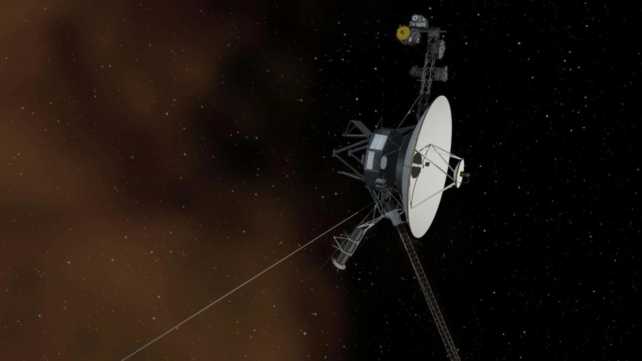
Voyager 1 officially reached a distance of one light-day from Earth on November 18, 2026, at 1016 UTC, becoming the first human-made object to achieve this milestone.
Light day is the distance light travels through a vacuum in 24 hours—approximately 25.9 billion kilometres, or roughly 173 times the distance between Earth and the Sun, meaning radio signals sent from Earth via NASA's Deep Space Network now take a full day to reach the probe and another day to return. Launched on September 5, 1977 (16 days after its twin, Voyager 2), Voyager 1 has traveled for nearly 49 years at a speed of 61,155 kilometers per hour(km/h) through interstellar space.
Originally designed to explore the outer planets, the spacecraft now operates with dwindling power from its radioisotope thermoelectric generators. Only two of its original scientific instruments—the magnetometer and the plasma wave subsystem—remain active, continuing to send data about the interstellar medium despite the aging 1970s technology and the vast communication delay.
While Voyager 1 has surpassed all other human artifacts in distance, this milestone represents only a tiny fraction of the journey to the nearest star system, Proxima Centauri, which lies 4.24 light-years away (roughly 1,550 light-days). Voyager 1 has covered just 0.0027% of that distance. If it were aimed at Proxima Centauri, the trip would take more than 72,000 years.
Voyager 1 is not headed toward Proxima Centauri. Its trajectory takes it toward the constellation Camelopardalis/Ursa Minor. It took a faster, shorter trajectory. It conducted historic flybys of Jupiter (1979) and Saturn (1980), where a close pass by Saturn's moon Titan bent its path upward and out of the plane of the planets. Voyager 2 went on to visit Uranus and Neptune, slowing it down; it won't reach the one-light-day mark until November 2035.
In 1990, Voyager 1 turned its cameras back to snap the famous Pale Blue Dot portrait of Earth before shutting its cameras down forever to save power. In August 2012, it crossed the heliopause—the outer boundary of the Sun's protective magnetic bubble—becoming the first spacecraft to enter interstellar space.
Powered by three decaying plutonium-238 radioisotope thermoelectric generators (RTGs), the spacecraft loses about 4 watts of power each year. Only two of its original 10 science instruments (the magnetometer and plasma wave subsystem) remain active today. NASA expects the probe to run out of power completely around the late 2020s or early 2030s.
Long after its transmitters fall silent, Voyager 1 will continue drifting through the Milky Way for billions of years, carrying the Voyager Golden Record—a 12-inch gold-plated copper phonograph disc containing sounds, music, images, and greetings from Earth in 55 languages.
In about 300 years, Voyager 1 will reach the inner edge of the Oort Cloud (taking roughly 30,000 years to pass through it). In approximately 40,000 years, it will pass within 1.6 to 1.7 light-years of the star Gliese 445 (AC +79 3888)—making it closer to that star than to our own Sun.
While one light-day is an unprecedented achievement for human engineering, compared to the distnace of Proxima Centauri, it illustrates the staggering scale of interstellar space.