keneci Network
News • Comedy • Science & Tech
US Strikes Iranian Targets As IRGC Declares Strait Of Hormuz Closed, After Attacking Transiting Ships
July 12, 2026
post photo preview

The U.S. launched a third round of strikes on Iran late Saturday into early Sunday, directly responding to the Islamic Revolutionary Guard Corps (IRGC) closing the Strait of Hormuz and attacking the Cyprus-flagged container ship M/V GFS Galaxy. Iran later attacked a second ship.

"At 7:15 p.m. ET today, U.S. Central Command [CENTCOM] forces began launching the third round of strikes this week against Iran after Islamic Revolutionary Guard Corps forces blatantly attacked M/V GFS Galaxy, a Cyprus-flagged container ship transiting the Strait of Hormuz," CENTCOM wrote on X. "A civilian crew member is missing and the vessel is unable to continue the journey due to an onboard fire and significant engineroom damage."

Earlier Saturday, the IRGC declared the strategic waterway closed "until further notice" after firing on vessels it claimed were using unauthorized routes, resulting in significant engine room damage to the Galaxy and leaving one civilian crew member missing. "Due to insecurity caused by the illegal intervention of foreigners, the Strait of Hormuz is closed until further notice and until the end of the United States' intervention in this region. No vessel will be allowed to pass," IRGC wrote in a statement.

The U.S. military reported the ship suffered extensive engine-room damage from a missile strike, leaving a civilian crew member missing. Iran countered that it merely fired a "warning shot" because the ship was navigating an unauthorized route.

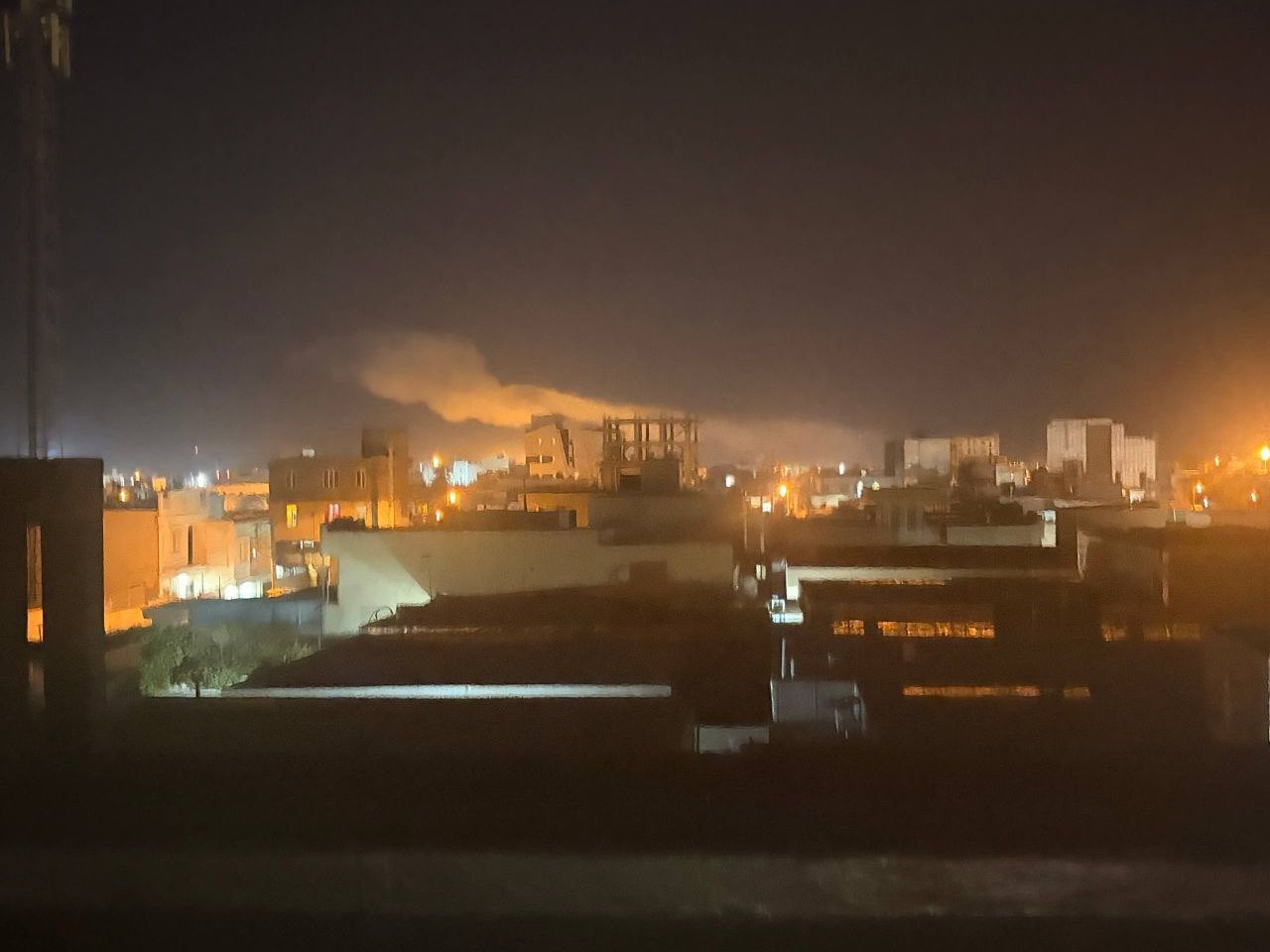
Within an hour of the IRGC's declaration, CENTCOM), acting on orders from President Donald Trump, launched the third major wave of its precision airstrikes this week. American land- and sea-based fighter jets, naval vessels, and drones pounded roughly 140 military targets along Iran’s southern coast. Large explosions were recorded near major energy hubs and port cities, including Bushehr, Bandar Abbas, Jask, and Chabahar.

In response, Iran launched missile and drone strikes on US military bases in Qatar, UAE Bahrain, Kuwait, Oman and Jordan. IRGC reportedly claimed it destroyed logistical support centers for US aircraft carriers and refueling platforms at Duqm port in Oman with ballistic, in the third phase of its response to the US strikes. This is the first Iranian strike on Oman since early March.

"The era of one-sided deals is OVER. We told you: keep your word or pay the price. Reality is knocking," Speaker of Iran's parliament Mohammad Bagher Ghalibaf wrote on X with a screenshot of the US-Iran memorandum of understanding highlighting article 5 which reads: “The Islamic Republic of Iran will make arrangements using its best efforts "for free passage of commercial vessels through Hormuz, “for 60 days only.”

Saturday's mediation efforts by Oman and Qatar failed as Iran rejected U.S. demand to issue a public statement guaranteeing the Strait of Hormuz is open. Trump had declared the ceasefire between US and Iran over; and on Saturday threatened total devastation if alleged assassination plots against him by Iran are realized.

community logo
Join the keneci Network Community
To read more articles like this, sign up and join my community today
0
What else you may like…
Videos
Posts
Articles
SpaceX Starlink Internet Satellites

With Starlink internet, data is continuously being sent between a ground dish and a Starlink satellite orbiting 550km above. Furthermore, the Starlink satellite zooms across the sky at 27,000 km/hr! MORE VIDEOS ON KENECI NETWORK RUMBLE CHANNEL: https://rumble.com/c/Keneci

00:28:08
Elon Musk, DOGE Speak On Waste And Fraud

US Department of Government Efficiency Services (USDS) led by Elon Musk speak on the "mind-boggling" fraud and waste in UInited States federal government

00:00:45
January 17, 2025
SpaceX Launches Starship 7th Test Flight

SpaceX successfully executed its second-ever “chopsticks” catch of a Super Heavy booster (or Booster 14) using the “Mechazilla” launch tower on Thursday(Jan. 16), during the seventh uncrewed test flight of the company's 123-meter Starship rocket. However, the megarocket's upper stage(or Ship 33) was lost approximately 8.5 minutes into the flight in a “rapid unscheduled disassembly(RUD)” or explosion

00:10:30
Welcome to Keneci Network!

Join the conversations!

December 09, 2025
Bitcoin White Paper By Satoshi Nakamoto

Bitcoin white paper

Bitcoin_White_Paper.pdf
September 17, 2024
Charges Against Sean 'Diddy' Combs In Grand Jury Indictment

The rapper was charged with racketeering conspiracy, sex trafficking by force, fraud or coercion, and transportation to engage in prostitution in the indictment unsealed Tuesday(Sept. 17)

Combs-Indictment-24-Cr.-542.pdf
September 23, 2026
post photo preview
Pezeshkian Slams Israel, US In Defiant UN Speech: Iran Will Never Bend The Knee

Iranian President Masoud Pezeshkian delivered a historic and defiant address to the United Nations General Assembly on Wednesday, becoming the first world leader to speak in person while his country is at active war with the host nation, the United States. Speaking a day after President Donald Trump threatened to "annihilate" Iran if a peace deal was not reached, Pezeshkian accused the U.S. and Israel of committing terrorism, war crimes, and violating international law.

Pezeshkian held up photographs of Ali Khamenei, the late Iranian Supreme Leader who was assassinated in the first hours of the U.S.-Israeli offensive in February 2026, as well as images of over 150 schoolchildren killed in a U.S. airstrike on a primary school in Minab.

The Iranian president said that a UN fact-finding mission found "reasonable grounds" to believe the U.S. committed a war crime in that attack. He further condemned the targeting of Iranian universities, hospitals, and infrastructure, asserting that Iran has "only defended itself" and will fight "until our last breath."

Addressing Trump by name, Pezeshkian rejected the U.S. president's characterization of Iran as a "bully" or "terrorist," declaring, "We have been the victims of terrorism." He vowed Iran would never "bend the knee" to sanctions or bullying but emphasized that Tehran remains "ready for dialogue and diplomacy and negotiations without accepting the language of force."

"The United States president described us as terrorists. We have been the victims of terrorism... We will never bow our head or bend at the knee in the face of sanctions, increased pressure, and increased bullying," Pezeshkian said.

Pezeshkian specified that any deal must include the end of the U.S. naval blockade in the Strait of Hormuz and the release of frozen Iranian assets. He heavily criticized Israel's "double standard," noting that Israel possesses nuclear weapons and kills civilians in Gaza yet faces no sanctions, while Iran is punished for seeking equal rights.

"Atomic and nuclear bombs are in the hands of the Israeli regime, but the inspectors are requested to come to Iran. Israel kills, but Iran is subject to sanctions," the Iranian president said.

Despite the fierce rhetoric, Pezeshkian closed his speech by stating that Iran remains willing to return to the negotiating table, provided force and coercion are dropped. "We are ready for dialogue, diplomacy, and negotiations without accepting the language of force," he said.

The U.S. delegation walked out during Pezeshkian's speech, and Secretary of State Marco Rubio subsequently dismissed the speech, questioning Iran's standing to lecture on human rights.

Pezeshkian, elected in July 2024 as a reform-minded candidate initially seeking to ease Western sanctions, has seen his presidency defined by intense military conflict. Following the military strikes in early 2026 and the assassination of Supreme Leader in February 2026, Pezeshkian has had to balance pressure from hardline factions at home while attempting to keep diplomatic channels open abroad.

Read full Article
September 23, 2026
post photo preview
Trump Threatens To Annihilate Iran In UN Speech, As China Rejects US Sanctions On Iranian Airlines

President Donald Trump delivered a 37-minute address to the United Nations General Assembly in New York City on Tuesday, in which he threatened to “annihilate the Islamic Republic” of Iran if a deal to end the ongoing war is not reached. Framing his decision as a binary choice, he said he would either allow Iran to “rebuild and create a far greater country” or “drive them into hell with no chance of survival.”

"Will a deal be made with Iran that lets them rebuild and create a far greater country than it ever was before? Or do I annihilate the Islamic Republic, and do it quickly... drive them into hell with no chance of survival...?" Trump said.

Trump called on all nations to enforce the “complete economic isolation of Iran” and maintain sanctions to bring down global energy prices. Iranian delegation reportedly walked out of the General Assembly hall during his address.

Trump defended the war, which began in February 2026 alongside Israel, as a necessary action to prevent Iran from acquiring nuclear weapons, dismissing reports of U.S. munitions shortages despite Pentagon inspector general reports of “strategic inventory shortfalls.”

The U.S. president later expressed confidence that a deal would ultimately be struck shortly after the upcoming U.S. midterm elections, asserting that Iranian officials are “waiting to see how I do” in that vote.

Iran’s armed forces condemned the speech as an “exploitation of the U.N.’s podium to legitimize aggression.” President Masoud Pezeshkian is scheduled to address the assembly on Wednesday.

Shortly after his speech, Trump announced that U.S. officials, including envoys Jared Kushner and Steve Witkoff, held a “very good” three-hour meeting with Iranian representatives at the U.N.

Beyond Iran, Trump touted U.S. operations in Venezuela, issued warnings to Cuba and Mexico regarding national security, announced plans to build two new military bases in Greenland via agreements with Denmark, and criticized international bodies like the UN Human Rights Council and the ICC.

 
US Envoy, Iranian Officials Hold Talks In New York

On the sidelines of the 2026 UN General Assembly, U.S. Special Envoy Steve Witkoff confirmed that American and Iranian delegations held a three-hour meeting mediated by Qatar and Pakistan, marking the first high-level contact between the sides in months.

Witkoff described the talks as "constructive and promising," stating in an X post, that mediators "shuttled between the two sides" throughout the day. President Donald Trump characterized the outcome as "very good" and "very productive."

The U.S. delegation included Witkoff and Trump's son-in-law Jared Kushner, while the Iranian side was led by Foreign Minister Abbas Araghchi. Iranian President Masoud Pezeshkian was also present in New York.

Although Trump initially suggested direct talks, Witkoff clarified via X that the negotiations were indirect, with mediators facilitating communication between the two delegations.

Iranian state media confirmed that Foreign Minister Araghchi presented Tehran’s non-negotiable conditions to reopen the strategic Strait of Hormuz. These terms include: an immediate lifting of the U.S. naval blockade, unfreezing seized Iranian financial assets abroad and an immediate halt to military operations across all regional fronts.

The meeting occurred against the backdrop of an ongoing conflict, with Iran's Foreign Minister Abbas Araghchi noting that discussions took place under the "constant threat of attack" as the U.S. conducted consecutive nights of strikes on Iranian military targets.

This indirect session marks the first high-level diplomatic exchange between Washington and Tehran since mid-June.

 
China Rejects US Sanctions On Iranian Airlines

As part of the U.S. campaign to enforce maximum economic pressure and isolate Tehran, Washington has imposed secondary sanctions on foreign entities doing business with Iranian transport and aviation infrastructure, notably Mahan Air and Iran Air.

Beijing has consistently rejected unilateral U.S. sanctions against Iranian transport and aviation, maintaining that economic relations and trade with Iran comply with international law. China continues to reject Washington's efforts to enforce unilateral extra-territorial jurisdiction over non-U.S. entities, officials say.

Read full Article
September 21, 2026
post photo preview
Google, Manufacturing Partners Open Pre-orders For The New Googlebook Laptop OS Devices

Google and PC manufacturing partners on Monday, opened pre-orders for Googlebook laptops, a new premium hardware category built on an Android-based technology stack paired with ChromeOS desktop foundations. The devices, manufactured by Acer, ASUS, Dell, HP, and Lenovo, launch with prices starting at $899 and are scheduled for general release in October 2026.

The Googlebook OS (internally known as Aluminium OS) represents a strategic unification of Google’s mobile and desktop ecosystems, ending years of internal debate about merging Android and ChromeOS. It retains the desktop windowing environment, multi-monitor management, desktop-class Google Chrome (with full extension support), and a robust file manager from ChromeOS.

The operating system runs on a native Linux kernel using the Android technology stack, integrating the Chrome browser and Play Store into a single, AI-first platform optimized for both ARM and x86 architectures. This means Google Play Store apps run natively on the host system with hardware acceleration, improving performance for desktop-class mobile apps like Adobe Photoshop, Lightroom, and CapCut.

Googlebook OS is centered on Gemini Intelligence, featuring tools like Magic Pointer for contextual analysis, Magic Cues, and Create My Widget. Devices offer deep integration with Android phones, allowing users to cast phone apps (Cast My Apps), access phone files via Quick Access, and sync settings and passwords seamlessly.

Each Googlebook device includes a Google Titan hardware root of trust, on-device malware detection, and a Level 5 security-certified pKVM hypervisor that isolates the Linux environment with direct terminal access for developers, enabling native execution of developer CLI tools, such as Claude Code and Google's Antigravity AI platform.

Googlebook device minimum requirements include flagship-tier chips (Intel Core Ultra Series 3 or Qualcomm Snapdragon X Elite) with NPUs, 16GB RAM (up to 32GB), and high-resolution OLED displays.

Google commits to 10 years of OS updates and feature drops. Every device includes 12 months of Google AI Pro (5TB storage + Gemini Advanced), 3 months of YouTube Premium, 1 year of GeForce NOW, and Adobe Photoshop.

The search and streaming giant also clarified that standard ChromeOS and Chromebooks will continue alongside Googlebook as lower-cost, web-focused options.

While ChromeOS established dominance in K-12 education, Chromebooks struggled to capture premium consumer markets against MacBook Airs and AI-centric Copilot+ PCs. Googlebook OS bridges the app gap by allowing high-end laptop silicon like Intel Panther Lake and Snapdragon X, to run Android's vast ecosystem natively while keeping the full desktop web browser and Linux workstation toolsets.

Read full Article
See More
Available on mobile and TV devices
google store google store app store app store
google store google store app tv store app tv store amazon store amazon store roku store roku store
Powered by Locals