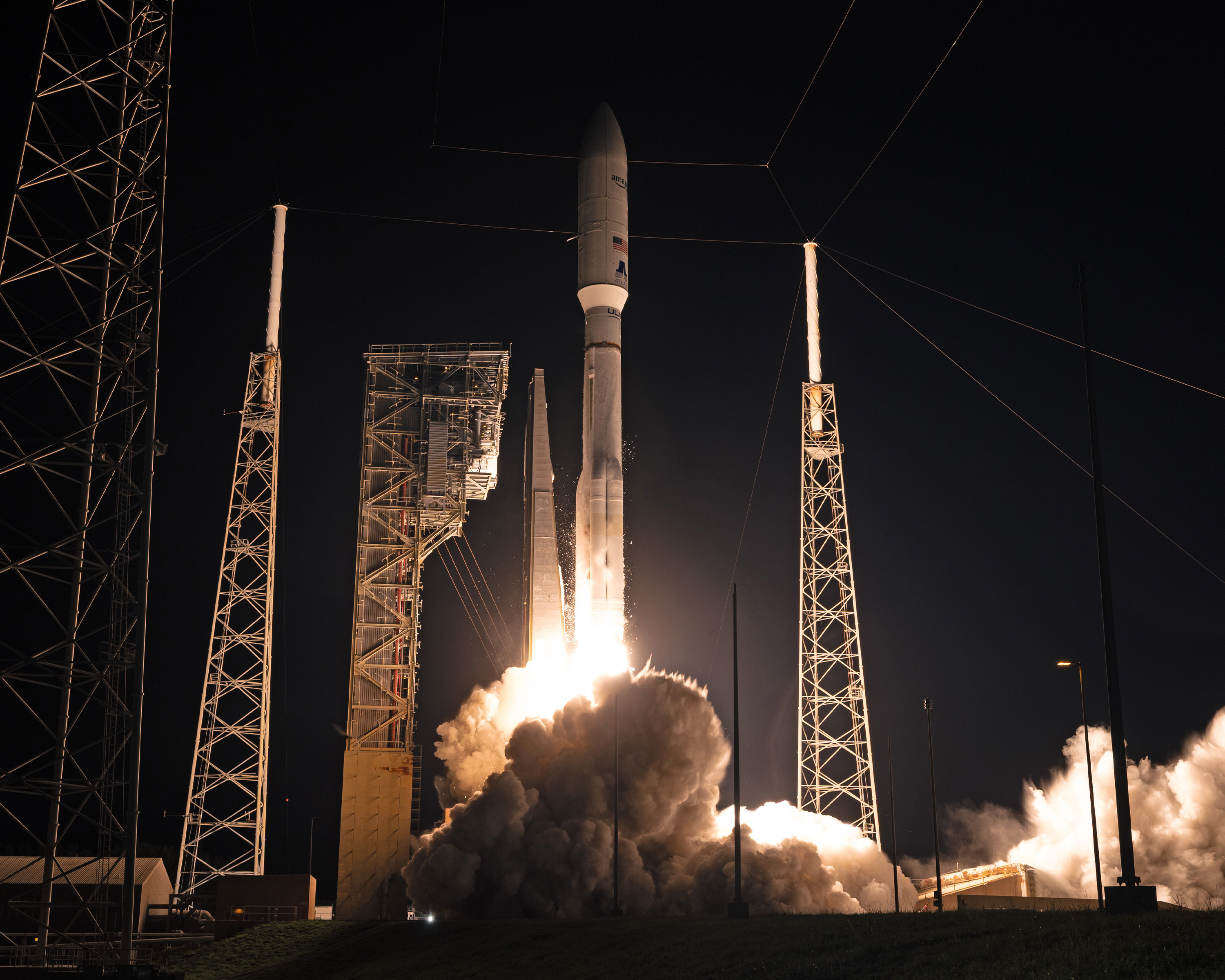
A United Launch Alliance (ULA) Atlas V 551 rocket launched the Amazon Leo (LA-08) mission at 0430 UTC on Thursday (July 2) from Space Launch Complex-41 (SLC-41) at Florida's Cape Canaveral Space Force Station, carrying 29 spacecraft for Amazon Leo broadband megaconstellation. All of the satellites were successfully deployed in low Earth orbit (LEO) as planned, ULA announced 70 minutes after liftoff.
Leo is the Amazon's broadband constellation in LEO (hence the name), which will eventually consist of about 3,236 satellites. It will compete with SpaceX's Starlink network, which has nearly 11,000 satellites currently and growing.
About 396 Amazon Leo satellites have reached orbit on a total of 15 missions to date, atop three different rockets -- the Atlas V, SpaceX's Falcon 9 and Arianespace's Ariane 6 -- making it the third-largest constellation currently active. With this milestone, Amazon Leo announced that the constellation has enough satellites to support continuous service across initial latitudes, preparing for an initial service rollout later in 2026.
LA-08 also represented the final flight in ULA’s Leo Atlas campaign, with the company having launched 224 satellites with a 100% success rate across eight Atlas V missions.
The 29 Amazon Leo satellites on Thursday's mission weighed a total of about 18 tons, tying the record for the heaviest load ever launched by an Atlas V. That mark was set on the Amazon Leo 5 mission in early April and has been equaled multiple times since.
Thursday's launch marks a strategic transition for Amazon Leo’s deployment strategy, shifting from the Atlas V to ULA’s newer, heavy-lift Vulcan rocket. Future Leo missions with ULA will utilize Vulcan, which is designed to carry larger payloads (over 40 satellites per launch) to accelerate deployment rates.
Amazon has secured more than 100 launches across multiple providers, including Arianespace, SpaceX, and Blue Origin (New Glenn), to meet its Federal Communications Commission (FCC) deadline of deploying 50% of the planned 3,236-satellite constellation by July 2026.