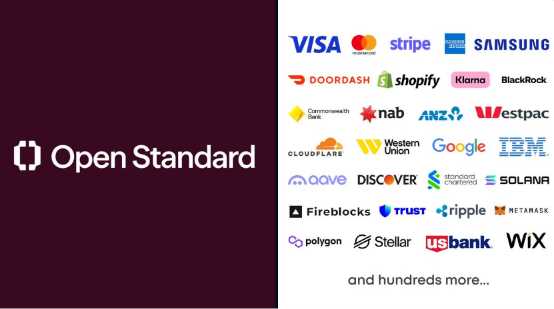
Open Standard, an independent entity governed by a consortium of over 140 companies announced the upcoming launch of a new dollar-pegged stablecoin called Open USD ($OUSD). Backed by a coalition of major players including Visa, Mastercard, BlackRock, Coinbase, Stripe and Google, Open USD is a direct enterprise-grade challenge to the long-standing duopoly of Tether (USDT) and Circle (USDC).
OUSD will launch natively on Solana, Stellar, Base, and Polygon simultaneously to capture fragmented liquidity and high-speed payment networks. Stripe plans to make OUSD the default stablecoin for its platform, while Coinbase will integrate it into its Base layer-2 network.
Unlike incumbents that keep reserve earnings, OUSD plans to distribute nearly all interest generated by its backing assets (cash and US Treasuries) to its partner companies after a small management fee. The stablecoin offers fee-free minting and redemption with no volume caps, incentivizing partners to drive adoption.
If all goes as planned, this is the ultimate selling point for enterprises. Instead of the issuer hoarding the interest generated by the multi-billion dollar reserve backing the stablecoin, Open Standard will distribute almost all reserve yield back to the network partners who adopt, distribute, and hold the coin (minus a nominal operational management fee). This transforms giant businesses from mere users into co-owners of the economic model.
For large corporations moving billions of dollars, the existing costs and artificial volume limits associated with creating or destroying tokens are a bottleneck. OUSD's zero-fee minting and redemption at institutional scale is another potential selling point.
Zach Abrams, the CEO of Bridge (the stablecoin infrastructure platform acquired by Stripe for $1.1 billion), is serving as the founding CEO of Open Standard. It will be controlled by a board of partner representatives rather than a single issuer, addressing enterprise concerns about counterparty dependence.
The consortium explicitly welcomes financial institutions, PSPs, card issuers, merchants, fintechs, exchanges, DeFi protocols, platforms, and marketplaces.
Tether and Circle combined control roughly 80% of the $300B+ stablecoin market. However, their business models are centralized: they collect user cash, invest it into yield-bearing assets like US Treasuries, and keep almost 100% of the interest profits for themselves.
Analysts note thar consortium-led networks like Open Standard's, are historically plagued by slow decision-making and friction when navigating fragmented global regulations. If Open Standard executes smoothly, OUSD could become the "SWIFT network" of programmable enterprise money; if not, it risks becoming an over-hyped corporate experiment.
Open USD is slated to go live later in 2026, meaning its liquidity and peg-stability are still untested.
Circle’s shares fell between 13% and 17% within hours of the announcement. Investors reacted to the realization that major partners like BlackRock and BNY (who historically support Circle's ecosystem) are now backing a direct economic competitor.
In a long X post, Circle CEO Jeremy Allaire publicly welcomed the competition but reiterated USDC's status as the most trusted asset, hinting at future enterprise-revenue-share changes. Tether CEO Paolo Ardoino wrote: "Welcome OUSD. Player 2 has entered the game." (a diss on USDC?).
Stablecoins like USDT and USDC have grown explosively because they offer fast, borderless, 24/7 dollar liquidity on blockchains.
USDT leads due to early adoption and liquidity (especially on Tron), while USDC gained traction through better transparency, regulatory compliance, and institutional trust. Both benefit from interest earned on reserves (mostly short-term U.S. Treasuries), which historically flowed mostly to the issuers.
Regulatory clarity accelerated corporate involvement. The upcoming OUSD launch aligns with the GENIUS Act, signed into law in 2025, by President Donald Trump which has opened the market for new, compliant stablecoin infrastructure.