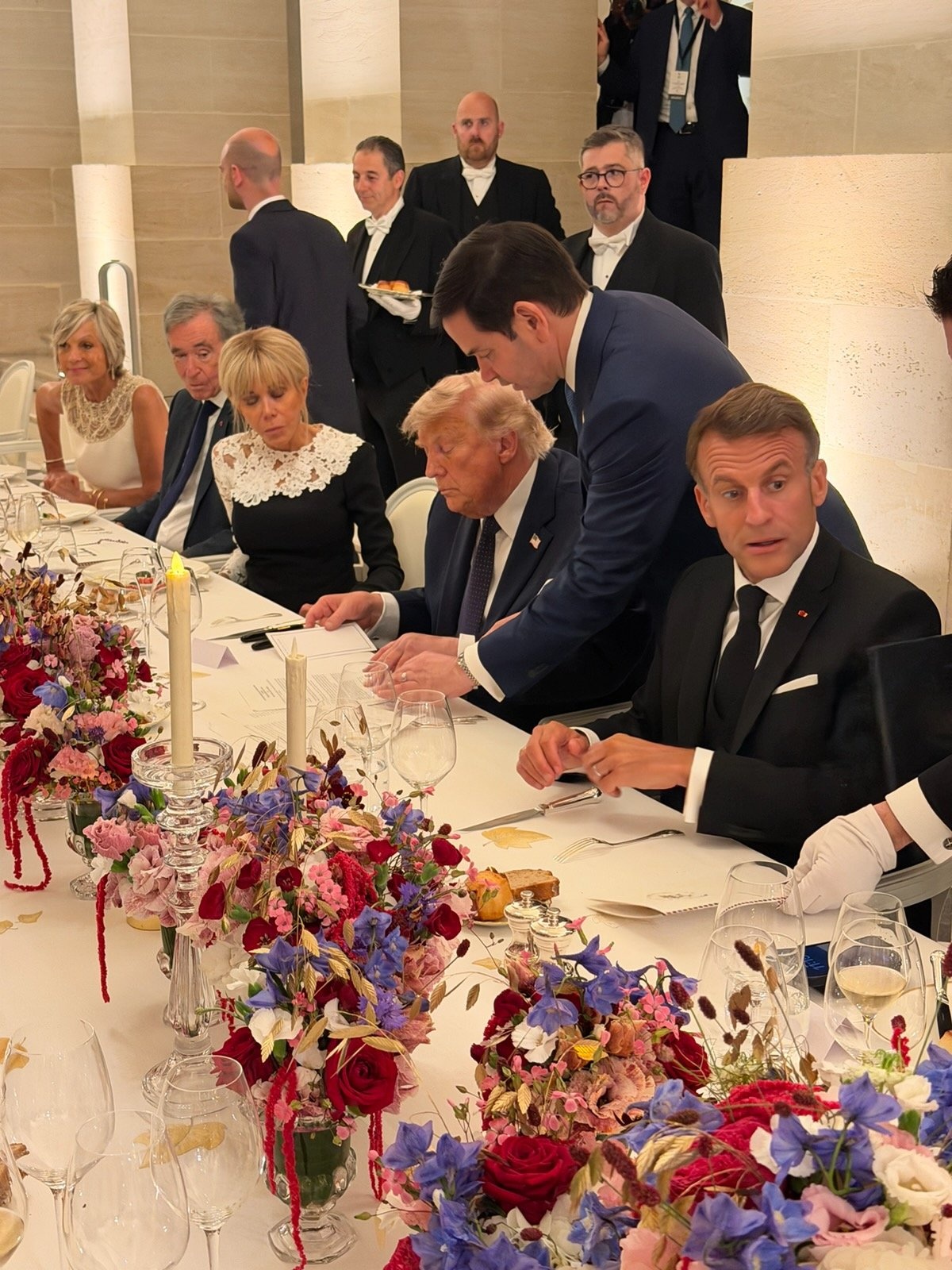
President Donald Trump personally signed the U.S.-Iran Memorandum of Understanding (MOU) on Wednesday, during a dinner with French President Emmanuel Macron at the Palace of Versailles, confirming the deal's immediate effect and canceling a planned formal ceremony in Switzerland.
The dinner was held, after the G7 summit in Évian-les-Bains, to honor the 250th anniversary of American independence. As Trump left the former palace of French kings, he cupped his hands and shouted to reporters: "It's signed, yeah. I signed it in Versailles."
Iranian President Masoud Pezeshkian also signed the document digitally, finalizing an interim agreement designed to end hostilities, reopen the Strait of Hormuz, and initiate a 60-day negotiation period regarding Iran's nuclear program.
The following is the MOU as released bu US officials.
The United States of America and the Islamic Republic of Iran have jointly agreed in good faith on [ __ date] on the following:
The United States of America and the Islamic Republic of Iran and their allies in the current war are signing this MOU to declare the immediate and permanent termination of military operations on all fronts, including in Lebanon, and undertake from now on not to initiate any war or any military operation against each other, and to refrain from the threat or use of force against each other, and ensuring the territorial integrity and sovereignty of Lebanon. The final deal will confirm the permanent termination of the war on all fronts, including in Lebanon and other provisions of this paragraph.
The United States of America and the Islamic Republic of Iran undertake to respect each other’s sovereignty and territorial integrity and to refrain from interfering in each other’s internal affairs.
The United States of America and the Islamic Republic of Iran commit to negotiating and achieving the final deal in maximum 60 days, extendable with mutual consent.
Immediately upon the signing of this MOU, the United States of America will begin the removal of its naval blockade and any disturbances or impediments against the Islamic Republic of Iran, and will fully end the naval blockade within 30 days. During this period, the traffic of vessels will be in proportion to the numbers of pre-war traffic being restored by the Islamic Republic of Iran. The United States of America further undertakes to remove its forces from the proximity of the Islamic Republic of Iran within 30 days after the final deal.
Upon the signing of this MOU, the Islamic Republic of Iran will make arrangements using its best efforts for the safe passage of commercial vessels with no charge, for 60 days only, from the Persian Gulf to the Sea of Oman and vice versa. The traffic of commercial vessels will immediately start, and considering the need for removing the technical and military obstacles and demining by the Islamic Republic of Iran will be instated within 30 days. The Islamic Republic of Iran will conduct dialog with the Sultanate of Oman to define the future administration and maritime services in the Strait of Hormuz in discussion with other Persian Gulf littoral states in line with the applicable international law and the sovereign rights of coastal states of the Strait of Hormuz.
The United States of America undertakes with regional partners to develop a definitive, mutually agreed plan with at least USD 300 billion for the reconstruction and economic development of the Islamic Republic of Iran. The mechanism for the implementation of this plan will be finalized as part of a final deal within 60 days. All required licenses, waivers, and permissions needed for the relevant financial transactions will be granted by the United States of America.
The United States of America undertakes to terminate all types of sanctions against the Islamic Republic of Iran, including the United Nations Security Council resolutions, IAEA Board of Governors resolutions, all unilateral US sanctions, primary and secondary in an agreed upon schedule as part of the final deal. The Islamic Republic of Iran and the United States of America acknowledge the critical importance of the sanctions termination issue above mentioned, and expressed their intentions to immediately address these issues in the negotiations in order to achieve mutual agreement on them.
The Islamic Republic of Iran reaffirms that it shall not procure or develop nuclear weapons. The United States of America and the Islamic Republic of Iran have agreed to resolve the disposition of stockpile enriched material pursuant to a mechanism that will be mutually agreed upon in accordance with the schedule mentioned in paragraph seven with the minimum methodology to be down blended on site under the supervision of the IAEA. The two parties also agreed to discuss the issue of enrichment and other mutually agreed matters related to the Islamic Republic of Iran’s nuclear needs, based on a satisfactory framework being agreed upon in the final deal. The final deal will confirm the provisions of this paragraph and the Islamic Republic of Iran acknowledge the critical importance of the nuclear issues above missions. They express their intention to immediately address these issues in the negotiations in order to achieve mutual agreement on them.
Pending the final deal, the United States of America and the Islamic Republic of Iran agree to maintain the status quo. The Islamic Republic of Iran will maintain the current status quo of its nuclear program, and the United States of America will not impose any new sanctions and will not deploy additional forces in the region.
The United States of America undertakes that immediately upon the signing of this MOU and until the termination of sanctions, US Department of Treasury will issue waivers for the export of Iranian crude oil, petroleum products, and derivatives, and all associated services, including banking transactions, insurances, transportation, etc.
The United States of America undertakes to make fully available for use the frozen or restricted funds and assets of the Islamic Republic of Iran upon the implementation of this MOU. The United States of America and the Islamic Republic of Iran will mutually agree on the procedures related to the release of these funds during negotiations. Such funds, whether obtaining the original account or transfer, shall be made fully usable for payment to any ultimate beneficiary designed by the Central Bank, excuse me, ultimate beneficiary designated by the Central Bank of the Islamic Republic of Iran. The United States of America undertakes to issue all necessary licenses and authorizations accordingly.
The United States of America and the Islamic Republic of Iran agree that an executive mechanism will be established to monitor the successful implementation of this MOU and the future compliance of the final deal.
After signing this MOU, and subject to the beginning of the implementation of paragraphs 1, 4, 5, 10, and 11 of this MOU, and the continuing implementation of these measures, the United States of America and the Islamic Republic of Iran will start negotiations regarding the final deal exclusively on the other paragraphs.
The final deal will be endorsed by a binding UNSC resolution.
The agreement, formally known as the Islamabad MOU, was quietly brokered behind the scenes over several weeks by Pakistani and Qatari negotiators.
The text was finalized days prior but held back at Iran's request. While Vice President JD Vance earlier confirmed a formal diplomatic signing ceremony to be hosted by Pakistan and Qatar in Geneva on Friday, Trump's sudden signature at Versailles effectively binds the executive branch to the ceasefire immediately.
A major focus of upcoming negotiations within the next 60 days, will be establishing robust verification mechanisms for Iran's nuclear commitments, a point emphasized by G7 leaders who welcomed the deal but urged a comprehensive follow-on agreement.
Trump Defends US-Iran Peace Deal, Iran's Ballistic Missiles And Civilian Nuclear Program
As the President spoke at a press conference after the G7 summit in Évian-les-Bains prior to signing the MOU, senior U.S. officials briefed the press, reading the 14 points of the memorandum aloud. The interim deal aims to halt the 110-day U.S.-Israel–Iran conflict that disrupted global markets.
During the marathon press conference alongside Secretary of State Marco Rubio and Commerce Secretary Howard Lutnick, Trump fiercely defended the agreement against escalating criticism from domestic hardliners and regional allies like Israel.
Trump defended the agreement as a necessary measure to avert a "worldwide depression" and economic catastrophe caused by prolonged conflict and closed oil routes. He characterized the MOU as a preliminary step rather than a final settlement, explicitly reserving the right to resume military attacks if Iran fails to comply with terms within the 60-day window, stating, "If they don't behave, we'll go right back to dropping bombs."
"It’s not final," Trump said. "It’s a memorandum of understanding, and if I don’t like it, we’ll go back to shooting at them, dropping bombs on their head... If it doesn't get done in 60 days, that's all right. We go back to bombing. I don't want to do that, because it's so good, but we might have to, because we're never going to let them have a nuclear weapon."
The President clarified that the referenced $300 billion reconstruction plan involves no direct U.S. funding, but rather facilitates the release of frozen Iranian assets and encourages private investment contingent on Tehran's adherence to the deal.
The agreement marks a shift from maximalist demands, accepting Iran's conventional missile capabilities in exchange for verifiable nuclear restrictions and the reopening of the Strait of Hormuz to toll-free commercial traffic.
When asked about Iran's ballistic missiles Trump defended allowing Iran to retain them, arguing they are necessary for regional balance since neighbors like Saudi Arabia possess them, saying, "Missiles are not the problem. They hurt a little location but they don't blow up the planet... If other countries have them, it’s a little bit unfair for them not to have some. If Saudi Arabia and Qatar... they all have some, I would say, in relative proportion, I think it’s okay."
Zionists and Israeli officials have been demanding restrictions be imposed on Iranian missile production, a demand critics call delusional and unrealistic since Iran is a sovereign nation of about 95 million people.
The President rebuked Israel's military actions in Lebanon, criticizing Prime Minister Benjamin Netanyahu for excessive force, "you do not have to knock down buildings in Beirut," he said, insisting the deal requires an immediate termination of hostilities in Lebanon involving Hezbollah.
Critics slammed the decision to grant oil waivers and unfreeze billions in Iranian assets. Speaking at the press conference, Trump countered with a pragmatic economic defense: "We have taken their money, it's their money. If we didn't give it back, nobody would ever invest in the dollar again... We have sanctions that will never let them rebuild [if they violate this]. There would be poverty."
Observers are now watching to see how Israel reacts to the US-Iran deal, as officials declare the Israel Defense Forces will not withdraw from Lebanon as demaded by Trump and Iran.