Israeli Prime Minister Benjamin Netanyahu and Defense Minister Israel Katz threatened fresh strikes on Beirut’s Dahiyeh district, blaming Hezbollah’s ceasefire violations and attacks on Israeli cities. This escalation coincides with the capture of Beaufort Castle by Israeli troops, marking their deepest incursion into Lebanon in over 25 years and prompting Israel to issue evacuation orders for seven southern Lebanese villages.
Israel has been violating the ceasefire agreed in mid-April, by the U.S. and Iran with their unrelenting attacks on Lebanon. Israeli forces over the weekend, conducted their deepest ground incursion into Lebanon in over 26 years. The IDF captured the strategic Crusader-era Beaufort Castle (Qalaat al-Shaqif) and its ridge near Nabatiyeh in southern Lebanon, north of the Litani River. This followed days of airstrikes, artillery, and ground clashes with Hezbollah militants in nearby villages. The site holds major symbolic and tactical importance; Israel previously held it during its occupation of southern Lebanon until 2000.
Netanyahu emphasized in a video Monday, that Hezbollah’s headquarters in Dahiyeh would not remain a sanctuary while attacking Israeli civilians. Defense Minister Katz warned there would be “no calm in Beirut” if attacks continued and referenced expanding a security zone. This marks a significant escalation since the US-brokered ceasefire.
Hezbollah has fired rockets/drone attacks into northern Israel (including near Haifa) in response. Israel has also issued evacuation warnings and conducted strikes elsewhere in southern Lebanon, and in Tyre where the IDF has been accused of massacring civilians.
“In light of the repeated violations of the ceasefire in Lebanon by the terrorist organization Hezbollah and the attacks against our cities and citizens, Prime Minister Benjamin Netanyahu and Defense Minister Israel Katz have instructed the IDF to strike terror targets in the Dahiyeh quarter of Beirut,” according to the joint statement.
Iran on Monday reportedly threatened to suspend ongoing Pakistan-mediated peace talks with U.S. over Israel's attacks on Lebanon.
Iranian Foreign Minister Seyed Abbas Araghchi declared in a post on X, that the ceasefire between Tehran and Washington is "unequivocally a ceasefire on all fronts, including in Lebanon," warning that violations in Lebanon constitute a breach of the wider truce.
Iranian Foreign Ministry spokesperson Esmaeil Baghaei insisted that a Lebanon ceasefire is an essential condition for any U.S.-Iran deal, accusing Washington of shifting demands and prolonging negotiations.
U.S. Secretary of State Marco Rubio in a failed attempt, reportedly proposed a gradual de-escalation plan to Lebanon's Parliament Speaker Nabih Berri, suggesting Hezbollah stop attacks in exchange for Israel refraining from escalation in Beirut.
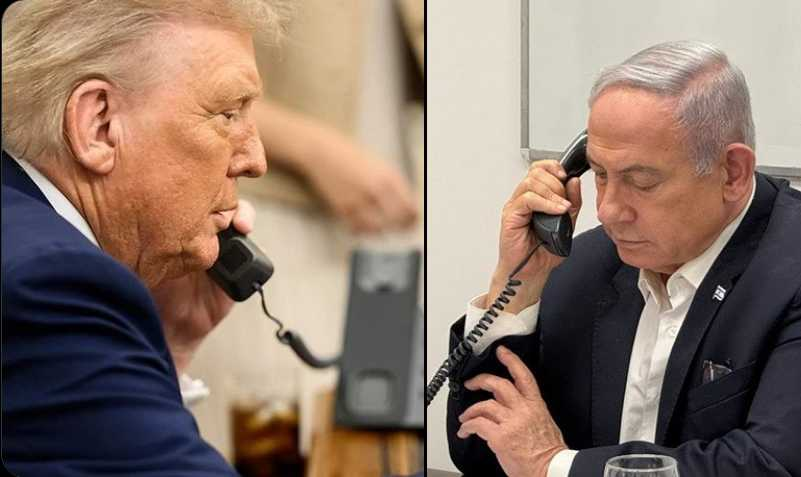
Later on Monday, after initially downplaying reports of Iran suspending peace talks with the US, Trump announced in a Truth Social post: "I had a very productive call with Prime Minister Bibi Netanyahu, of Israel, and there will be no Troops going to Beirut, and any Troops that are on their way, have already been turned back. Likewise, through highly placed Representatives, I had a very good call with Hezbollah, and they agreed that all shooting will stop — That Israel will not attack them, and they will not attack Israel."
The U.S. president later added, "Talks are continuing, at a rapid pace, with the Islamic Republic of Iran. Thank you for your attention to this matter!"
The conflict in Lebanon, described as the broadest spillover of the wider Iran war, has displaced over 1.2 million people and killed more than 3,370 people since March 2, 2026. Despite a nominal ceasefire brokered by the U.S. on April 16-17, hostilities have intensified, with Hezbollah using kamikaze drones and Israel expanding ground operations north of the Litani River.
Meanwhile, early on Monday, Iran’s Islamic Revolutionary Guard Corps (IRGC) launched retaliatory attacks on US' Ali Al Salem Air base in Kuwait following earlier U.S. Central Command (CENTCOM) strikes on Iranian infrastructure, including a telecoms tower and radar systems on Sirik Island and Qeshm Island, after a U.S. MQ-1 Reaper drone was shot down. Kuwait blamed Iran for the missile and drone attacks, which were intercepted by its air defenses.
“Following the aggression of the US army on a communication tower on Sirik Island in Hormozgan Province an hour ago, the IRGC Aerospace Force fighters targeted the airbase where the aggression originated, and the predicted targets were destroyed," IRGC said in a statement. It warned that any further US action would elicit a response “completely different” in scale and nature, with responsibility on the US.
CENTCOM stated the strikes over the weekend, targeted Iranian radar systems and drone command facilities as acts of "self-defense" after the drone downing. The command emphasized restraint during the ceasefire while protecting forces and regional waters. No US personnel were harmed.
Trump is facing intense pressure from Netanyahu, Jewish neoconservatives and war hawks to restart military strikes on Iran and to end the ongoing negotiations with the Persian nation. He's also facing calls from his 'America first' supporters and other world leaders to reach a peace deal with the Iranians and reopen the Strait of Hormuz, amid rising gas prices and global economic pressures.
"Iran really wants to make a deal, and it will be a good one for the U.S.A. and those that are with us," Trump wrote on Truth Social Monday. "But don’t the Dumocrats, and various seemingly unpatriotic Republicans, understand that it is MUCH tougher for me to properly do my job and negotiate, when political hacks keep negatively 'chirping,' at levels never seen before, over and over again, that I should move faster, or move slower, or go to war, or not go to war, or whatever. Just sit back and relax, it will all work out well in the end - It always does!"