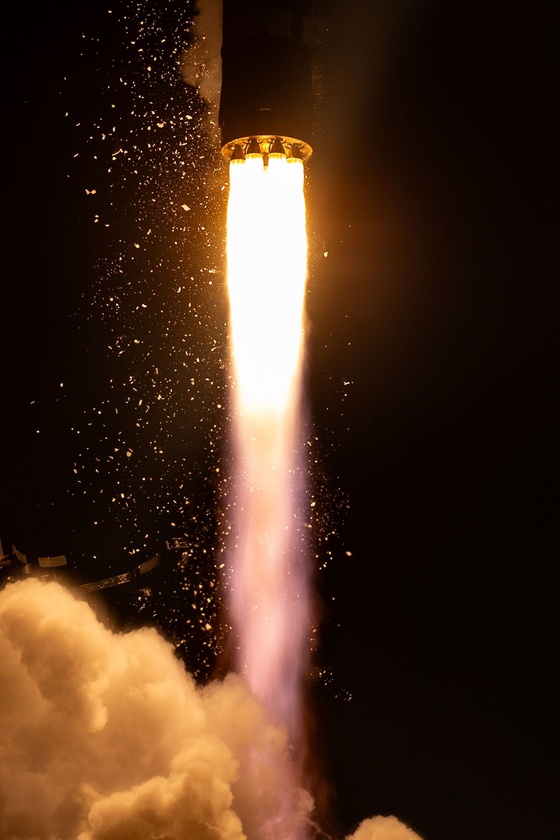
Blue Origin’s New Glenn rocket experienced a catastrophic explosion during a static fire test at Launch Complex 36(LC-36) in Cape Canaveral at around 1400 UTC on May 29, destroying the vehicle and causing extensive damage to the launch site’s infrastructure. No personnel were injured, but the incident has frozen the company’s launch manifest and jeopardized critical NASA Artemis and Amazon Leo missions.
The anomaly occurred as the rocket’s seven BE-4 engines ignited for a hotfire test. The 321-foot (98 meters) rocket collapsed, causing its methane and liquid oxygen load to erupt into a massive fireball that obliterated the transporter erector and knocked out at least one lightning protection tower.
The blast destroyed the New Glenn rocket itself and severely damaged LC-36, Blue Origin’s only orbital launch facility. Reports indicate significant damage to the pad, hangars, and test facilities, with no backup pad available to replace it.
"We experienced an anomaly during today's hotfire test," Blue Origin wrote in an statement. " All personnel have been accounted for. We will provide updates as we learn more."
Nobody was injured, Blue Origin said in an update on X on Thursday night. But damage to the pad — Launch Complex 36 (LC-36) — could be extensive, judging by the extent of the explosion, which multiple rocket-watchers captured on video.
"All personnel are accounted for and safe. It’s too early to know the root cause but we’re already working to find it," Jeff Bezos, the billionaire and founder of Blue Origin, wrote in a statement on social media. "Very rough day, but we’ll rebuild whatever needs rebuilding and get back to flying. It’s worth it.
The FAA confirmed the test was outside licensed activities and will not lead a separate inquiry. Blue Origin must determine the root cause before the site can be cleared, a process expected to take longer than the investigation itself due to the need to rebuild the pad.
"RUD (rapid unscheduled disassembly) events are not unusual in the rocket world," SpaceX CEO Elon Musk wrote on X Friday.
The explosion directly threatens NASA’s lunar exploration timeline, as New Glenn is the designated launch vehicle for Blue Origin’s Blue Moon landers. Moon Base 1, a mission scheduled for fall 2026 to deliver lunar terrain vehicles is now in doubt, despite a recent $188 million contract award.
The Blue Moon Mark 2 prototype, intended for a 2027 low-Earth orbit demonstration for Artemis 3, and the subsequent crewed landing for Artemis 4 in 2028, face significant delays.
Administrator Jared Isaacman said that NASA is assessing near-term mission impacts and will provide updates on the Artemis and Moon Base programs as more information becomes available.
"Spaceflight is unforgiving, and developing new heavy-lift launch capability is extraordinarily difficult," Isaacman said in an X post. "We will work with our partners to support a thorough investigation of this anomaly, assess near-term mission impacts, and get back to launching rockets. We will provide information on any impacts to the Artemis and Moon Base programs as it becomes available."
The incident suspended all 24 contracted launches for Amazon’s Leo broadband constellation. The NG-4 mission was scheduled to deploy 48 satellites on June 4, 2026, but no satellites were on board during the test.
Both New Glenn and United Launch Alliance’s Vulcan Centaur use the same BE-4 engine. If the investigation identifies engine failure as the root cause, ULA’s Vulcan rocket—already grounded due to a separate booster anomaly—could face additional constraints.
This is the third major anomaly for New Glenn in its brief history. The rocket recently resumed flight operations after an FAA grounding following the NG-3 mission’s upper-stage failure in April 2026.