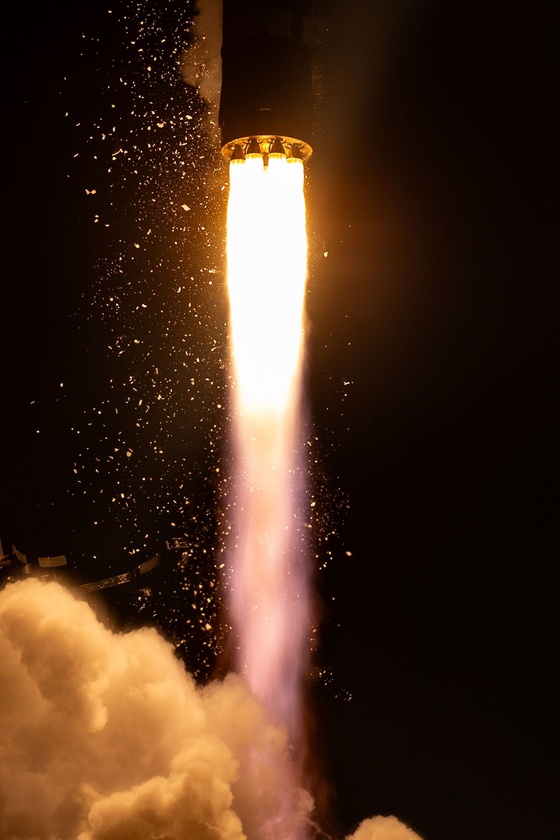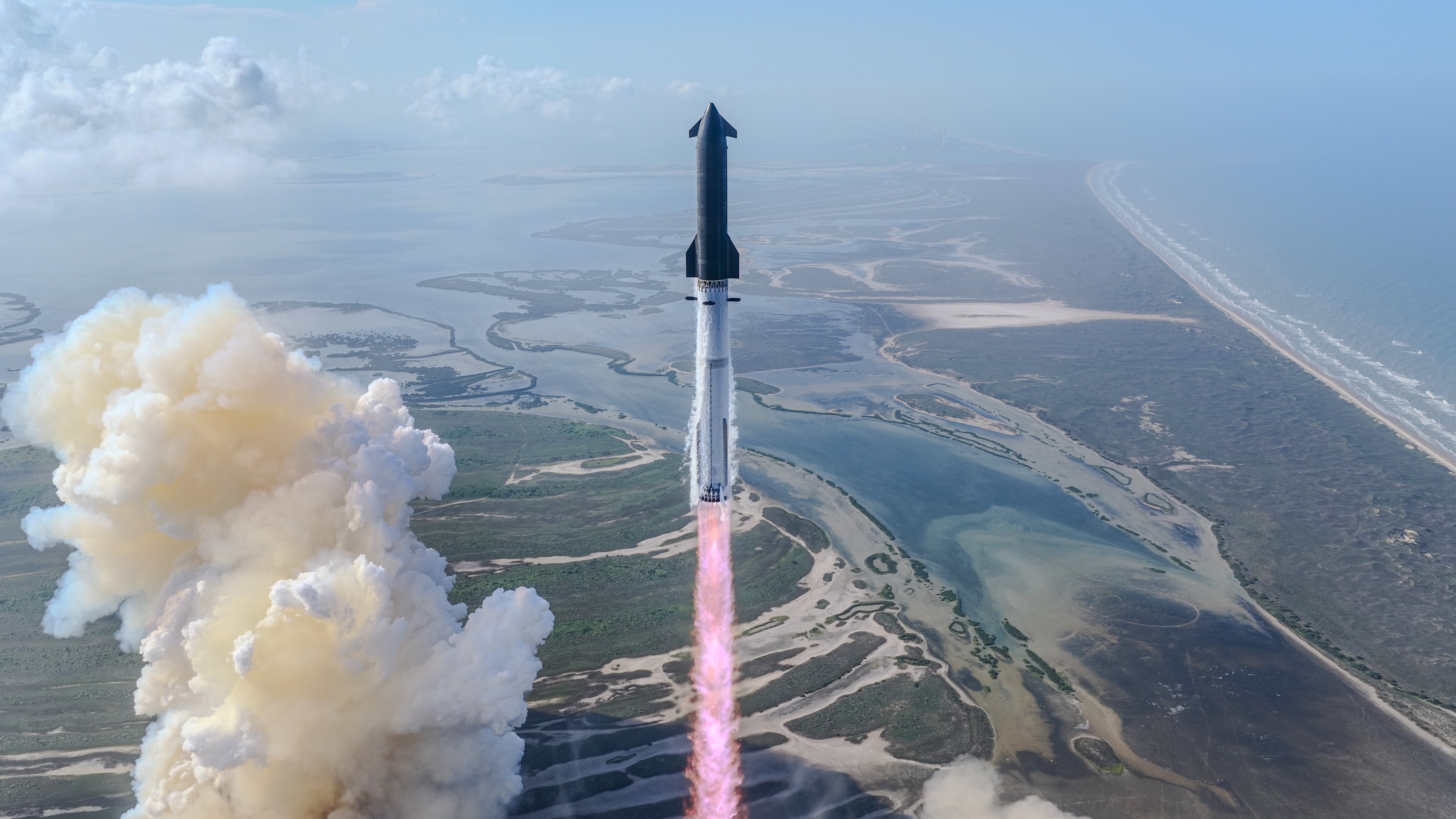
SpaceX successfully launched Starship Flight 12 on Friday, (May 22), at 2230 UTC, marking the debut of the Starship V3 megarocket from the new Pad 2 at Starbase, Texas. The 407-foot-tall (124 meters) vehicle, generating up to 18 million pounds of thrust, completed its 12th suborbital test flight, achieving most primary objectives despite minor engine anomalies.
The first notable event after the rocket cleared the tower occurred about 2 minutes and 20 seconds into flight, when Super Heavy initiated "hot staging" and separation from Ship. (It's known as hot staging because Ship begins firing its engines before separating from Super Heavy.)
The Super Heavy booster (first stage or Booster 19) experienced a single Raptor engine shutdown during ascent and failed to complete its planned "boost back" burn due to additional engine irregularities, resulting in a splashdown in the Gulf of Mexico short of the target.
Meanwhile, the Starship upper stage (Ship 39) also lost one of its six Raptor engines during ascent but compensated by keeping the remaining five active longer, successfully reaching an acceptable suborbital trajectory.
"I wouldn't call it nominal orbital insertion, but we're in on a trajectory that we had analyzed, and it's within bounds," SpaceX spokesperson Dan Huot said in live commentary. "So, teams continuing to work through it with that engine out there, working some through some steps on the engines."
After stage separation, Super Heavy reoriented and attempted to perform a one-minute boostback burn toward Starbase. However, something went wrong and the burn didn't go as planned, Huot said.
"The booster didn't complete its full boost back," Huot said just after lifotff. "Its mission ended a little bit early, but landed in the clear area that we had set in advance."
During the suborbital cruise phase, Starship deployed 22 payloads, including 20 dummy Starlink satellites and two modified Starlink spacecraft ("Dodger Dogs"). These two satellites carried cameras that captured images of the Starship heat shield tiles, providing data to assess thermal protection integrity for future missions. A planned in-space re-ignition of a Raptor engine was skipped due to the earlier engine loss.
Shortly after the final two Starlink simulators deployed (the ones with cameras that SpaceX nicknamed "Dodger Dogs" after the famed hotdogs at Dodger Stadium), SpaceX broadcast the spectactular video they captured as they flew away from Starship.
"That is a Starship in space," Huot said.
"Congratulations SpaceX team on an epic first Starship V3 launch & landing!," SpaceX CEO Elon Musk wrote on X after the launch. "You scored a goal for humanity."
Ship 39 began its reentry to Earth's atmosphere about 50 minutes into the flight, falling as its belly became engulfed in a bright plasma. During its descent, Ship 39 performed a series of exercises designed to stress parts of the vehicle to their structural limit. It also executed a novel banking maneuver for its landing burn meant to mimic the trajectory and orientation needed for a launch tower catch on a return to Starbase.
Huge cheers rang out at SpaceX's headquareters and Starbase facilities as the Ship 39 ignited two engines for a final landing burn. The manuever initially called for three engines, but that one shut down early at liftoff. After the landing, Starship toppled over into the ocean waters and exploded in a magnificent fireball (again, as planned) as SpaceX workers cheered.
Friday'he launch occurred following delays Thursday, caused by a stuck hydraulic pin and weather.
Starship V3 features significant upgrades over its predecessors, including Raptor 3 engines, larger fuel tanks, and docking ports for in-orbit refueling—a critical capability for NASA’s Artemis moon landing program.
Unlike its V2 predecessor, which featured an interstage ring that fell away at separation, Starship V3 is built with similar hardware secured to the top of the booster, like a fence around the fuel tank's dome to give some breathing room to the upper stage engines' ignition and initial thrust away from the booster.
The vehicle is designed to be fully reusable, with NASA targeting Starship as the lunar lander for Artemis 3 (scheduled for 2027/2028). "We're looking forward to seeing this thing fly, because hopefully at some point in the not too distant future we're gonna, we're gonna join up in an earth orbit," NASA Administrator Jared Isaacman, who was present at the launch, said during the live comentary.
NASA is relying on Starship as one of the crewed lunar landers for its Artemis program, which aims to eventually establish a permanent human presence on the moon. The space agency has also contracted Blue Moon, a Blue Origin spacecraft, to land Artemis astronauts on the moon, and has indicated a willingness to fly with whichever private lander is ready when it's time for the missions to get off the ground.
The next of those missions is Artemis 3 — the follow-up to April's Artemis 2, which flew four astronauts aboard NASA's Orion spacecraft on a successful 10-day mission around the moon. NASA is targeting mid to late 2027 for Artemis 3, which will launch Orion to low Earth orbit (LEO) to rendezvous and dock with one or both of the private lunar landers, and late 2028 for the first lunar landing on Artemis 4.
After the launch, Isaacman hailed the work of SpaceX's Starship team.
"Congrats SpaceX team and Elon Musk on a hell of a V3 Starship launch," Isaacman wrote on X. "One step closer to the Moon ... one step closer to Mars."
Starship has a number of boxes to check before NASA certifies the vehicle to fly astronauts, but V3 has been built with those goalposts in mind. For example, NASA is requiring both Starship and Blue Moon to demonstrate uncrewed lunar landings before they fly astronauts down to the lunar surface, putting SpaceX and Blue Origin on a short timeline to ready vehicles for the planned Artemis 4 landing in 2028.
Flight 12 represents a major milestone ahead of SpaceX’s anticipated initial public offering (IPO) in June.