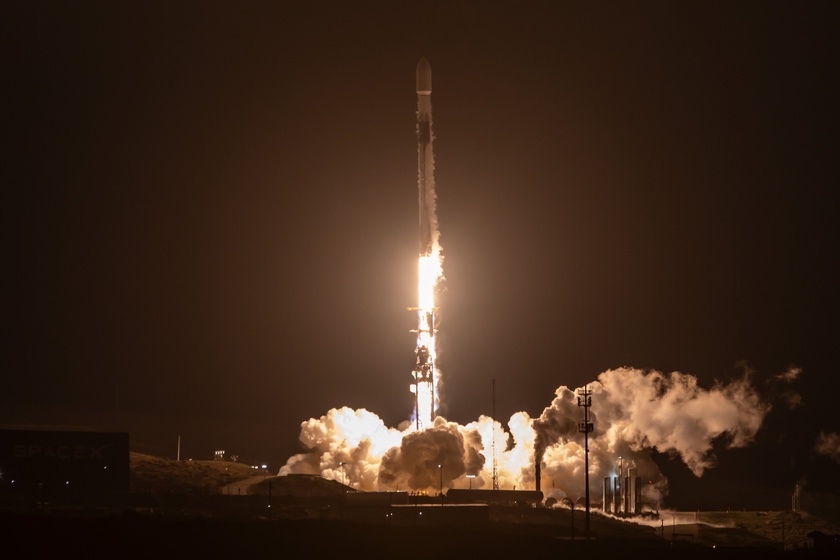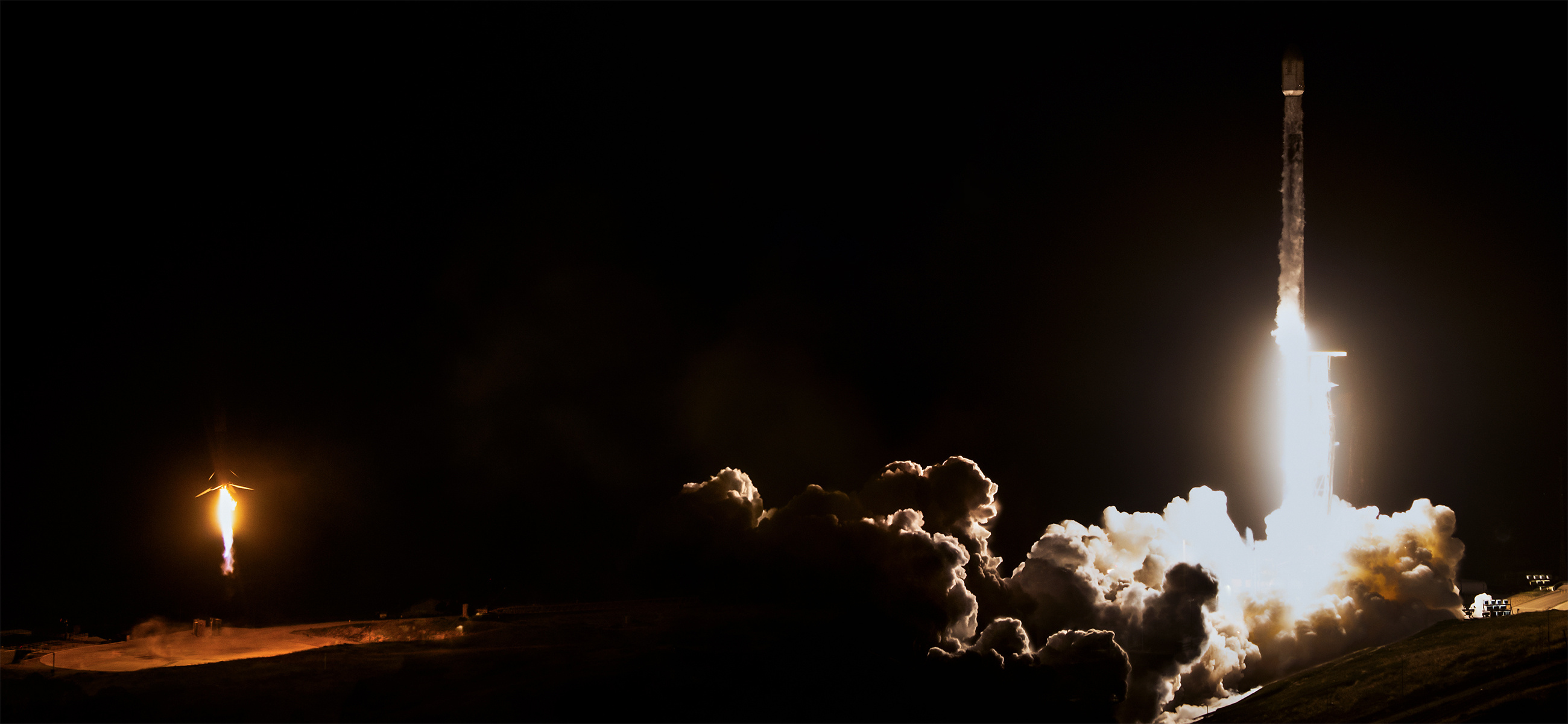
SpaceX launched a Falcon 9 rocket from Vandenberg Space Force Base at 0700 UTC on Sunday (May 3), delivering 45 satellites -- including the primary payload CAS500-2, a South Korea’s 500 kg-class Earth observation spacecraft -- into Sun-synchronous orbit in a dedicated rideshare mission.
The Falcon 9 first-stage booster, B1071, completed its 33rd flight and landed at Landing Zone 4 (LZ-4) roughly 7.5 minutes after launch. The second stage meanwhile, continued spaceward and started payload deployment sequence about an hour after liftoff, beginning with CAS500-2 and followed by the other payloads over the next hour and a half.
CAS500-2, built by Korea Aerospace Industries (KAI), is designed for high-resolution disaster monitoring and agricultural observation. The satellite captures imagery with a ground resolution of 0.5 meters in panchromatic mode and 2 meters in color mode.
South Korea's CAS500 ("Compact Advanced Satellite 500") program aims to operate a total of five satellites in low Earth orbit. CAS500-2 is the second satellite in the program, following CAS500-1 (launched in 2021) and preceding CAS500-3 (launched on South Korea’s Nuri rocket in late 2025).
The remaining 44 payloads were manifested by various international commercial and governmental operators, including: Planet Labs's three Pelican high-resolution Earth imaging satellites; Exolaunch's diverse batch of 21 CubeSats and 18 MicroSats from various global customers; Italian company Argotec's seven HEO MicroSats for the IRIDE emergency monitoring constellation; Loft Orbital and EarthDaily Analytics' six satellites for an AI-driven data constellation; Lynk Global's two Lynk Tower satellites for direct-to-device connectivity; True Anomaly's Jackal Autonomous Orbital Vehicle; and Indian company GalaxEye's Mission Drishti satellite, featuring synthetic aperture radar and multi-spectral imaging.
CAS500-2 launch faced significant delays due to Russia’s invasion of Ukraine, which disrupted its original 2022 launch plan on a Russian rocket