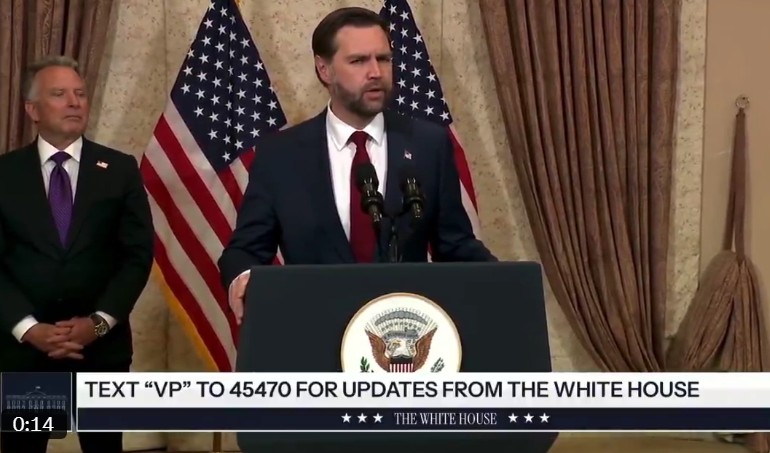
The U.S.-Iran peace talks in Pakistan ended without an agreement after 21 hours of negotiations, with Vice President JD Vance saying that the Iranian delegation "has chosen not to accept our terms." Speaking from Islamabad’s Serena Hotel on Sunday, Vance emphasized that the core U.S. demand was an affirmative commitment from Iran not to pursue nuclear weapons or the tools to rapidly develop them, which Tehran refused. He described the outcome as “bad news for Iran much more than it’s bad news for the United States,” and said the U.S. delegation was leaving behind its “final and best offer.”
President Donald Trump responded later Sunday, by ordering a naval blockade of the Strait of Hormuz, escalating pressure on Iran. The directive, posted on Truth Social, was backed by U.S. Central Command (CENTCOM), which deployed a carrier strike group to the region. The move followed Iran’s alleged mining of the strait and its continued closure, which Trump labeled “world extortion.”
Oil prices surged nearly 7% amid fears of supply disruption. Iran denied U.S. claims of de-mining operations by American destroyers in the area and accused Washington of failing to gain Tehran’s trust during talks.
Iran’s state media blamed “excessive American demands” for the failed talks, citing disputes over the Strait of Hormuz and nuclear technology.
The Pakistani government hosted the talks, with Prime Minister Shehbaz Sharif calling them a “make-or-break moment.” Iran’s delegation was led by Parliament Speaker Mohammad Bagher Ghalibaf who claimed the U.S. failed to build trust despite Iran’s “constructive initiatives.”
"In intensive talks at highest level in 47 years, Iran engaged with US in good faith to end war. But when just inches away from 'Islamabad MoU,' we encountered maximalism, shifting goalposts, and blockade. Zero lessons earned," Iran's Foreign Minister Seyed Abbas Araghchi wrote on X Sunday.
Vance maintained constant communication with Trump during the talks, who was reportedly attending a UFC event in Miami when the negotiations concluded.
A fragile two-week ceasefire remains in place, but its future is uncertai, as Iranian officials said any maritime blockade by the U.S. will be a violation of the ceasefire agreement.
Meanwhile, ongoing Israeli airstrikes in Lebanon have killed over 2055 people, particularly in southern regions like Nabatieh, with Lebanon’s Ministry of Public Health confirming casualties from sustained bombardment linked to ongoing regional hostilities. Iranian negotiators have accused the U.S. of breaching the terms of their ceasefire agreement which calls for Israel to stop its bombardment of Lebanon.
The war between the U.S.-Israel and Iran began on February 28, 2026, and had entered its seventh week at the time of the talks.