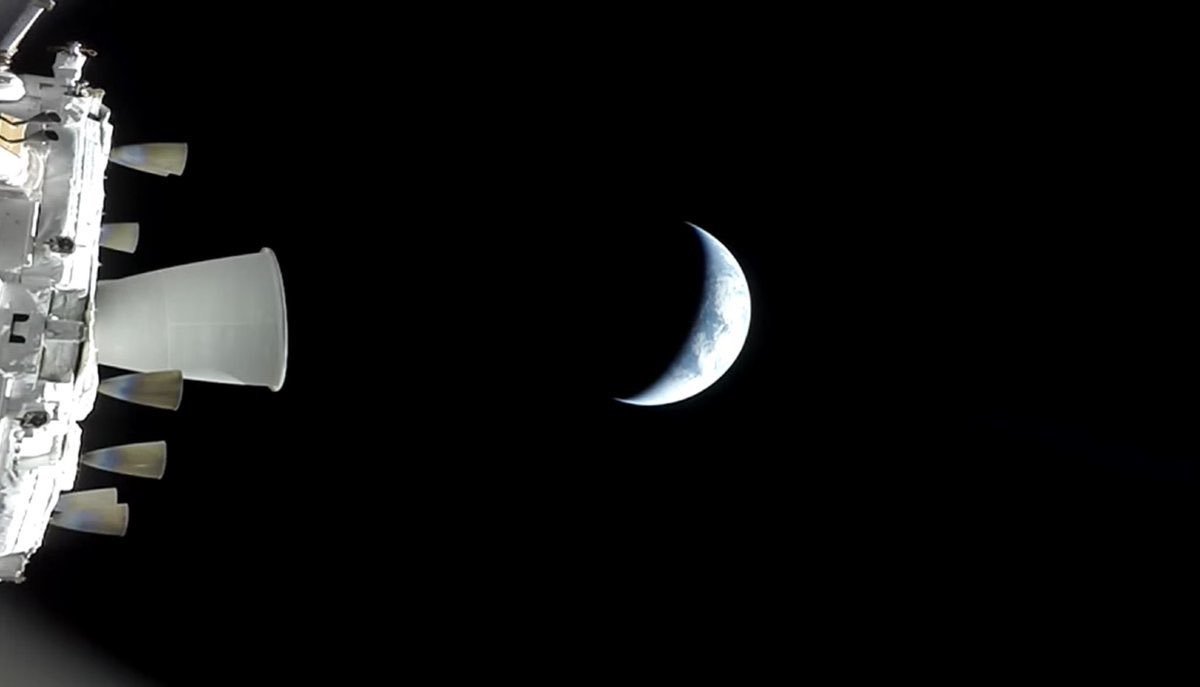
The translunar injection (TLI) burn for the Artemis II mission was successfully completed on Thursday, (April 2), at 2349 p.m. UTC, sending the crew and the Orion spacecraft, Integrity on a path toward the Moon for the first time since 1972. The engine fired for about five minutes and 50 seconds (some reports cite 5:49 to 5:55), adding 867 mph to Integrity's velocity and accelerating it to 24,500 mph to escape Earth's gravitational clasp
This critical maneuver placed Integrity into a free-return trajectory that will carry the four astronauts around the far side of the Moon and back toward Earth without requiring further major engine firings. The burn utilized the Orbital Maneuvering System engine on the European Service Module, generating up to 6,000 pounds of thrust, and was preceded by a "Go" poll from NASA's Mission Management Team after confirming the spacecraft's systems were healthy.
The engine fired at an altitude of just 115 miles above Earth. Mission controllers in Houston described the burn as "flawless," with the crew reporting they are "glued to the window" observing Earth. Integrity is now on track to reach a distance of 252,455 miles from Earth, surpassing the record set by Apollo 13, with a planned splashdown on Day 10 of the mission.
Following liftoff Wednesday, NASA astronauts Reid Wiseman, Victor Glover, Christina Koch, and Canadian Space Agency(CSA) astronaut Jeremy Hansen aboard Integrity stayed in Earth orbit for more than 24 hours, checking out the capsule's various systems ahead of its planned plunge into deep space.
"With that successful TLI, the crew is feeling pretty good up here on our way to the moon, and we just wanted to communicate to everyone around the planet who's worked to make Artemis possible that we firmly felt the power of your perseverance during every second of that burn," Hansen, said just after the maneuver.
"Humanity has once again shown what we are capable of, and it's your hopes for the future that carry us now on this journey around the moon," he added.
Artemis 2 launched Wednesday evening (April 1) from NASA's Kennedy Space Center in Florida, sending four astronauts aloft on the first-ever crewed flight of Orion and its Space Launch System (SLS) rocket. The duo had flown together just once before, on the uncrewed Artemis 1 mission to lunar orbit in 2022.
"Our TLI burn, the burn that gets us going to the moon, is also our deorbit burn," Koch said in a NASA interview before launch. "As soon as we take that burn, we have bought off on basically the rest of the mission."
The TLI burn used Orion's main orbital maneuvering engine, which was salvaged from NASA's space shuttle program and upgraded for an Artemis trip to the moon. The engine has flown in space 19 times before on three different space shuttles. If you strapped it to a car, it would accelerate you from zero to 60 mph (97 kph) in 2.7 seconds.
=================
NASA successfully launched the Artemis II mission on Wednesday, (April 1), at 2235 UTC from Kennedy Space Center's Launch Complex 39B, marking the first crewed flight beyond low Earth orbit since the Apollo 17 mission in 1972.
The Space Launch System (SLS) rocket, standing 32 stories tall, ignited its twin solid rocket boosters and four RS-25 engines to generate 8.8 million pounds of thrust, lifting the Orion spacecraft named "Integrity" into space.
The four-person crew consists of NASA astronauts Reid Wiseman (Commander), Victor Glover (Pilot), and Christina Koch (Mission Specialist), alongside Canadian Space Agency astronaut Jeremy Hansen (Mission Specialist), who became the first Canadian and non-U.S. citizen to travel to the Moon's vicinity.
Close to three and a half hours into the Artemis 2 mission, pilot Victor Glover took control of Orion after the capsule separated from the Space Launch System rocket's Interim Cryogenic Propulsion Stage, or ICPS. Glover will now manually pilot Orion around ICPS, carrying out a series of maneuvers designed to test the spacecraft's propulsion systems and ability to operate in close proximity to another object in space.
"I see it. Look at that, woohoo! I see the ICPS and the moon in the field of view," Glover said during NASA's live broadcast of the mission.
These tests, known as proximity operations or "prox ops," are a key part of this test flight and will evaluate Orion's ability to fly near and interface with future Artemis program hardware such as the lunar lander that will eventually be chosen for NASA's planned moon landings.
"It's quite nice and very responsive," Glover said, referencing the spacecraft's Digital Autopilot (DAP) system.
The 10-day mission is a lunar flyby that will not involve a landing but will travel approximately 250,000 miles from Earth, surpassing the previous record set by Apollo 13 in 1970 by reaching 4,600 miles beyond the Moon's far side.
Key mission objectives include testing Orion's life support and navigation systems, performing an in-space rendezvous with the spent Interim Cryogenic Propulsion Stage, and validating emergency procedures for future lunar landings.
The crew is expected to perform a translunar injection burn to commit to the Moon, fly around the lunar far side, and return to Earth for a planned **splashdown in the Pacific Ocean** around April 11, 2026. This flight serves as the critical second step in NASA's Artemis program, paving the way for **Artemis III (lunar landing in 2027)** and the eventual establishment of a sustainable human presence on the Moon.