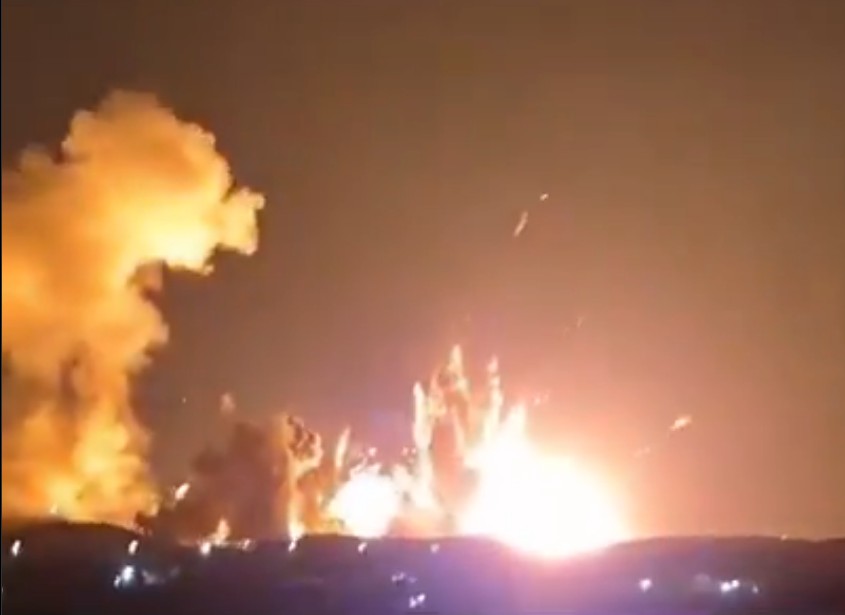
The U.S. and Israel conducted joint airstrikes on Isfahan, Iran, early Monday, targeting a major ammunition depot and military infrastructure, including the Badr airbase, using 2,000-pound bunker-buster bombs. The strikes triggered massive explosions and secondary blasts, with President Donald Trump sharing a video of the fiery aftermath on Truth Social without comment.
According to U.S. officials, the operation was part of Operation Epic Fury, now in its second month, aimed at degrading Iran’s nuclear and weapons capabilities. Defense Secretary Pete Hegseth and Joint Chiefs Chairman Gen. Dan Caine held a press briefing at the Pentagon Tuesday, confirming the strikes and stating that negotiations to end the war with Iran are “real” and “gaining strength.”
Hegseth disclosed he had recently visited U.S. troops in the Middle East and emphasized that the U.S. is maintaining strategic ambiguity about ground operations, saying, “Our adversary right now thinks there are 15 different ways we could come at them with boots on the ground. And guess what? There are.” He also urged allied navies, particularly the UK’s, to help secure the Strait of Hormuz, which remains largely closed, spiking global oil prices.
Iran and Hezbollah launched retaliatory attacks following the Isfahan strikes. Iran shot down a U.S. MQ-9 Reaper drone over Isfahan and launched ballistic missiles toward Israel, with explosions heard in Jerusalem and interceptors deployed over Tel Aviv.
In Lebanon, Hezbollah fired rockets into northern Israel, injuring three, prompting Israeli airstrikes on southern Lebanon, Beirut, and the Beqaa Valley. Hezbollah framed its actions as defensive, citing Israeli aggression and occupation of Lebanese territories. The Israel Defense Force claimed to have killed senior Hezbollah and Palestinian Islamic Jihad leaders in the strikes. Israel’s Foreign Minister Israel Katz on Monday, also announced plans to occupy Lebanon.
President Trump on Tuesday, has declared that European and allied nations should "go get your own oil" from the Strait of Hormuz, asserting that the U.S. may end its military campaign in Iran even if the strategic waterway remains closed. He emphasized that the "hard part" of the war—dismantling Iran’s military capabilities—has been completed, and suggested allies like the UK and France must now take responsibility for reopening the strait, accusing them of failing to support U.S. efforts.
The U.S. has signaled it will not lead operations to forcibly reopen the Strait of Hormuz, despite its closure by Iran disrupting about 20% of global oil flow and pushing prices above $100 per barrel.
Trump wrote on Truth Social: "Build up some delayed courage, go to the Strait, and just TAKE IT," and warned that the U.S. "won’t be there to help you anymore." Hegseth echoed this during Tuesday's press conference, questioning why allies like the UK, with its "big, bad Royal Navy," aren’t stepping in.
Iran continues to block the strait, threatening to "completely close" it if U.S. attacks proceed. European nations, including Spain, Italy, and France, have refused U.S. military overflight or basing requests, deepening transatlantic tensions.
Iran has retaliated to U.S. strikes, by attacking oil tankers and listing U.S. companies like Apple and Boeing for targeting.
The U.S. has deployed additional forces, including the 82nd Airborne and the USS Tripoli, but Trump has ruled out extending the war beyond his four-to-six-week timeline.
Despite diplomatic overtures, including a peace plan from China and Pakistan, Trump suggested victory could be declared without securing Iran’s uranium stockpile or reopening the strait.
Trump said Tuesday, that the U.S. military campaign in Iran would end within "two or three weeks," asserting that the primary goal of preventing Iran from obtaining a nuclear weapon had already been achieved. Speaking in the Oval Office, Trump declared, "We'll be leaving very soon," and emphasized that the U.S. would withdraw "whether we have a deal or not," claiming Iran would be unable to develop a nuclear weapon for years due to extensive military strikes.
The president claimed the U.S. had "obliterated" Iran’s nuclear program, missile-making facilities, navy, air force, and leadership, asserting dominance over Iranian skies and describing the new leadership as "much more rational." He dismissed the need for a negotiated deal as essential, though he claimed acknowledged Iranian leaders were "begging to make a deal."
Iran's Foreign Minister Seyed Abbas Araghchi said there is no ongoing direct negoiations with the U.S. "No negotiation has taken place, he told Al Jazeera. "We have not responded to the US proposal and we have not given a counter-proposal. Trust with the US is at zero. We are waiting for their ground troops."