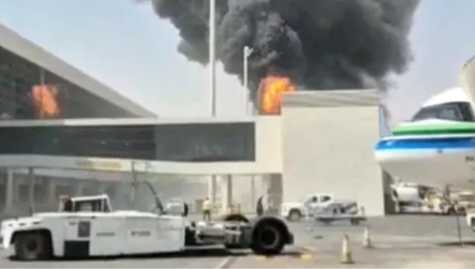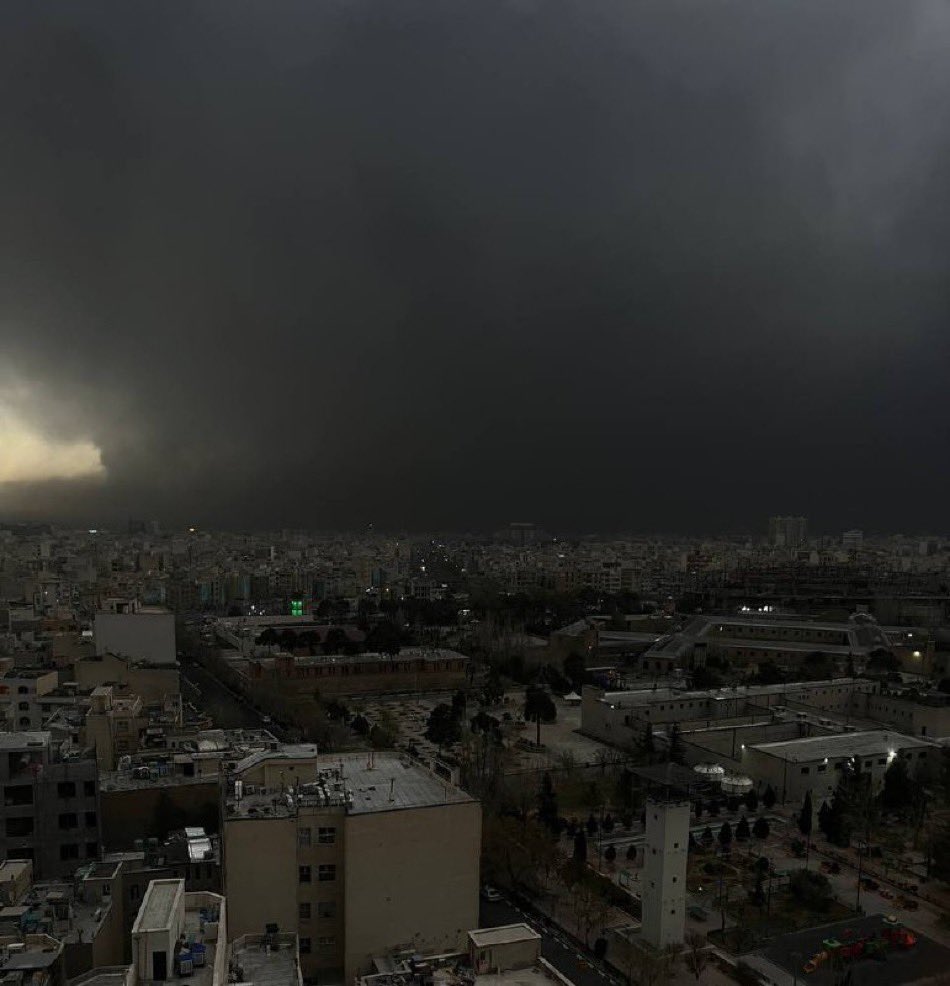
Thick black smoke and acidic, oil-tainted rainfall blanketed Tehran early Sunday, following Israeli airstrikes on multiple fuel depots, including the Aghdasieh and Shahran facilities in Tehran and an oil depot in Karaj. The attacks, part of a broader Israeli campaign targeting Iranian infrastructure, caused massive fires that burned for hours, leaving residents struggling to breathe and reporting skin irritation, sore eyes, and headaches.
Iran’s Red Crescent Society warned the public that the rainfall could be “highly dangerous and acidic,” potentially causing chemical burns and lung damage.
This comes a day after Iranian President Masoud Pezeshkian apologized in a televised address, to neighboring Gulf countries for attacks carried out by Iran’s armed forces, calling them “brothers” and stating, “I deem it necessary to apologise to neighbouring countries that were attacked.”
Pezeshkian claimed the strikes were due to “miscommunication” within Iran’s military chain of command and announced a new order: Iran’s armed forces would not attack neighboring countries unless first attacked. He emphasized Iran’s intent to pursue regional cooperation and peace, while condemning U.S. demands for unconditional surrender.
Hours after Pezeshkian’s apology, U.S. President Donald Trump posted on Truth Social, declaring, “Today Iran will be hit very hard!” and warning that “under serious consideration for complete destruction and certain death, because of Iran’s bad behavior, are areas and groups of people that were not considered for targeting up until this moment in time.”
Trump later claimed Iran had “surrendered to Middle East neighbours,” a statement contradicted by Iran’s continued missile and drone attacks on Gulf states.
Despite the apology, following Trump's taunting social media posts, Iran launched fresh waves of attacks on Bahrain, Saudi Arabia, the UAE, and Lebanon, with drones and missiles intercepted by Gulf defenses. Explosions were reported near Dubai International Airport, and a Pakistani driver was killed by debris from an intercepted missile.
In Lebanon, Israeli strikes killed at least 16 people, and Hezbollah clashed with Israeli forces in eastern Lebanon. The U.S. and Israel have conducted over 3,000 strikes in seven days, targeting Iranian military sites, naval vessels, and missile systems, including a desalination plant on Qeshm Island—though both U.S. and Israeli officials denied involvement.
The conflict began on February 28, 2026, after U.S.-Israeli strikes killed Iran’s supreme leader and top military officials, triggering a regional war. Iran has since retaliated with missile and drone barrages, while the U.S. and Israel maintain air dominance.
Israeli forces have since been bombarding Southern Lebanon since Hezbollah militants joined the war following Khamenei's killing by Israeli airstrikes in Tehran.
Over 1,300 in Iranian civilians, 200 in Lebanon and seven American service members have reportedly been killed in the war. Global leaders, including UN Secretary-General Antonio Guterres and Russian President Vladimir Putin, have called for an immediate ceasefire, warning of a broader regional catastrophe.
Meanwhile Seyyed Mojtaba Khamenei has been formally appointed as Iran’s new Supreme Leader by the Assembly of Experts, the 88-member clerical body responsible for selecting the country’s top religious and political authority. The announcement came just over a week after his father, Ayatollah Ali Khamenei, was killed in a U.S.-Israeli airstrike, along with his wife, son, daughter and nephew. The Assembly confirmed the appointment in a statement issued just after midnight Tehran time, calling it a “decisive vote” and urging national unity around the new leader.
The appointment marks a pivotal moment in Iran’s political trajectory, signaling that hardline factions remain firmly in control despite the devastating attacks. Mojtaba Khamenei, 57, is a mid-ranking cleric with deep ties to the Islamic Revolutionary Guard Corps (IRGC), having served as his father’s close aide for decades.
Though he lacks the high clerical rank of his father and has never held elected office, he has cultivated influence through his role in Iran’s security and economic networks. His selection is unprecedented in the Islamic Republic’s history, representing a de facto family succession.
Israel’s Prime Minister Benjamin Netanyahu has publicly vowed to target the new supreme leader, stating his government will strike Iran’s rulers “without mercy” and that the new leader is an “unequivocal target for elimination.” The Israeli Defense Forces have already intensified strikes on Iranian military and strategic facilities, in what they describe as a coordinated effort to destabilize the regime.
Trump has rejected the appointment, calling Mojtaba Khamenei “unacceptable” and asserting that any new leader must have U.S. approval to “last long.” In an interview with ABC News, Trump declared, “If he doesn't get approval from us, he's not going to last long,” and later told the Times of Israel that the war’s end would be a “mutual” decision with Netanyahu. The comments have been widely interpreted as a threat of continued military pressure, even as Iran’s leadership defiantly insists the selection was a legal and sovereign process.
Iran’s leadership has responded with unity. The Islamic Revolutionary Guard Corps pledged full obedience and readiness to sacrifice for the new leader, while President Pezeshkian and security chief Ali Larijani welcomed the appointment, framing it as a sign of national resilience. Larijani stated that the enemies “thought the country would reach a dead end,” but the Assembly proceeded with the selection “despite threats” — including from Trump.
Despite international pressure and internal challenges, Mojtaba Khamenei’s rise underscores the regime’s determination to maintain continuity and power — even as the country faces existential threats. His leadership will likely deepen Iran’s hardline stance, with no immediate signs of diplomatic engagement.
================
IRIS Dena, an Iranian frigate, was sunk by a U.S. submarine in international waters approximately 25 miles south of Sri Lanka on March 4, 2026, just days after completing a peacetime naval exercise hosted by India. The ship had participated in Exercise MILAN 2026 and the International Fleet Review 2026 in Visakhapatnam, India, from February 15 to 25, where it represented Iran alongside 74 other nations. The vessel was en route home when it was struck by a single Mark 48 torpedo fired from a U.S. fast-attack submarine.
The sinking occurred amid escalating hostilities between the U.S., Israel, and Iran, now in its sixth day. The conflict has spread beyond the Middle East, with Iran and its proxies launching retaliatory strikes across the region, including in Cyprus and U.S. allied territories. The U.S. Department of Defense released video footage showing the frigate breaking apart after the torpedo strike.
Sri Lanka’s navy responded to a distress signal, recovering 87 bodies and rescuing 32 survivors, with around 10 sailors still unaccounted for. A second Iranian naval vessel entered Sri Lanka’s exclusive economic zone afterward, prompting concerns over regional stability.
Iranian Foreign Minister Seyed Abbas Araghchi condemned the attack as an “atrocity at sea,” accusing the U.S. of violating international norms by targeting a warship that had been a “guest of India’s Navy” and was not engaged in hostilities. He warned the U.S. would “bitterly regret the precedent it has set.”
U.S. Defense Secretary Pete Hegseth described the strike as a demonstration of American military capability and referred to the IRIS Dena as a “prize ship.” President Donald Trump reiterated the war’s objective: to “wipe out Iran’s navy.”
The U.S. has justified the attack under a March 2 executive order by Trump aimed at ensuring the free flow of commerce through the Strait of Hormuz. Analysts debate the legality, noting the Dena was en route home and not engaged in hostilities.
India has remained silent on the incident, drawing sharp criticism from opposition leaders, including Rahul Gandhi and Mallikarjun Kharge, who accused Prime Minister Narendra Modi of failing to uphold India’s role as a “net security provider” in the Indian Ocean. Former diplomat Kanwal Sibal emphasized India’s moral responsibility, noting the ship was in the region due to India’s invitation.
Australia, while not directly involved in the attack, has expressed concern over the incident, as the U.S. submarine reportedly carried three Australian personnel.
The sinking marks a significant escalation in the conflict, which has now spread far beyond the Middle East, with ongoing airstrikes between Iran, Israel, and U.S. forces. The incident has triggered diplomatic tensions and raised concerns about the safety of maritime routes and international law.
================
U.S. and Israeli forces have intensified their bombardment of Iran for the fifth consecutive day, targeting government, military, and infrastructure sites across 24 of Iran’s 31 provinces.
Strikes have hit Tehran’s central districts, including the Basij paramilitary headquarters, internal security command centers, and missile launch sites, according to the Israeli Defense Forces (IDF). The attacks have caused widespread destruction, with smoke rising over Tehran, Karaj, and Isfahan, and a school in Minab struck by three missiles, killing an estimated 180 children—a claim confirmed by Iran’s Health Ministry but not independently verified.
Iran has responded with a wave of retaliatory strikes, launching hundreds of drones and missiles across the Middle East. These attacks have targeted U.S. military bases in Qatar (Al Udeid), Bahrain (U.S. Navy 5th Fleet), Kuwait, the UAE, Jordan, Oman, and Saudi Arabia, as well as Israeli cities including Tel Aviv and Beit Shemesh. In Israel, nine people were killed and over 20 injured in a missile strike on Beit Shemesh, while 40 buildings in Tel Aviv were damaged. The U.S. military confirmed six soldiers killed, with 18 injured, and three U.S. fighter jets crashed in Kuwait, though all crew survived.
Hezbollah, the Iran-backed militant group in Lebanon, has engaged in direct combat with the IDF, launching rocket and drone attacks on northern Israel, including a strike near Haifa. In response, Israel launched over 60 strikes on Hezbollah targets in southern Lebanon and Beirut, killing at least 50 people and injuring 335, including civilians. Israeli forces have reportedly entered southern Lebanon, seizing strategic areas to prevent cross-border attacks. The IDF has been attacking Hezbollah targets over the past year in violation of the ceasefire agreement brokered by the U.S.
Iran’s retaliatory campaign includes attacks on energy infrastructure and diplomatic compounds, such as the U.S. consulate in Dubai and the U.S. Embassy in Riyadh, both hit by drones. Qatar Airways suspended all flights after missile strikes on Al Udeid base, and Qatar’s air defenses intercepted 65 missiles and 12 drones. The UK’s RAF Akrotiri base in Cyprus was also struck by an Iranian drone, causing minimal damage.
So far in the war, casualty estimates include 1,045 dead in Iran, 11 in Israel, 6 U.S. soldiers, and 18 in Gulf states. The Israeli government has barred journalists from publishing pictures of the damages done by Iranian missiles across the Jewish state.
The conflict has disrupted energy supplies, grounded airlines, and triggered regional evacuations, with Lebanon, Qatar, and the UAE declaring emergency measures.
The nuclear watchdog (IAEA) confirmed no radiological release in Iran, noting damage at two buildings near Isfahan but no harm to nuclear facilities.
Iran’s Supreme Leader, Ayatollah Ali Khamenei, was killed during the initial wave of strikes, a development that has significantly escalated the conflict. Iran has declared all U.S. military installations in the region as legitimate targets under its “decentralized Mosaic Defence” strategy.
U.S. officials say the conflict could last weeks or longer, with President Trump asserting that "someone from within" the Iranian government may replace the current regime after the war. He again suggested the U.S conducted initial strikes under pressure from Israeli Prime Minister Benjamin Netanyahu.
Netanyahu reportedly asked the White House for clarifications earlier this week after learning that Trump administration officials might be communicating with the Iranian governement. He was told no such talks took place.
Trump has been facing harsh criticisms from his MAGA supporters and 'America first' conservative critics who accuse him of "betrayal," and being a "traitor" for breaking his campaign promise of "no new wars." They slam the president for "sending Americans to die in Israel's war."
=================
The conflict between Iran, Israel, and the United States escalated into its third day Monday, with widespread missile and airstrike attacks across the Middle East. The war began on Saturday, when the U.S. and Israel launched a large-scale military operation—dubbed “Operation Epic Fury”—targeting Iran’s military infrastructure, including the Islamic Revolutionary Guards Corps (IRGC) headquarters, naval bases, and missile facilities.
The strikes killed Iran’s Supreme Leader Ali Khamenei, along with senior military commanders, including Defense Minister Amir Nasirzadeh and Revolutionary Guards commander Mohammed Pakpour. The country’s leadership is now in the hands of a three-person council following the death of Supreme Leader Ayatollah Ali Khamenei.
The U.S. and Israel also targeted key sites outside Tehran, including the Shajarah Tayyebeh school in Minab, which was struck in a bombing that killed at least 175 children, according to Iranian health officials. This attack was condemned by UNESCO as a grave violation of humanitarian law.
In retaliation, Iran launched waves of missiles and drones at Israel, Gulf states, and U.S. military installations. Beit Shemesh, an Israeli city near Jerusalem, was hit by an Iranian missile, killing nine people and injuring nearly 30—making it the deadliest incident in Israel since the conflict began.
Israeli air defenses intercepted most of the incoming threats, but some missiles breached the system. In response, Israel intensified its attacks, conducting strikes in Lebanon and targeting Hezbollah strongholds outside Beirut.
These strikes killed at least 31 people and wounded 149, according to Lebanon’s Health Ministry. Hezbollah claimed to have launched rockets and drones at Israeli military sites, marking its first major attack in over a year.
The war rapidly spread beyond Iran and Israel. U.S. military bases in Kuwait, Bahrain, Qatar, and the UAE came under attack, with Iranian drones and missiles targeting the U.S. Embassy in Kuwait, the U.S. Navy’s Fifth Fleet in Bahrain, and Al Udeid Air Base in Qatar.
In Kuwait, a missile strike killed three U.S. service members, bringing the American death toll to six. A drone attack on Kuwait International Airport caused injuries, while a missile fragment killed one worker in Bahrain. The U.S. military confirmed that four U.S. troops were killed and five seriously wounded, with additional minor injuries reported.
Iran’s retaliation extended to energy infrastructure. A drone struck an oil tanker in the Gulf of Oman, killing one mariner, and Saudi Arabia’s Ras Tanura refinery was targeted by drones, though defenses intercepted them. QatarEnergy halted liquefied natural gas (LNG) production, sending European gas prices up 40%. The Strait of Hormuz, a vital oil transit route, saw shipping activity slow significantly. Qatar also confirmed it shot down two Iranian Su-24 bombers and intercepted seven ballistic missiles and five drones.
Global consequences are mounting. Air travel has been disrupted, with Emirates and Etihad restarting limited flights after grounding. Oil prices surged, and the U.S. pledged to mitigate energy market spikes. The UK, U.S., and other nations urged citizens to evacuate 14 countries in the region, including Israel, Iran, and Gulf states.
The UN Secretary-General called for de-escalation, warning of nuclear safety risks. U.S. President Donald Trump stated the campaign could last 4 to 5 weeks, vowing to avenge U.S. casualties and suggesting he would be open to dialogue with Iran’s new leadership. However, Iran’s top security official Ali Larijani declared on X: “We will not negotiate with the United States.”
The situation remains fluid, with Israel and the U.S. continuing to strike Tehran and Iran’s proxy networks, while Iran and its allies maintain a relentless campaign across the region.
During a press conference Monday with the Chairman of the Joint Chiefs of Staff Gen. Dan Caine, U.S. Secretary of War, Pete Hegseth said the operation is not a “regime change war” but aims to “destroy the missile threat, destroy the navy, no nukes,” emphasizing the U.S. has no intention of engaging in nation-building like in Iraq.
Caine described the strikes as a “long-term campaign” requiring months or years of planning, noting the operation is not a single, overnight event and that more U.S. losses are expected.
Trump told the press at the White House, that combat operations would continue “until all objectives are achieved,” warning it could go “far longer.” He cited the killing of U.S. service members as justification for enduring the conflict and claimed the strikes had “annihilated” Iran’s navy and were destroying its missile capabilities.
Israeli Prime Minister Benjamin Netanyahu on his part, confirmed Israel launched strikes in Lebanon in response to Hezbollah attacks, targeting command centers and weapons storage. He also emphasized the attacks on Iran was necessary to counter “imminent threat,” though he did not provide evidence of an imminent attack.
U.S. Secretary of State Marco Rubio told reporters on Capitol Hill, that the U.S. acted preemptively to prevent Iran from retaliating against U.S. forces after Israel’s planned military action. He said, “We weren’t going to sit there and absorb a blow before we responded,” and confirmed U.S. ground troops remain a possible option.
Rubio's comments outraged many conservatives, Trump's MAGA supporters and detractors online who slammed the administration for allowing Netayahu to drag the United States into a devastating war against Iran, which, they argue, is not in America's interest. The criticsms were harsh and bipartisan, with many accusing Israel destabilizing Middle East in pursuit of its messianic 'Greater Israel' project.
Popular U.S. journalist and commentator Tucker Carlson called the strikes "absolutely disgusting and evil" and said this war is happening "purely because Israel wanted it to be waged... Israel is the only reason" the US is involved.
Carlson reportedly met with Trump multiple times to urge restraint, warning of risks to US troops in Gulf allies like Qatar, Saudi Arabia, Kuwait and energy prices. He also revealed that Qatar and Saudi Arabia arrested Mossad agents who were planning to set off bombs in the Gulf states, actions aimed to incite chaos.
The conservative commentator argued it's not America's fight and will "shuffle the deck in a profound way" for Trump's movement.
================
President Donald Trump announced "major combat operations" in Iran early Saturday, launching "Operation Epic Fury"—a joint U.S.-Israel airstrike campaign targeting hundreds of military and political sites across Iran. The strikes, carried out by U.S. attack planes and Israeli forces, hit at least nine Iranian cities, including Tehran, Qom, Shiraz, and Chabahar.
Israel reportedly targeted around 500 locations, focusing on ballistic missile sites, air defense systems, and high-value regime assets, including a high-security compound housing Iran’s Supreme Leader Ali Khamenei, which showed extensive damage in satellite imagery, and unconfirmed reports and announcement by Trump that the supreme leader is dead. The 86-year-old has ruled Iran for 36 years. He died along with his wife, daughter-in-law and grandchild.
In retaliation, Iran launched waves of ballistic missiles and drones at Israel and U.S. military bases across the Middle East, in Operation True Promise 4. Targets included Al Udeid Air Base in Qatar, Al Salem Base in Kuwait, Al Dhafra Air Base in the UAE, and the U.S. Fifth Fleet base in Bahrain. Iran also attacked Jordan, Saudi Arabia, and the UAE, with debris from an Iranian missile killing at least one person in the UAE. The United Arab Emirates, Qatar, Bahrain, and Kuwait confirmed attacks, while Jordan reported a blast in its capital.
The U.S. and Israel struck Iran following a breakdown in last-ditch nuclear talks, months of escalating rhetoric amd intense lobbying of Trump administration by zealous Zionist activists and donors.
President Trump, in a video post on Truth Social, vowed to "destroy their missiles," "annihilate their navy," and "enable the overthrow of the regime,"urging Iranians to "take over your government." The U.S. Central Command confirmed that its forces successfully defended against hundreds of Iranian missile and drone attacks, with minimal damage to U.S. bases and no reported U.S. combat deaths.
Khamenei has reportedly put in place detailed plans for succession and emergency chains of command in the event of his death, elevating longtime loyalist Ali Larijani to manage the war and become the de facto leader of Iran.
The conflict has severely disrupted global energy markets. Shipping through the Strait of Hormuz—critical for one-fifth of the world’s oil—has been halted or rerouted, with the U.S. Maritime Administration advising vessels to avoid the region. Iran’s Revolutionary Guards declared the strait unsafe, and oil prices surged amid fears of prolonged supply disruptions.
Casualty reports from Iran are alarming. Iranian state media and the Red Crescent reported over 60 deaths in a strike on a girls’ elementary school in Minab, with Iran’s IRIB broadcaster citing about 150 dead and over 100 injured. The U.S. and Israel have not confirmed the school strike, but the attack has drawn international condemnation.
Regional tensions have escalated further. The Houthis in Yemen denounced the strikes and called for mass protests, while New York City Mayor Zohran Mamdani condemned the operation as a "catastrophic escalation in an illegal war of aggression." World leaders urged restraint, though Canada and Australia publicly backed the U.S.-Israel action.
Many conservatives on social media were outraged with many calling Trump a "traitor" for breaking his "no new wars" promise to voters during the 2024 presidential election campaign. Popular podcaster and Trump ally Tucker Carlson called the bombing of Iran "disgusting and evil."
Analysts warn the conflict risks spiraling into a protracted war with no clear exit. The Iranian military has vowed to continue retaliating until the U.S. and Israel are "definitively defeated," signaling sustained hostilities. The situation remains highly volatile as the region braces for further escalation.