keneci Network
News • Science & Tech • Comedy
SpaceX Crew-12 Astronauts Arrive At Short-staffed ISS On Valentine's Day
February 14, 2026
post photo preview

SpaceX Crew-12 Dragon Freedom successfully docked at the space-facing port of the Harmony module of the International Space Station (ISS) on Saturday, (Feb. 14), at 2015 UTC, marking the beginning of their eight-month long-duration mission. Freedom, carrying four astronauts, arrived on Valentine’s Day, completing a 34-hour journey from launch.

"With that gentle contact, we have bridged the legacy of humankind's continuous presence in space. It has been more than 25 years at this very site," radioed Jessica Meir, Crew-12 commander. "The International Space Station is more than a structure, it is a promise kept. Decades in the making, built by nations, sustained by trust and partnerships, and powered by science, innovation and curiosity."

"As we look back at Earth through these windows, we are reminded that cooperation is not just possible, it is essential. Up here there are no borders and hope is universal," she said.

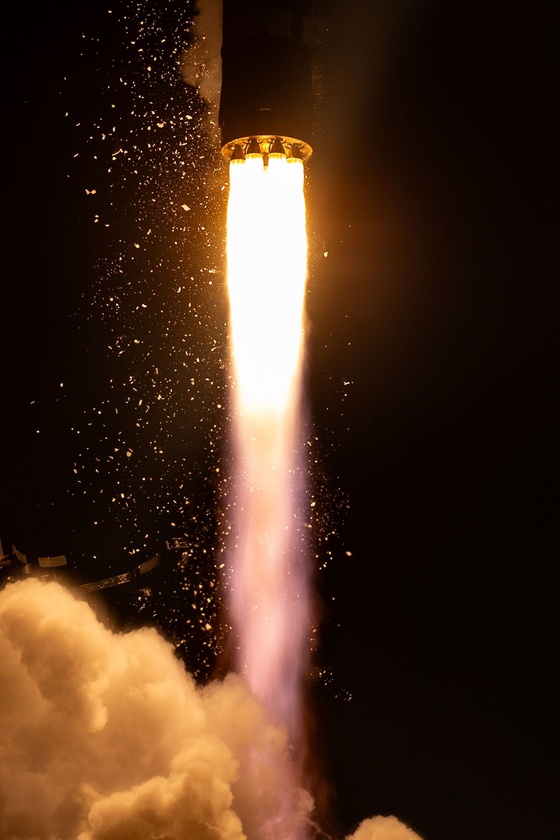
SpaceX Falcon 9 successfully launched the Crew-12 mission on Friday (Feb. 13), at 1015 UTC from Space Launch Complex 40 (SLC-40) at Cape Canaveral Space Force Station, Florida.

Also aboard Freedom are mission pilot and NASA astronaut Jack Hathaway, European Space Agency (ESA) astronaut Sophie Adenot; and mission specialist and Roscosmos cosmonaut Andrey Fedyaev.

“Soft capture complete.” Meir confirmed Dragon's soft capture with the ISS port.

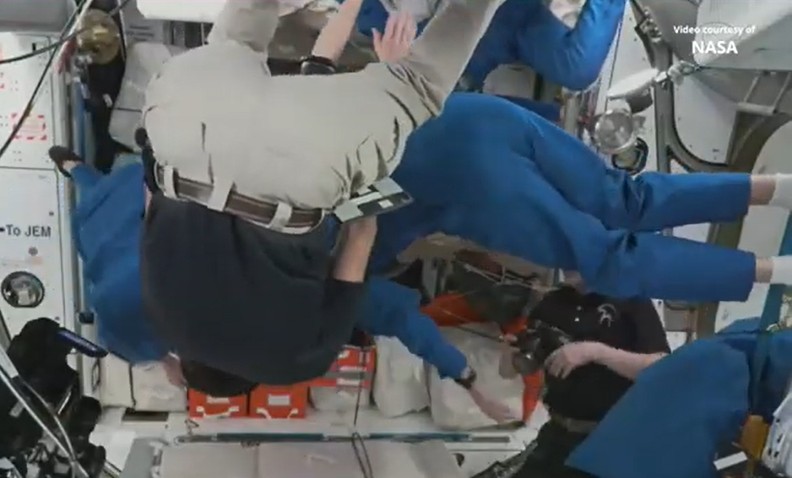
After standard leak checks and pressure equalization, the hatches between the Dragon and the ISS opened at 2030 UTC.

The new crew was welcomed aboard the ISS by the Expedition 74 crew: NASA’s Chris Williams and Roscosmos cosmonauts Sergey Kud-Sverchkov and Sergey Mikaev.

The crew unveiled a handmade crocheted zero-G indicator featuring a model of Earth with four connected satellites, each representing a crew member. The Earth was made by Meir’s childhood friend, and the bananas symbolize Adenot.

The crew shared a message of unity: “We’re reminded that we’re all connected. Take care of one another and keep reaching higher.”

After hatch opening, the crew began offloading cargo and transitioning into their new orbital home. Their mission includes two spacewalks (postponed due to Crew-11’s early departure), research on microgravity’s effects on human physiology, pneumonia-causing bacteria, and plant-microbe interactions to support future Artemis missions to the Moon and Mars.

The ISS had been operating with a "skeleton crew" of three after the unprecedented medical evacuation of the Crew-11 astronauts in mid-January 2026 due to a serious health issue. Crew-12 was launched to restore the station’s full crew of seven, ensuring continuity of scientific operations and station maintenance.

The mission follows the Crew-9 return, which saw NASA astronauts Sunita Williams and Barry Wilmore spend nearly nine months on the ISS after their original Starliner mission was cut short due to technical issues.

Crew-12 mission marks SpaceX’s 12th long-duration crewed flight to the ISS since 2020. The ISS is expected to remain operational until 2030, under a U.S.-Russia-led international partnership.

=================

SpaceX Falcon 9 successfully launched the Crew-12 mission on Friday (Feb. 13), at 1015 UTC from Space Launch Complex 40 (SLC-40) at Cape Canaveral Space Force Station, Florida. The rocket carried the Crew Dragon 'Freedom' capsule with four astronauts to the International Space Station (ISS), replacing the Crew-11 team that departed early due to the first-ever medical evacuation from the ISS.

Falcon 9 first stage B1101, previously used in the Starlink 6-88 mission, successfully returned to Earth and landed at Landing Zone 40 (LZ-40) — the first crewed mission to land at the pad adjacent to the launch site.

The Falcon 9's upper stage, meanwhile, continued its course into orbit and separated from Freedom after an orbital insertion burn. The capsule is scheduled to dock with the Harmony module’s zenith port on the ISS at about 2015 UTC on Feb. 14, 2026.

Crew-11 mission was cut short in mid-January 2026 after an undisclosed serious health condition affected one crew member, prompting an emergency return to Earth. This left the ISS operating with a skeleton crew of three: NASA astronaut Chris Williams and Roscosmos cosmonaut Sergey Kud-Sverchkov and Sergei Mikaev.

To restore the ISS to its normal crew complement of seven, NASA and SpaceX accelerated the Crew-12 launch to ensure a timely relief mission.

Aboard Freedom are Commander and NASA astronaut Jessica Meir, a marine biologist who is on her second spaceflight, previously made history with the first all-female spacewalk; Mission pilot Jack Hathaway a rookie NASA astronaut and former U.S. Navy fighter pilot; mission specialist and European Space Agency (ESA) astronaut Sophie Adenot a French helicopter pilot on first spaceflight; and mission specialist and Roscosmos cosmonaut Andrey Fedyaev who is on second ISS mission and replaced cosmonaut Oleg Artemyev, who was pulled from the mission in December 2025.

"That was quite a ride," Meir radioed to Mission Control after reaching orbit. "We have left the Earth, but the Earth has not left us."

During their about 8-month stay in space, they will continue research into microgravity's effects on human physiology and technologies supporting future Artemis missions to the Moon and Mars. They will also perform station maintenance, including two spacewalks that were postponed after the emergence of the Crew-11 medical situation.

Crew-12 was the second-ever crewed flight to launch from SLC-40 and the first mission to use SpaceX's new landing zone at that pad, dubbed LZ-40. SpaceX's previous crewed missions have primarily launched from Launch Complex-39A (LC-39A) at NASA's Kennedy Space Center, which is a few miles up the coast from the Space Force station. But recent work at LC-39A has prompted SpaceX to move all Falcon 9 launches to SLC-40 going forward.

SpaceX recently removed the crew access arm on the tower at LC-39A and is continuing construction at the pad to support its new Starship rocket, which recently cleared an environmental review for future launches from the Space Coast. The company will continue launching Falcon Heavy missions from LC-39A and is expected to complete construction to support Starship this year.

community logo
Join the keneci Network Community
To read more articles like this, sign up and join my community today
0
What else you may like…
Videos
Posts
Articles
SpaceX Starlink Internet Satellites

With Starlink internet, data is continuously being sent between a ground dish and a Starlink satellite orbiting 550km above. Furthermore, the Starlink satellite zooms across the sky at 27,000 km/hr! MORE VIDEOS ON KENECI NETWORK RUMBLE CHANNEL: https://rumble.com/c/Keneci

00:28:08
Elon Musk, DOGE Speak On Waste And Fraud

US Department of Government Efficiency Services (USDS) led by Elon Musk speak on the "mind-boggling" fraud and waste in UInited States federal government

00:00:45
January 17, 2025
SpaceX Launches Starship 7th Test Flight

SpaceX successfully executed its second-ever “chopsticks” catch of a Super Heavy booster (or Booster 14) using the “Mechazilla” launch tower on Thursday(Jan. 16), during the seventh uncrewed test flight of the company's 123-meter Starship rocket. However, the megarocket's upper stage(or Ship 33) was lost approximately 8.5 minutes into the flight in a “rapid unscheduled disassembly(RUD)” or explosion

00:10:30
Welcome to Keneci Network!

Join the conversations!

December 09, 2025
Bitcoin White Paper By Satoshi Nakamoto

Bitcoin white paper

Bitcoin_White_Paper.pdf
September 17, 2024
Charges Against Sean 'Diddy' Combs In Grand Jury Indictment

The rapper was charged with racketeering conspiracy, sex trafficking by force, fraud or coercion, and transportation to engage in prostitution in the indictment unsealed Tuesday(Sept. 17)

Combs-Indictment-24-Cr.-542.pdf
post photo preview
SpaceX Wins 2.29B US Space Force Contract To Build Space Data Network

The U.S. Space Force awarded SpaceXAI a $2.29 billion fixed-price Other Transaction Authority (OTA) contract to develop the Space Data Network (SDN) Backbone, a proliferated low Earth orbit (pLEO) satellite constellation designed for secure, high-speed military communications.

The agreement covers the SDN Backbone, a resilient network architecture providing high-capacity, low-latency data transport for connecting military sensors and weapons platforms globally. SpaceXAI must deliver a fully operational prototype capability by the end of 2027.

The system utilizes an expanded optically interconnected mesh of satellites to deliver worldwide low latency tactical communications and broadband services, functioning alongside the Space Development Agency’s (SDA) Transport Layer to form a unified Department of Defense data transport architecture.

The network is foundational to the Golden Dome missile defense initiative, providing the communications pathways to move data from missile warning sensors to interceptors in near real time.

While SpaceX is currently the sole provider for the backbone (formerly known as MILNET), the Space Force plans to identify additional contractors for satellite construction and other network elements to galvanize the U.S. industrial base.

Read full Article
post photo preview
US Targets Iran In 'Self-defense' Strikes, After Speedboat Mine-laying Incident, As Israeli Bombing Of Lebanon Intensifies In Operation Arrows Of Fire

Israeli Prime Minister Benjamin Netanyahu vowed Monday, to "crush" Hezbollah and intensify airstrikes in Lebanon, while U.S. Central Command conducted defensive strikes against Iranian targets in Bandar Abbas and the Strait of Hormuz in response to mine-laying activities.

Netanyahu announced he would "increase the blows" and firepower against Hezbollah, citing the group's use of fiber-optic drones to attack Israeli forces. The Israeli Air Force struck more than 70 Hezbollah sites, including command centers and weapons depots in southern Lebanon and the Bekaa Valley, as it launched Operation Arrows of Fire.

Residents in Beirut’s southern suburbs were seen fleeing as evacuation orders were issued for villages in southern Lebanon; Israeli strikes reportedly killed three people in the region.

Despite a US-brokered ceasefire with Iran that took effect in April, Israel maintains that the agreement does not cover Hezbollah, leading to continued cross-border hostilities and accusations of ceasefire violations from both sides.

Iran’s Foreign Minister Abbas Araghchi expressed support for Hezbollah, while in Doha, Qatar, with Iranian Parliament Speaker Mohammad Bagher Ghalibaf on Monday, to discuss terms for a regional settlement that would reopen the Strait of Hormuz.

Israeli security elites, Jewish supremacists in government and political commentators have criticized Netanyahu’s alignment with US diplomatic efforts, warning that a deal could empower Iran and damage Israel’s strategic position.

Meanwhile the US military launched strikes on southern Iran, targeting Revolutionary Guard(IRGC) vessels and a surface-to-air missile(SAM) site in Bandar Abbas, which it described as defensive actions against threats to US forces. Targets included Bandar Abbas airport, Shahid Bahonar pier, and possibly Mount Mubarak in Jask.

"U.S. forces conducted self-defense strikes in southern Iran today to protect our troops from threats posed by Iranian forces," CENTCOM's Captain Tim Hawkins said. "Targets included missile launch sites and Iranian boats attempting to emplace mines. U.S. Central Command continues to defend our forces while using restraint during the ongoing ceasefire"

The attacks followed reports that Iranian boats were laying mines in the Strait of Hormuz, a vital waterway for global oil transport. Two IRGC Navy speedboats were reportedly attacked last night. Iran reportedly responded by downing about two US MQ-9 drones, and firing at U.S. warships in the Gulf of Oman, which then allegedly triggered American strikes on the eastern side of Bandar Abbas and the activation of Iranian air defenses.

US officials said the strikes were conducted "with restraint" during the ongoing ceasefire and did not indicate its collapse, though explosions were heard across the region.

These military actions occurred simultaneously with high-stakes peace talks between the US and Iran, led by Trump’s administration, which is pushing for Iran to hand over or destroy its enriched uranium stockpile under IAEA oversight.

President Donald Trump appeared to soften US position on the fate of the highly enriched Uranium stockpile in Iran, which he had demanded be handed over to the US in any future peace deal.

"The Enriched Uranium (Nuclear Dust!) will either be immediately turned over to the United States to be brought home and destroyed or, preferably, in conjunction and coordination with the Islamic Republic of Iran, destroyed in place or, at another acceptable location, with the Atomic Energy Commission, or its equivalent, being witness to this process and event. Thank you for your attention to this matter!" Trump wrote on Truth Social early morning Tuesday.

The US president on Monday, also issued a lengthy Truth Social post, saying he had spoken with Gulf Arab leaders and stipulated that any deal to end the Iran war should require them to sign the Abraham Accords, which normalized relations between Israel and a handful of Middle Eastern countries. A demand rejected out of hand by officials in Qatar, Saudi Arabia and Pakistan, Monday.

Strait of Hormuz blockade have caused oil prices to fluctuate, with West Texas Intermediate falling below $91.33 a barrel on optimism for a deal, while Brent crude remained near $97.68.

Read full Article
post photo preview
Flight 12: SpaceX Launched Upgraded Starship V3 Megarocket In Spectacular Test Mission

SpaceX successfully launched Starship Flight 12 on Friday, (May 22), at 2230 UTC, marking the debut of the Starship V3 megarocket from the new Pad 2 at Starbase, Texas. The 407-foot-tall (124 meters) vehicle, generating up to 18 million pounds of thrust, completed its 12th suborbital test flight, achieving most primary objectives despite minor engine anomalies.

The first notable event after the rocket cleared the tower occurred about 2 minutes and 20 seconds into flight, when Super Heavy initiated "hot staging" and separation from Ship. (It's known as hot staging because Ship begins firing its engines before separating from Super Heavy.)

The Super Heavy booster (first stage or Booster 19) experienced a single Raptor engine shutdown during ascent and failed to complete its planned "boost back" burn due to additional engine irregularities, resulting in a splashdown in the Gulf of Mexico short of the target.

Meanwhile, the Starship upper stage (Ship 39) also lost one of its six Raptor engines during ascent but compensated by keeping the remaining five active longer, successfully reaching an acceptable suborbital trajectory.

"I wouldn't call it nominal orbital insertion, but we're in on a trajectory that we had analyzed, and it's within bounds," SpaceX spokesperson Dan Huot said in live commentary. "So, teams continuing to work through it with that engine out there, working some through some steps on the engines."

After stage separation, Super Heavy reoriented and attempted to perform a one-minute boostback burn toward Starbase. However, something went wrong and the burn didn't go as planned, Huot said.

"The booster didn't complete its full boost back," Huot said just after lifotff. "Its mission ended a little bit early, but landed in the clear area that we had set in advance."

During the suborbital cruise phase, Starship deployed 22 payloads, including 20 dummy Starlink satellites and two modified Starlink spacecraft ("Dodger Dogs"). These two satellites carried cameras that captured images of the Starship heat shield tiles, providing data to assess thermal protection integrity for future missions. A planned in-space re-ignition of a Raptor engine was skipped due to the earlier engine loss.

Shortly after the final two Starlink simulators deployed (the ones with cameras that SpaceX nicknamed "Dodger Dogs" after the famed hotdogs at Dodger Stadium), SpaceX broadcast the spectactular video they captured as they flew away from Starship.

"That is a Starship in space," Huot said.

"Congratulations SpaceX team on an epic first Starship V3 launch & landing!," SpaceX CEO Elon Musk wrote on X after the launch. "You scored a goal for humanity."

Ship 39 began its reentry to Earth's atmosphere about 50 minutes into the flight, falling as its belly became engulfed in a bright plasma. During its descent, Ship 39 performed a series of exercises designed to stress parts of the vehicle to their structural limit. It also executed a novel banking maneuver for its landing burn meant to mimic the trajectory and orientation needed for a launch tower catch on a return to Starbase.

Huge cheers rang out at SpaceX's headquareters and Starbase facilities as the Ship 39 ignited two engines for a final landing burn. The manuever initially called for three engines, but that one shut down early at liftoff. After the landing, Starship toppled over into the ocean waters and exploded in a magnificent fireball (again, as planned) as SpaceX workers cheered.

Friday'he launch occurred following delays Thursday, caused by a stuck hydraulic pin and weather.

Starship V3 features significant upgrades over its predecessors, including Raptor 3 engines, larger fuel tanks, and docking ports for in-orbit refueling—a critical capability for NASA’s Artemis moon landing program.

Unlike its V2 predecessor, which featured an interstage ring that fell away at separation, Starship V3 is built with similar hardware secured to the top of the booster, like a fence around the fuel tank's dome to give some breathing room to the upper stage engines' ignition and initial thrust away from the booster.

The vehicle is designed to be fully reusable, with NASA targeting Starship as the lunar lander for Artemis 3 (scheduled for 2027/2028). "We're looking forward to seeing this thing fly, because hopefully at some point in the not too distant future we're gonna, we're gonna join up in an earth orbit," NASA Administrator Jared Isaacman, who was present at the launch, said during the live comentary.

NASA is relying on Starship as one of the crewed lunar landers for its Artemis program, which aims to eventually establish a permanent human presence on the moon. The space agency has also contracted Blue Moon, a Blue Origin spacecraft, to land Artemis astronauts on the moon, and has indicated a willingness to fly with whichever private lander is ready when it's time for the missions to get off the ground.

The next of those missions is Artemis 3 — the follow-up to April's Artemis 2, which flew four astronauts aboard NASA's Orion spacecraft on a successful 10-day mission around the moon. NASA is targeting mid to late 2027 for Artemis 3, which will launch Orion to low Earth orbit (LEO) to rendezvous and dock with one or both of the private lunar landers, and late 2028 for the first lunar landing on Artemis 4.

After the launch, Isaacman hailed the work of SpaceX's Starship team.

"Congrats SpaceX team and Elon Musk on a hell of a V3 Starship launch," Isaacman wrote on X. "One step closer to the Moon ... one step closer to Mars."

Starship has a number of boxes to check before NASA certifies the vehicle to fly astronauts, but V3 has been built with those goalposts in mind. For example, NASA is requiring both Starship and Blue Moon to demonstrate uncrewed lunar landings before they fly astronauts down to the lunar surface, putting SpaceX and Blue Origin on a short timeline to ready vehicles for the planned Artemis 4 landing in 2028.

Flight 12 represents a major milestone ahead of SpaceX’s anticipated initial public offering (IPO) in June.

Read full Article
See More
Available on mobile and TV devices
google store google store app store app store
google store google store app tv store app tv store amazon store amazon store roku store roku store
Powered by Locals