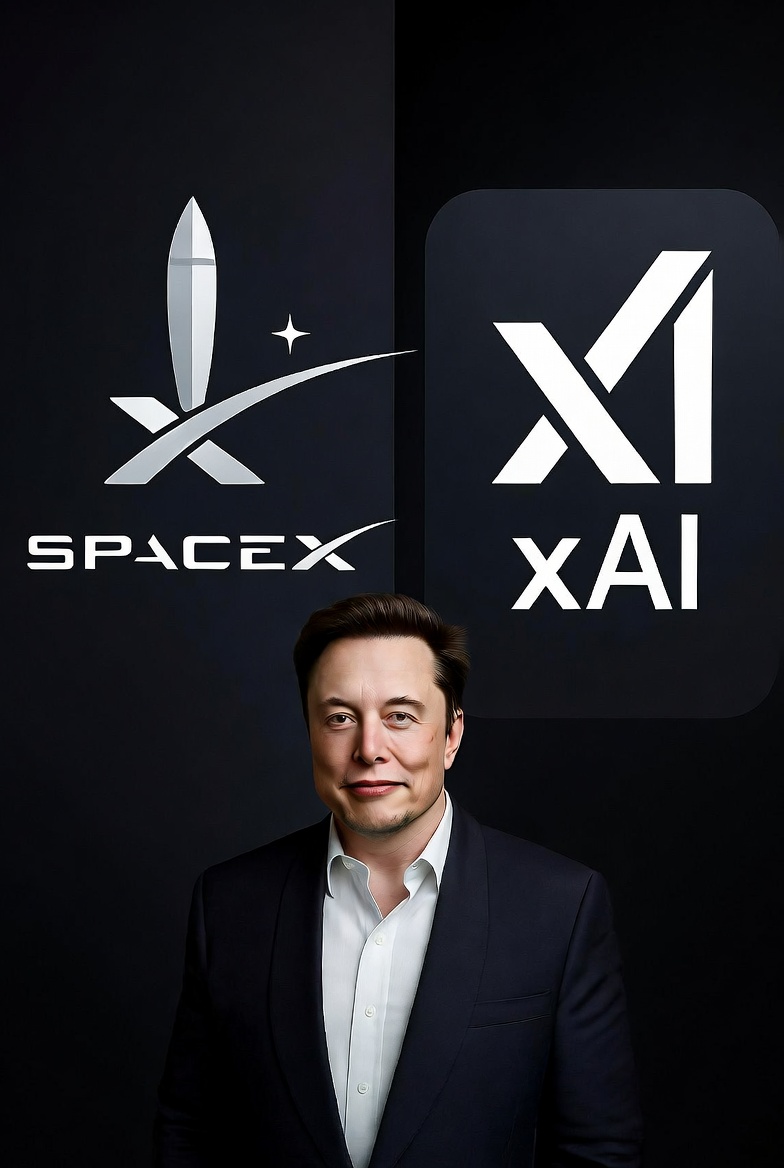
SpaceX has officially acquired artificial intelligence startup xAI, merging two of Elon Musk’s most ambitious ventures into a single, vertically-integrated entity valued at $1.25 trillion (SpaceX at approximately $1 trillion and xAI at $230–250 billion).
The acquisition, confirmed Monday, was announced via a public statement from SpaceX, with Musk stating: “SpaceX has acquired xAI to form the most ambitious, vertically-integrated innovation engine on (and off) Earth, with AI, rockets, space-based internet, direct-to-mobile device communications and the world’s foremost real-time information and free speech platform.”
The merger follows SpaceX’s February 2026 filing with the Federal Communications Commission (FCC) seeking approval to launch a constellation of up to 1 million satellites designed to function as orbital data centers. These solar-powered satellites, operating between 500 km and 2,000 km altitude in Sun-Synchronous Orbit, are intended to provide unprecedented computing capacity for AI models.
Musk emphasized that “the lowest cost way to generate AI compute will be in space” within two to three years, citing the limitations of terrestrial data centers in terms of power, cooling, and environmental impact. He argued that space offers “vast power and space” — specifically, the ability to harness solar energy on a massive scale — as the only viable long-term solution for AI’s exponential growth.
xAI, founded in 2023, owns the social media platform X and developed the AI chatbot Grok.
SpaceX, valued at $800 billion pre-merger, is preparing for a $1.5 trillion IPO later in 2026, with the merger seen as a strategic move to bolster investor confidence by linking space infrastructure with AI demand.
The combined entity will leverage SpaceX’s Starlink satellite network, Starship rocket system, and xAI’s AI research, aiming to fund future projects like self-sustaining lunar bases and Martian colonies.
SpaceX and xAI have long shared personnel and operational overlap; the merger formalizes this integration. This positions the combined entity for massive scale in AI and space, and could accelerate Starship development and multiplanetary goals.
Full SpaceX statement by Elon Musk:
SpaceX has acquired xAI to form the most ambitious, vertically-integrated innovation engine on (and off) Earth, with AI, rockets, space-based internet, direct-to-mobile device communications and the world’s foremost real-time information and free speech platform. This marks not just the next chapter, but the next book in SpaceX and xAI's mission: scaling to make a sentient sun to understand the Universe and extend the light of consciousness to the stars!
Current advances in AI are dependent on large terrestrial data centers, which require immense amounts of power and cooling. Global electricity demand for AI simply cannot be met with terrestrial solutions, even in the near term, without imposing hardship on communities and the environment.
In the long term, space-based AI is obviously the only way to scale. To harness even a millionth of our Sun’s energy would require over a million times more energy than our civilization currently uses!
The only logical solution therefore is to transport these resource-intensive efforts to a location with vast power and space. I mean, space is called “space” for a reason. 😂
By directly harnessing near-constant solar power with little operating or maintenance costs, these satellites will transform our ability to scale compute. It’s always sunny in space! Launching a constellation of a million satellites that operate as orbital data centers is a first step towards becoming a Kardashev II-level civilization, one that can harness the Sun’s full power, while supporting AI-driven applications for billions of people today and ensuring humanity’s multi-planetary future.
Orbital Data Centers
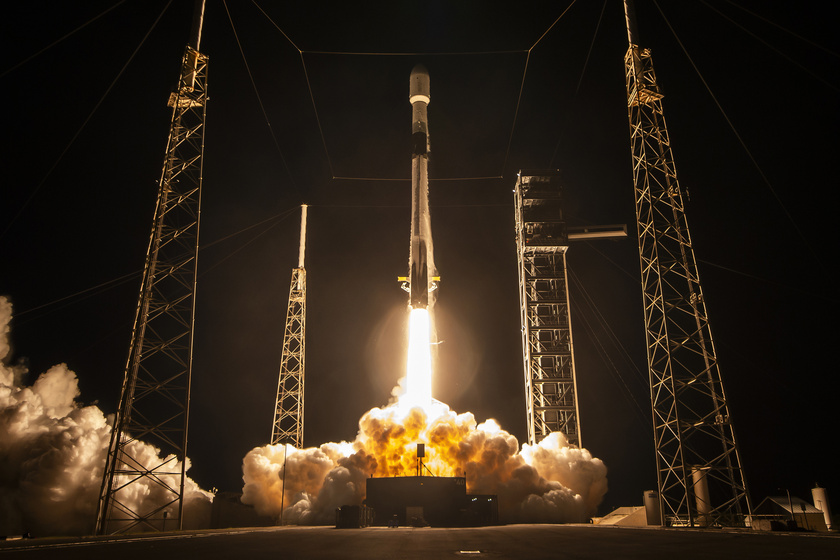
In the history of spaceflight, there has never been a vehicle capable of launching the megatons of mass that space-based data centers or permanent bases on the Moon and cities on Mars require. Even in 2025, the most prolific year in history in terms of the number of orbital launches, only about 3000 tons of payload was launched into orbit, primarily consisting of Starlink satellites carried by our Falcon rocket.
The requirement to launch thousands of satellites to orbit became a forcing function for the Falcon program, driving recursive improvements to reach the unprecedented flight rates necessary to make space-based internet a reality. This year, Starship will begin delivering the much more powerful V3 Starlink satellites to orbit, with each launch adding more than 20 times the capacity to the constellation as the current Falcon launches of the V2 Starlink satellites. Starship will also launch the next generation of direct-to-mobile satellites, which will deliver full cellular coverage everywhere on Earth.
While the need to launch these satellites will act as a similar forcing function to drive Starship improvements and launch rates, the sheer number of satellites that will be needed for space-based data centers will push Starship to even greater heights. With launches every hour carrying 200 tons per flight, Starship will deliver millions of tons to orbit and beyond per year, enabling an exciting future where humanity is out exploring amongst the stars.
The basic math is that launching a million tons per year of satellites generating 100 kW of compute power per ton would add 100 gigawatts of AI compute capacity annually, with no ongoing operational or maintenance needs. Ultimately, there is a path to launching 1 TW/year from Earth.
My estimate is that within 2 to 3 years, the lowest cost way to generate AI compute will be in space. This cost-efficiency alone will enable innovative companies to forge ahead in training their AI models and processing data at unprecedented speeds and scales, accelerating breakthroughs in our understanding of physics and invention of technologies to benefit humanity.
This new constellation will build upon the well-established space sustainability design and operational strategies, including end-of-life disposal, that have proven successful for SpaceX’s existing broadband satellite systems.
While launching AI satellites from Earth is the immediate focus, Starship’s capabilities will also enable operations on other worlds. Thanks to advancements like in-space propellant transfer, Starship will be capable of landing massive amounts of cargo on the Moon. Once there, it will be possible to establish a permanent presence for scientific and manufacturing pursuits. Factories on the Moon can take advantage of lunar resources to manufacture satellites and deploy them further into space. By using an electromagnetic mass driver and lunar manufacturing, it is possible to put 500 to 1000 TW/year of AI satellites into deep space, meaningfully ascend the Kardashev scale and harness a non-trivial percentage of the Sun’s power.
The capabilities we unlock by making space-based data centers a reality will fund and enable self-growing bases on the Moon, an entire civilization on Mars and ultimately expansion to the Universe.
Thank you for everything you have done and will do for the light cone of consciousness.
Ad Astra!
Elon