keneci
News • Science & Tech • Comedy
NG-2: Blue Orign New Glenn Launches NASA's ESCAPADE To Mars, Lands Booster Successfully For The First Time
November 14, 2025
post photo preview

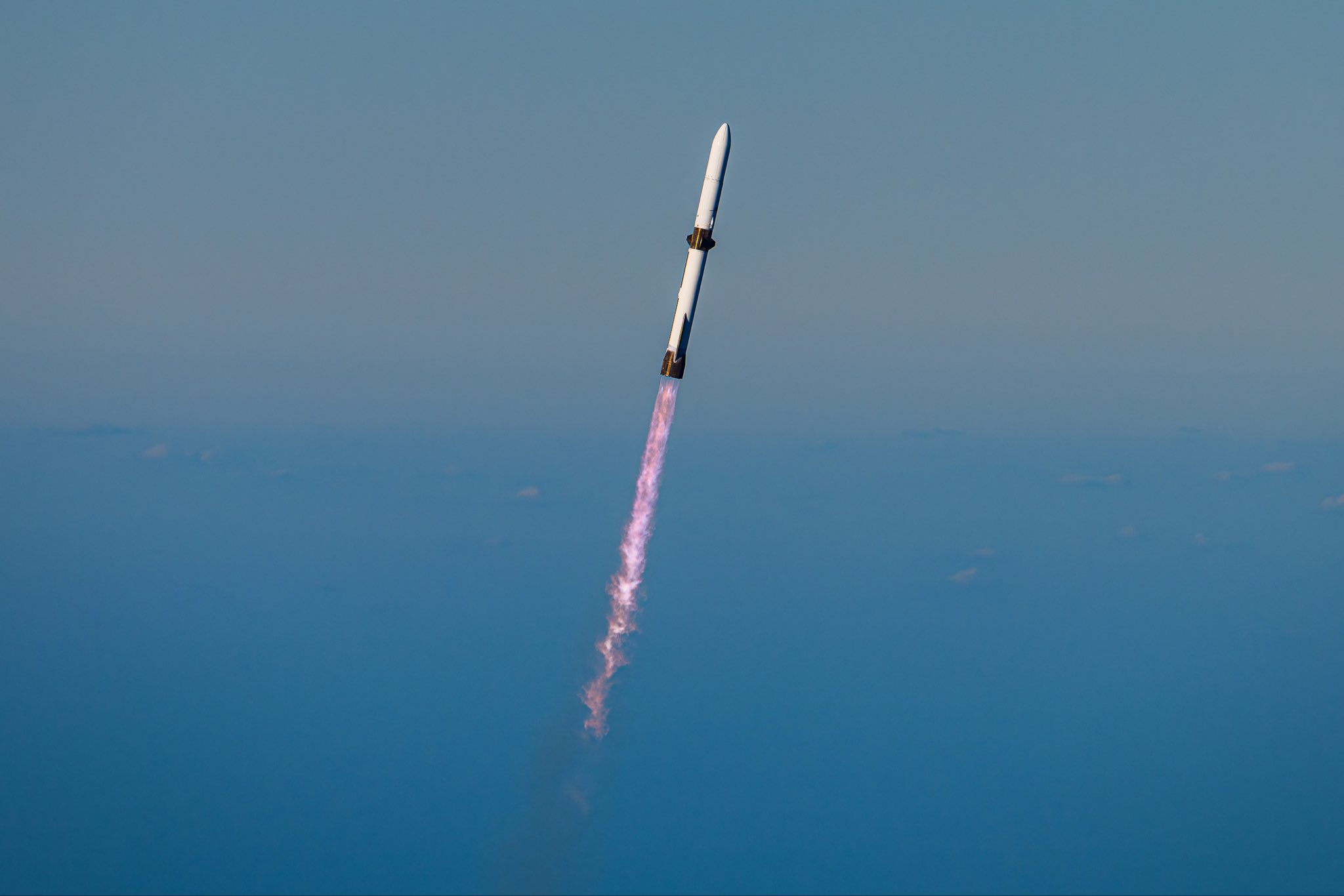
Blue Origin successfully launched its New Glenn rocket on its second flight from Launch Complex 36(LC-36) at Cape Canaveral Space Force Station on Florida's space coast, on Thurday(Nov. 13), at 2045 UTC, deploying NASA’s ESCAPADE (Escape and Plasma Acceleration and Dynamics Explorers) twin spacecraft on a novel trajectory toward Mars.

The NG-2 mission marked the first customer payload launch for New Glenn and achieved a historic milestone with the successful vertical landing of the first-stage booster, GS1-SN002(nicknamed "Never Tell Me The Odds"), on the autonomous recovery ship "Jacklyn" in the Atlantic Ocean.

Following liftoff at T+0, and 3 minutes of powered flight, the first stage separated following main engin cutoff, and initiated a series of deceleration burns. At T+7 minutes, GS1-SN002 reignited three of its seven BE-4 engines for atmospheric entry, followed by a landing burn at T+8:27 minutes, culminating in a vertical touchdown on Jacklyn at T+9:09 minutes, validating the rocket’s reusability and a key step toward commercial viability.

"A landed orbital rocket!" Blue Origin's Ariane Cornell said during the company's launch webcast today. "What an incredible day for Blue Origin, for the space industry." The Jeff Bezos company tried for a similar landing during the first New Glenn launch in January of this year but was unsuccessful. 

Meanwhile the second stage, powered by two BE-3U engines, continued to orbit, performing two burns to achieve the required Earth-escape trajectory.

The ESCAPADE spacecraft were deployed 33.5 minutes after liftoff, beginning a 30-second separation sequence. The twin probes, Blue and Gold, were released into a loiter orbit around the Earth-Sun Lagrange point 2, an area of gravitational stability located approximately 1.5 million kilometers from Earth.

"ESCAPADE, you are headed to Mars!" Cornell said after the second spacecraft separated from New Glenn's upper stage.

ESCAPADE, is a low-cost, dual-spacecraft mission led by the University of California, Berkeley, and built by Rocket Lab for NASA. The mission, costing $107.4 million, aims to study how Mars lost its atmosphere by measuring the interaction between the solar wind and the planet’s upper atmosphere.

Due to the timing, the mission could not launch during the traditional 26-month Earth-Mars transfer window, so it adopted a novel trajectory: the probes will spend 11 months in a loiter orbit beyond the Moon before performing a gravity assist flyby of Earth in November 2026. This maneuver will provide the necessary velocity to reach Mars, with arrival scheduled for September 2027.

The twin spacecraft will operate in tandem to provide a "stereo view" of space weather processes, enabling unprecedented cause-and-effect analysis of atmospheric escape.

"I think ESCAPADE is really exciting because it's a trailblazer, a pathfinder if you will, for what we think is a new way of doing space science missions," ESCAPADE Principal Investigator Robert Lillis, of the University of California, Berkeley's Space Sciences Laboratory, told reporters during a press briefing on Saturday (Nov. 8).

"We build a high delta V system that not only cruises to Mars and performs the Mars orbit insertion maneuver, but first climbs out of the Earth's gravity well, eliminating the need for Mars direct transfer from the launch vehicle, significantly increasing the available launch options," Richard French, Rocket Lab's vice president of business development and strategy, told reporters on Saturday.

If all goes well, ESCAPADE will leave its Lagrange point 2 loiter spot in November 2026 and arrive in orbit around the Red Planet in September 2027. Once there, mission leads at the University of California, Berkeley will operate the orbiters, dubbed Blue and Gold (for the university's colors), for about 11 months.

The probes will collect data with four different science instruments (which are identical on both of them). The science team will use this information to construct a 3D map of the environment around Mars to study how the solar wind contributes to the depletion of Mars' atmosphere, among other tasks.

"The geological evidence shows that Mars once had water on it, and in order to keep the water, you need a thick atmosphere,” ESCAPADE Deputy Principal Investigator Shaosui Xu, a space physicist at UC Berkeley's Space Sciences Laboratory, said in a statement.

"So we know that there was a thick enough atmosphere on Mars once upon a time, but now it is very tenuous," Xu added. "There are only two ways for atmosphere to leave — either go into the ground or escape to space, and there are a lot of studies showing that escape has been a very significant contributor to the evolution of the atmosphere."

Lillis said the misson team is particularly excited because ESCAPADE will study Mars in tandem with other spacecraft already at the Red Planet. NASA's MAVEN orbiter has been closely studying the planet's atmosphere since its arrival there in 2014. Other spacecraft at Mars include NASA's Curiosity and Perseverance rovers and two European orbiters — Mars Express and the ExoMars Trace Gas Orbiter. And Japan's planned Mars Moons Explorer mission will track the solar wind at the Martian moon Phobos, giving yet another eye on space weather at the Red Planet.

"This is a really exciting time where we're going to have all these assets at Mars," Lillis said.

ESCAPADE is the first Mars mission to launch in more than five years. The most recent one, NASA's Perseverance rover (and ride-along Ingenuity helicopter) lifted off atop a United Launch Alliance Atlas V rocket in July 2020.

Thursday's mission also tested Viasat’s InRange telemetry relay service for NASA’s future communications needs.

In addition to ESCAPADE, New Glenn carried a secondary payload for customer ViaSat to test that company's InRange launch telemetry relay service as part of a project for NASA's Communications Services Project (CSP). The technology could be used in a successor system for NASA's aging Telemetry and Data Relay Satellite (TDRS) system.

"We are excited to be working with Blue Origin as our launch partner to showcase our innovative launch telemetry services,” Susan Miller, president of Viasat Government, said in a statement. "As NASA looks ahead to replacing the TDRS system, commercial capabilities need to deliver greater performance, flexibility and resilience to support future missions."

Blue Origin is now the second company in history to recover a rocket during an operational flight. This practice has become the norm for SpaceX, which has so mastered landing and reusing its Falcon 9 rocket that boosters launching for the first time are now a rarity.

The success of today's flight also puts New Glenn one step closer toward qualification to fly lucrative national security payload contracts for the U.S. Space Force and the National Reconnaissance Office.

Blue Origin already has a manifest of missions for customers ranging from the U.S. government to communications companies. The company has also partnered with Amazon, to help launch the Amazon Leo (formerly Project Kuiper) satellite-internet megaconstellation, which will compete with SpaceX's Starlink network. Amazon currently has a license to launch over 3,000 Kuiper internet satellites, which will fly on a variety of different rockets.

Standing 98 meters) tall with a 7-meter diameter, New Glenn is a partially reusable, heavy-lift launch vehicle capable of carrying up to 45 metric tons to low Earth orbit(LEO). It uses seven BE-4 engines on its first stage, powered by liquid methane and liquid oxygen, and two BE-3U engines on its second stage, using liquid hydrogen and liquid oxygen. The first stage is designed for at least 25 flights with refurbishment, aiming to reduce launch costs.

New Glenn is comparable to, but not quite as powerful as, SpaceX's Falcon Heavy and not comparable to Starship megarocket. It has nearly twice the lifting capacity as United Launch Alliance's new Vulcan Centaur. Blue Origin intends to position New Glenn to take on some of the Falcon 9's current share of the launch market.


community logo
Join the keneci Community
To read more articles like this, sign up and join my community today
0
What else you may like…
Videos
Posts
Articles
SpaceX Starlink Internet Satellites

With Starlink internet, data is continuously being sent between a ground dish and a Starlink satellite orbiting 550km above. Furthermore, the Starlink satellite zooms across the sky at 27,000 km/hr! MORE VIDEOS ON KENECI NETWORK RUMBLE CHANNEL: https://rumble.com/c/Keneci

00:28:08
Elon Musk, DOGE Speak On Waste And Fraud

US Department of Government Efficiency Services (USDS) led by Elon Musk speak on the "mind-boggling" fraud and waste in UInited States federal government

00:00:45
January 17, 2025
SpaceX Launches Starship 7th Test Flight

SpaceX successfully executed its second-ever “chopsticks” catch of a Super Heavy booster (or Booster 14) using the “Mechazilla” launch tower on Thursday(Jan. 16), during the seventh uncrewed test flight of the company's 123-meter Starship rocket. However, the megarocket's upper stage(or Ship 33) was lost approximately 8.5 minutes into the flight in a “rapid unscheduled disassembly(RUD)” or explosion

00:10:30
Welcome to Keneci Network!

Join the conversations!

December 09, 2025
Bitcoin White Paper By Satoshi Nakamoto

Bitcoin white paper

Bitcoin_White_Paper.pdf
September 17, 2024
Charges Against Sean 'Diddy' Combs In Grand Jury Indictment

The rapper was charged with racketeering conspiracy, sex trafficking by force, fraud or coercion, and transportation to engage in prostitution in the indictment unsealed Tuesday(Sept. 17)

Combs-Indictment-24-Cr.-542.pdf
December 24, 2025
post photo preview
U.S. Bars EU Censorship Officials From Entering The Country

The U.S. State Department, under Secretary of State Marco Rubio, has imposed visa restrictions barring five Europeans from entering the United States, accusing them of leading efforts to pressure American tech firms to censor or suppress American viewpoints online.

The move announced Tuesday, is part of a broader President Trump administration campaign against foreign influence over online speech, using immigration law rather than platform regulations or sanctions.

The targeted individuals include former European Union Commissioner Thierry Breton, leaders of German anti-hate group HateAid, and heads of organizations focused on so-called disinformation and digital hate

Breton, former EU Commissioner for Digital Affairs, was sanctioned for his role in enforcing the EU’s Digital Services Act (DSA), which has clashed with tech companies like Elon Musk’s X. He previously sent a letter to Musk demanding compliance with the DSA ahead of a Trump interview.

Imran Ahmed, CEO of the Centre for Countering Digital Hate, was targeted for his organization’s 2022 “Disinformation Dozen” report, which highlighted anti-vaccine figures including Robert F. Kennedy Jr.

Clare Melford, CEO of the Global Disinformation Index, was sanctioned for allegedly using U.S. taxpayer funds to advocate for censorship and blacklisting of American speech.

Josephine Ballon and Anna-Lena von Hodenberg, leaders of HateAid, were sanctioned for their ostensible work combating so-called online hate and disinformation, with the group calling the U.S. actions an “authoritarian attack on free speech.”

The State Department cited these individuals as part of a “global censorship-industrial complex” that advances foreign government censorship campaigns targeting American speakers and companies.

The sanctions are based on a visa policy announced in May 2025 that restricts entry for foreigners deemed responsible for censorship of protected speech in the U.S. The Department of Homeland Security may initiate removal proceedings against those already in the country.

The move follows a broader trend of U.S. officials, including Vice President JD Vance, criticizing European nations for censorship, particularly over content related to the Covid-19 lab leak theory and other political topics.

The EU has not yet responded publicly to the sanctions, but European officials have expressed concern over the U.S. actions undermining European sovereignty.

The U.S. has also previously targeted visitors from certain African and Middle Eastern countries and the Palestinian Authority with similar visa restrictions.

Read full Article
December 23, 2025
post photo preview
Spotify Music Library Scraped, Released Online By Activist Pirate Group: 86M Files

A pirate activist group known as Anna’s Archive has claimed to have scraped and begun releasing a massive archive of Spotify’s music catalog, asserting it has backed up nearly all of the platform’s most popular tracks. As of Tuesday. Spotify has confirmed the breach.

Anna’s Archive claims to have scraped 86 million audio files from Spotify, representing approximately 99.6% of total listens on the platform, with the entire archive totaling around 300 terabytes in size.

The archive includes metadata for 256 million tracks—covering an estimated 99.9% of Spotify’s catalog—already released via torrent, with the actual music files planned for future release in order of popularity. The group has also indicated that individual file downloads may be added if there is sufficient demand.

The group states this constitutes the “world’s first preservation archive” for music, prioritizing tracks by popularity and aiming to protect humanity’s musical heritage from potential loss due to disasters or corporate decisions.

The full release of the music torrents are expected to in the coming days, organized by popularity and quality—160 kbit/s for popular tracks and 75 kbit/s for less popular ones to conserve space.

Spotify has confirmed the incident and stated that it has identified and disabled the user accounts involved in the unlawful scraping. The company emphasized its ongoing commitment to protecting artists and rights holders, noting it has implemented new safeguards against such anti-copyright attacks, and is actively monitoring for suspicious behavior.

Anna’s Archive, known for its shadow library of books and academic papers, frames the action as a preservation effort rather than pure piracy, arguing that existing digital archives are overly focused on popular content and high-quality files. The group acknowledges that Spotify does not contain all music ever produced but considers it a strong starting point.

AAzXCkfWc740EhWPlYCMNUZkGJP8PAD5DrEtONI1CfVGSXmgrEn2PR7fWdNTJrth7VKqH4i-ejSTRQ0FJERrH45Gwm2TR75ygt8uakl5zWQIq8dqCWZI2KuIpqaHuA8_i1oCdS8bsYVdOQWBABQirIwGO8-WG5h3k8apU2AAj63qqbgnXOZzUlTfBnf4D-WUvP3wNk-BlA410fjnn4f0gG8l4FGCPq5uu-E5eKNV=w1280
AAzXCkdoVIcnt0jcwVHxWv3dw8Sp_fn6sfxMtHBfOEaEK8KzaxMVRK6mhEyWdj1ghDiUU502g4Dhl2DNxwUa9h4Pbfm7_xaFOWF8xNaS-RWumg4pTBKZ0KpotNVNeLlqgnE9fzO5dts3_VKjpFr8SiIcArtGQVpM8eLCiNCx5EKTH3Mk0_kiC6v1D44tn1aBRscN4IarcFPVMxwdm7Z3OEX8V7Oztl6TFivNS-fKn68=w1280

The breach raises concerns about the potential use of the 300TB dataset to train AI models without consent, a growing ethical and legal issue in the tech industry. The group’s actions also highlight vulnerabilities in how public metadata and DRM can be exploited to access copyrighted content at scale.

Read full Article
December 23, 2025
post photo preview
China Builds EUV Prototype Machine To Challenge Western Advanced Chipmaking Dominance

China has completed a prototype extreme ultraviolet (EUV) lithography machine in a high-security Shenzhen laboratory, marking a major milestone in its drive for semiconductor independence through a state-led 'Manhattan Project-style' initiative.

The machine, operational since early 2025 and now undergoing testing, was built by a team of former ASML(Advanced Semiconductor Materials Lithography) Holding engineers like Lin Nan, who filed key patents. They reverse-engineered the Dutch company’s technology, using parts from older ASML systems and secondary markets to circumvent Western export controls.

While the prototype successfully generates EUV light, it has not yet produced functional chips, with analysts estimating a realistic timeline for working chip production between 2030 and 2035, despite an official government target of 2028.

The project, launched as a six-year national effort under President Xi Jinping’s strategic priorities, is coordinated by Huawei and overseen by Ding Xuexiang, a close confidant of Xi and head of the Central Science and Technology Commission.

Former ASML engineers were recruited with substantial incentives, including signing bonuses of up to $700,000, and worked under aliases with false identification cards to maintain secrecy.

The prototype occupies nearly an entire factory floor and is operated within a highly isolated, secure compound where staff often sleep on-site, with strict communication restrictions and surveillance.

Despite ASML CEO Christophe Fouquet’s public statements in 2024 and 2025 that China would need "many, many years" to develop EUV capability, the existence of the prototype suggests Beijing’s timeline may be accelerating significantly.

While the Chinese machine’s light generation is confirmed, major technical hurdles remain, particularly in replicating the precision optical systems—such as specialized mirrors from Germany’s Zeiss—that are critical for high-volume, reliable chip manufacturing.

The breakthrough challenges long-standing U.S.-led export controls that have barred China from acquiring advanced EUV systems since 2018, with the Biden administration expanding restrictions in 2022.

The ultimate goal, as stated by sources, is to produce advanced chips on entirely China-made machines and to fully remove U.S. influence from its semiconductor supply chains.

Advanced chip manufacturing machine generates extreme ultraviolet light to etch tiny circuits for AI, smartphones, and military systems—tech once monopolized by ASML

Read full Article
See More
Available on mobile and TV devices
google store google store app store app store
google store google store app tv store app tv store amazon store amazon store roku store roku store
Powered by Locals