keneci Network
News • Science & Tech • Comedy
Apple iPhones To Support SpaceX Starlink Satellite Network's Direct-to-cell Service
January 29, 2025
post photo preview

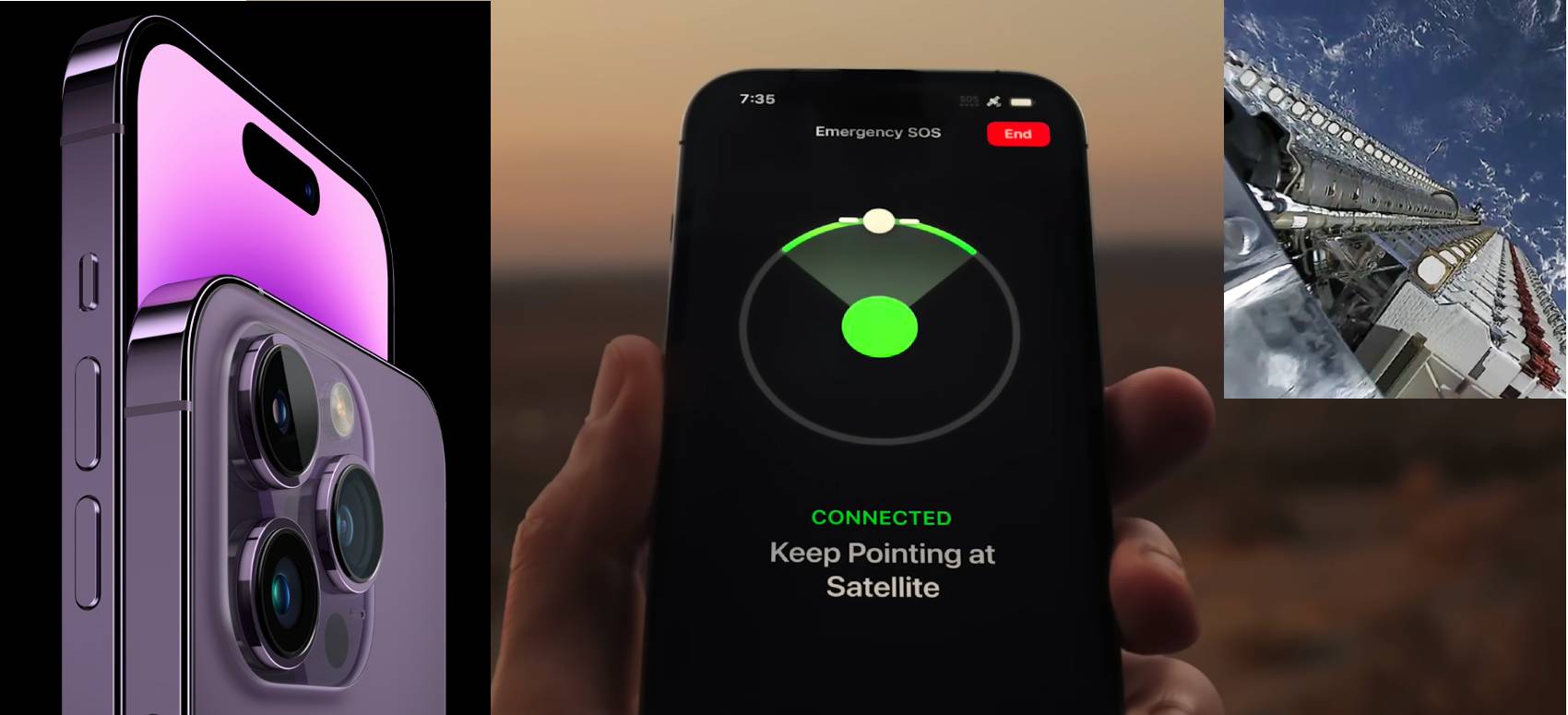
Apple has reportedly been working with SpaceX and T-Mobile to add support for the Starlink satellite network's direct-to-cell(DTC) service in its latest iPhone software, providing an alternative to the company’s in-house satellite-communication service. The initial version of Starlink is exclusively for texting, but SpaceX and T-Mobile have said that they plan to expand into data connections and voice calls in the future.

This development marks a significant step in expanding satellite connectivity for smartphone users, with the Starlink option designed to work automatically, even when the phone is in a customer’s pocket.

The Starlink DTC service is currently available only in the US and is limited to T-Mobile users, with a small number of iPhones enabled as part of a beta test. The current Apple feature requires users to point their iPhone to the sky to find a satellite, whereas the Starlink option is designed to work automatically.

Participants in the beta received messages from T-Mobile, informing them of their inclusion in the Starlink program. The company said that the test will initially support select smartphones, with plans to expand to more devices.

The integration of Starlink into iPhones is seen as a major accessibility shift, making off-the-grid communication more accessible to users.

SpaceX is looking to expand Starlink's DTC service to other carriers globally, and the program may be available on other devices in the future.


community logo
Join the keneci Network Community
To read more articles like this, sign up and join my community today
0
What else you may like…
Videos
Posts
Articles
SpaceX Starlink Internet Satellites

With Starlink internet, data is continuously being sent between a ground dish and a Starlink satellite orbiting 550km above. Furthermore, the Starlink satellite zooms across the sky at 27,000 km/hr! MORE VIDEOS ON KENECI NETWORK RUMBLE CHANNEL: https://rumble.com/c/Keneci

00:28:08
Elon Musk, DOGE Speak On Waste And Fraud

US Department of Government Efficiency Services (USDS) led by Elon Musk speak on the "mind-boggling" fraud and waste in UInited States federal government

00:00:45
January 17, 2025
SpaceX Launches Starship 7th Test Flight

SpaceX successfully executed its second-ever “chopsticks” catch of a Super Heavy booster (or Booster 14) using the “Mechazilla” launch tower on Thursday(Jan. 16), during the seventh uncrewed test flight of the company's 123-meter Starship rocket. However, the megarocket's upper stage(or Ship 33) was lost approximately 8.5 minutes into the flight in a “rapid unscheduled disassembly(RUD)” or explosion

00:10:30
Welcome to Keneci Network!

Join the conversations!

December 09, 2025
Bitcoin White Paper By Satoshi Nakamoto

Bitcoin white paper

Bitcoin_White_Paper.pdf
September 17, 2024
Charges Against Sean 'Diddy' Combs In Grand Jury Indictment

The rapper was charged with racketeering conspiracy, sex trafficking by force, fraud or coercion, and transportation to engage in prostitution in the indictment unsealed Tuesday(Sept. 17)

Combs-Indictment-24-Cr.-542.pdf
post photo preview
Artemis II Crew's Orion Capsule Completes Translunar Injection Burn On Path To The Moon

The translunar injection (TLI) burn for the Artemis II mission was successfully completed on Thursday, (April 2), at 2349 p.m. UTC, sending the crew and the Orion spacecraft, Integrity on a path toward the Moon for the first time since 1972. The engine fired for about five minutes and 50 seconds (some reports cite 5:49 to 5:55), adding 867 mph to Integrity's velocity and accelerating it to 24,500 mph to escape Earth's gravitational clasp

This critical maneuver placed Integrity into a free-return trajectory that will carry the four astronauts around the far side of the Moon and back toward Earth without requiring further major engine firings. The burn utilized the Orbital Maneuvering System engine on the European Service Module, generating up to 6,000 pounds of thrust, and was preceded by a "Go" poll from NASA's Mission Management Team after confirming the spacecraft's systems were healthy.

The engine fired at an altitude of just 115 miles above Earth. Mission controllers in Houston described the burn as "flawless," with the crew reporting they are "glued to the window" observing Earth. Integrity is now on track to reach a distance of 252,455 miles from Earth, surpassing the record set by Apollo 13, with a planned splashdown on Day 10 of the mission.

Following liftoff Wednesday, NASA astronauts Reid Wiseman, Victor Glover, Christina Koch, and Canadian Space Agency(CSA) astronaut Jeremy Hansen aboard Integrity stayed in Earth orbit for more than 24 hours, checking out the capsule's various systems ahead of its planned plunge into deep space.

"With that successful TLI, the crew is feeling pretty good up here on our way to the moon, and we just wanted to communicate to everyone around the planet who's worked to make Artemis possible that we firmly felt the power of your perseverance during every second of that burn," Hansen, said just after the maneuver.

"Humanity has once again shown what we are capable of, and it's your hopes for the future that carry us now on this journey around the moon," he added.

Artemis 2 launched Wednesday evening (April 1) from NASA's Kennedy Space Center in Florida, sending four astronauts aloft on the first-ever crewed flight of Orion and its Space Launch System (SLS) rocket. The duo had flown together just once before, on the uncrewed Artemis 1 mission to lunar orbit in 2022.

"Our TLI burn, the burn that gets us going to the moon, is also our deorbit burn," Koch said in a NASA interview before launch. "As soon as we take that burn, we have bought off on basically the rest of the mission."

The TLI burn used Orion's main orbital maneuvering engine, which was salvaged from NASA's space shuttle program and upgraded for an Artemis trip to the moon. The engine has flown in space 19 times before on three different space shuttles. If you strapped it to a car, it would accelerate you from zero to 60 mph (97 kph) in 2.7 seconds.

=================

NASA successfully launched the Artemis II mission on Wednesday, (April 1), at 2235 UTC from Kennedy Space Center's Launch Complex 39B, marking the first crewed flight beyond low Earth orbit since the Apollo 17 mission in 1972.

The Space Launch System (SLS) rocket, standing 32 stories tall, ignited its twin solid rocket boosters and four RS-25 engines to generate 8.8 million pounds of thrust, lifting the Orion spacecraft named "Integrity" into space.

The four-person crew consists of NASA astronauts Reid Wiseman (Commander), Victor Glover (Pilot), and Christina Koch (Mission Specialist), alongside Canadian Space Agency astronaut Jeremy Hansen (Mission Specialist), who became the first Canadian and non-U.S. citizen to travel to the Moon's vicinity.

Close to three and a half hours into the Artemis 2 mission, pilot Victor Glover took control of Orion after the capsule separated from the Space Launch System rocket's Interim Cryogenic Propulsion Stage, or ICPS. Glover will now manually pilot Orion around ICPS, carrying out a series of maneuvers designed to test the spacecraft's propulsion systems and ability to operate in close proximity to another object in space.

"I see it. Look at that, woohoo! I see the ICPS and the moon in the field of view," Glover said during NASA's live broadcast of the mission.

These tests, known as proximity operations or "prox ops," are a key part of this test flight and will evaluate Orion's ability to fly near and interface with future Artemis program hardware such as the lunar lander that will eventually be chosen for NASA's planned moon landings.

"It's quite nice and very responsive," Glover said, referencing the spacecraft's Digital Autopilot (DAP) system.

The 10-day mission is a lunar flyby that will not involve a landing but will travel approximately 250,000 miles from Earth, surpassing the previous record set by Apollo 13 in 1970 by reaching 4,600 miles beyond the Moon's far side.

Key mission objectives include testing Orion's life support and navigation systems, performing an in-space rendezvous with the spent Interim Cryogenic Propulsion Stage, and validating emergency procedures for future lunar landings.

The crew is expected to perform a translunar injection burn to commit to the Moon, fly around the lunar far side, and return to Earth for a planned **splashdown in the Pacific Ocean** around April 11, 2026. This flight serves as the critical second step in NASA's Artemis program, paving the way for **Artemis III (lunar landing in 2027)** and the eventual establishment of a sustainable human presence on the Moon.

Read full Article
post photo preview
Trump Threatens To Bomb Iran Back To The Stone Ages

President Donald Trump delivered a prime-time address late Wednesday, declaring that U.S. military objectives in Iran are nearing completion after one month of Operation Epic Fury. He vowed to "bring Iran back to the Stone Ages" with intense strikes over the next two to three weeks, asserting that country’s navy is “gone,” its air force “in ruins,” and its leadership decimated.

Trump conditioned any ceasefire on the reopening of the Strait of Hormuz, which Iran has effectively blocked since the conflict began, disrupting global oil supplies. He urged oil-dependent nations to “build up some delayed courage” and take control of the strait themselves, while suggesting they buy U.S. oil instead. He claimed the U.S. does not rely on the waterway, stating, “We haven’t needed the Hormuz Strait, and we don’t need it.”

U.S. goals include destroying Iran’s missile and nuclear programs, eliminating its navy, and preventing nuclear weapon development—objectives Trump said are nearly achieved. He claimed Iran’s new leadership had sought a ceasefire, but Iran’s Foreign Ministry denied any such request.

Oil prices surged past $100 per barrel after the speech, with markets reacting to the lack of a clear exit strategy despite Trump’s claims of imminent victory.

Trump also threatened to target Iran’s electric grid and oil infrastructure if no deal is reached, while asserting that regime change has already occurred due to the death of top Iranian leaders.

Iran’s President Masoud Pezeshkian warned of “consequences beyond Iran’s borders,” and state media rejected negotiations unless the U.S. fully withdraws from the region and pays compensation. Iran insists it will not reopen to the U.S., saying, “The strait will reopen, but not for you.”

Meanwhile, Israel intensified operations against Hezbollah in Lebanon, killing senior commander Haj Youssef Ismail Hashem, with over 1,300 Lebanese killed and more than 3,900 wounded.

The U.K. is hosting a 35-nation virtual meeting to discuss reopening the strait; as Trump threatened to withdraw the U.S. from NATO over allies’ inaction.

Read full Article
post photo preview
Artemis II: NASA Launches Astronauts To The Moon

NASA successfully launched the Artemis II mission on Wednesday, (April 1), at 2235 UTC from Kennedy Space Center's Launch Complex 39B, marking the first crewed flight beyond low Earth orbit since the Apollo 17 mission in 1972.

The Space Launch System (SLS) rocket, standing 32 stories tall, ignited its twin solid rocket boosters and four RS-25 engines to generate 8.8 million pounds of thrust, lifting the Orion spacecraft named "Integrity" into space.

The four-person crew consists of NASA astronauts Reid Wiseman (Commander), Victor Glover (Pilot), and Christina Koch (Mission Specialist), alongside Canadian Space Agency astronaut Jeremy Hansen (Mission Specialist), who became the first Canadian and non-U.S. citizen to travel to the Moon's vicinity.

Close to three and a half hours into the Artemis 2 mission, pilot Victor Glover took control of Orion after the capsule separated from the Space Launch System rocket's Interim Cryogenic Propulsion Stage, or ICPS. Glover will now manually pilot Orion around ICPS, carrying out a series of maneuvers designed to test the spacecraft's propulsion systems and ability to operate in close proximity to another object in space.

"I see it. Look at that, woohoo! I see the ICPS and the moon in the field of view," Glover said during NASA's live broadcast of the mission.

These tests, known as proximity operations or "prox ops," are a key part of this test flight and will evaluate Orion's ability to fly near and interface with future Artemis program hardware such as the lunar lander that will eventually be chosen for NASA's planned moon landings.

"It's quite nice and very responsive," Glover said, referencing the spacecraft's Digital Autopilot (DAP) system.

The 10-day mission is a lunar flyby that will not involve a landing but will travel approximately 250,000 miles from Earth, surpassing the previous record set by Apollo 13 in 1970 by reaching 4,600 miles beyond the Moon's far side.

Key mission objectives include testing Orion's life support and navigation systems, performing an in-space rendezvous with the spent Interim Cryogenic Propulsion Stage, and validating emergency procedures for future lunar landings.

The crew is expected to perform a translunar injection burn to commit to the Moon, fly around the lunar far side, and return to Earth for a planned **splashdown in the Pacific Ocean** around April 11, 2026. This flight serves as the critical second step in NASA's Artemis program, paving the way for **Artemis III (lunar landing in 2027)** and the eventual establishment of a sustainable human presence on the Moon.

Read full Article
See More
Available on mobile and TV devices
google store google store app store app store
google store google store app tv store app tv store amazon store amazon store roku store roku store
Powered by Locals