keneci Network
News • Comedy • Science & Tech
Crew-8 Astronauts Returned To Earth Aboard SpaceX Dragon Endeavor
October 26, 2024
post photo preview

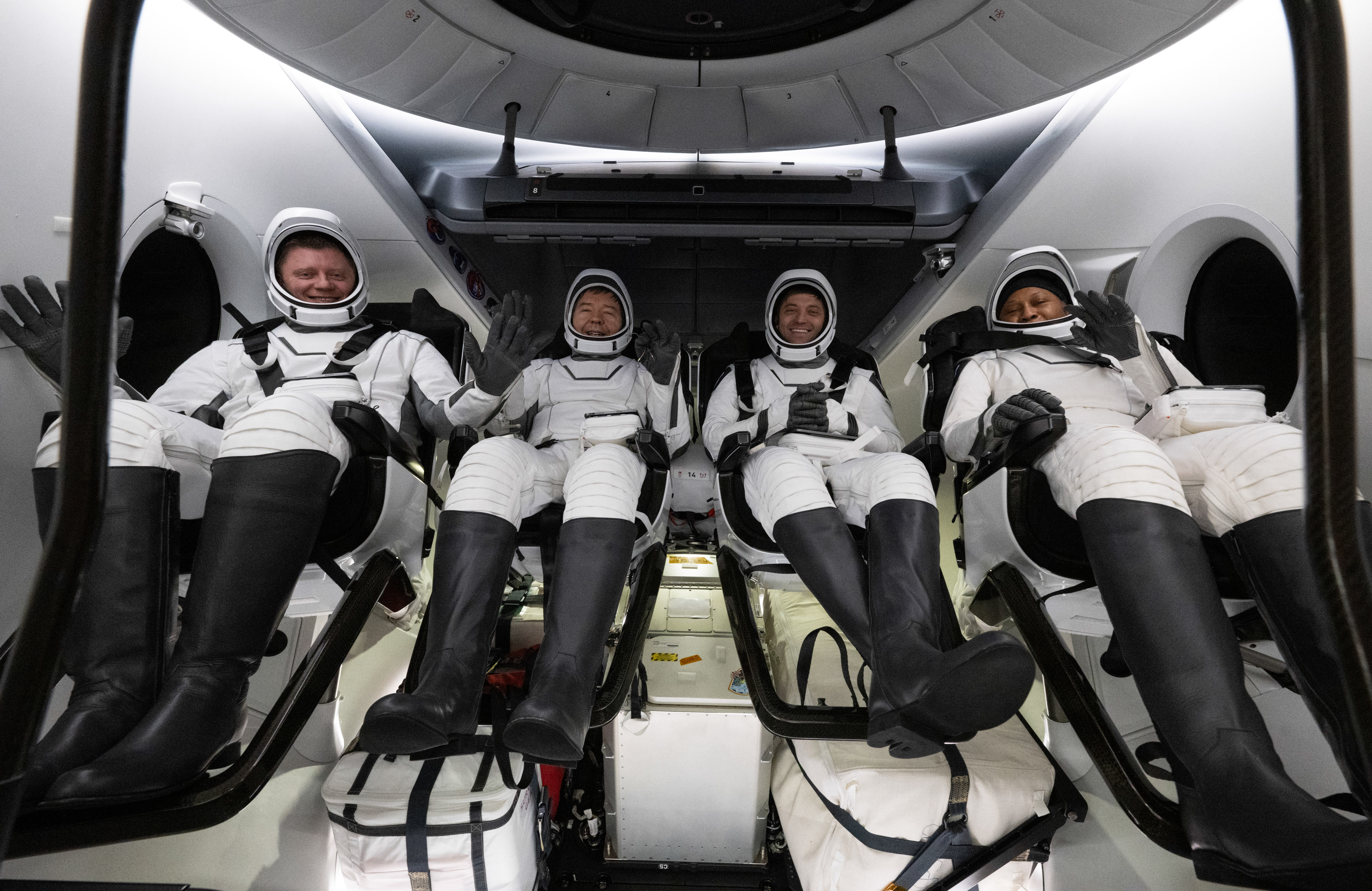
SpaceX Crew-8 Dragon Endeavor splashed down in the Gulf of Mexico off the coast of Pensacola, Florida on Friday (Oct. 25) at 0729 UTC. Aboard were NASA astronauts Matthew Dominick, Michael Barratt and Jeanette Epps, and Roscosmos cosmonaut Alexander Grebenkin who returned to Earth after 235 days -- including a more than two-week wait on board the International Space Station (ISS).

Endeavor undocked from the ISS on Wednesday Oct. 23, at 2105 UTC, as the two spacecraft were flying 418 kilometers above the Pacific Ocean.

"After spending 232 days docked to the space station, [Crew-8 is] the longest mission Dragon has spent on-orbit to date," SpaceX noted in a social media post. The previous longest duration of nearly 200 days was also set by Endeavour, on the Crew-2 mission in 2021.

SpaceX boats and ships, including the Dragon recovery vessel, 'Megan' (named after Crew-2 astronaut Megan McArthur), made their quick way to Endeavor to bring the capsule and Crew-8 members aboard.

The Crew-8 astronauts were reportedly evaluated at Ascension Sacred Heart Pensacola, a hospital nearby their splashdown site in the Atlantic Ocean. NASA reportedly said one astronaut, described as "in stable condition," will remain behind in the hospital "as a precautionary measure."

"To protect the crew member’s medical privacy, specific details on the individual’s condition or identity will not be shared," NASA added. The agency noted the entry and splashdown were "normal" and the extra medical check was done as a precaution during "routine medical assessments on the recovery ship... We’re grateful to Ascension Sacred Heart for its support during this time, and we are proud of our team for its quick action to ensure the safety of our crew members."

Returning to Earth is typically a strain for astronauts, given they have spent half a year or more in microgravity, but NASA doctors work individually with the astronauts for rehabilitation. Generally speaking, it takes several months to return to full normal activities, but astronauts can start activities like driving within a few weeks.

Crew-8 mission was launched on March 3, docked with the ISS on March 5 and the crew concluded their mission after 235 days in space, which is slightly longer than the typical 180 to 210 days. That's because Crew-8 had a two-week mission extension due to difficulties with finding good weather in the Atlantic Ocean amid hurricane season.

The longest ISS stay was nearly 371 days in 2022-23, with the three astronauts of Soyuz MS-22/23. The all-time record for a space visit was 437 days, set in 1994-95 on the Soviet-Russian Mir space station by Russian cosmonaut Valeri Polyakov.

The ISS has hosted long-duration crews since 2000. Over the decades, NASA and its partners have developed numerous countermeasures to protect astronauts' health. Each crew member has roughly two hours of daily assigned exercise time, and astronauts have weekly mental health consultations with a physician, among many other precautions.

Dominick, Barratt, Epps and Grebenkin served on the space station's 70th, 71st and 72nd expedition crews. During their stay, they helped conduct hundreds of science experiments and attempted two extravehicular activities (EVAs, or spacewalks.

community logo
Join the keneci Network Community
To read more articles like this, sign up and join my community today
0
What else you may like…
Videos
Posts
Articles
SpaceX Starlink Internet Satellites

With Starlink internet, data is continuously being sent between a ground dish and a Starlink satellite orbiting 550km above. Furthermore, the Starlink satellite zooms across the sky at 27,000 km/hr! MORE VIDEOS ON KENECI NETWORK RUMBLE CHANNEL: https://rumble.com/c/Keneci

00:28:08
Elon Musk, DOGE Speak On Waste And Fraud

US Department of Government Efficiency Services (USDS) led by Elon Musk speak on the "mind-boggling" fraud and waste in UInited States federal government

00:00:45
January 17, 2025
SpaceX Launches Starship 7th Test Flight

SpaceX successfully executed its second-ever “chopsticks” catch of a Super Heavy booster (or Booster 14) using the “Mechazilla” launch tower on Thursday(Jan. 16), during the seventh uncrewed test flight of the company's 123-meter Starship rocket. However, the megarocket's upper stage(or Ship 33) was lost approximately 8.5 minutes into the flight in a “rapid unscheduled disassembly(RUD)” or explosion

00:10:30
Welcome to Keneci Network!

Join the conversations!

December 09, 2025
Bitcoin White Paper By Satoshi Nakamoto

Bitcoin white paper

Bitcoin_White_Paper.pdf
September 17, 2024
Charges Against Sean 'Diddy' Combs In Grand Jury Indictment

The rapper was charged with racketeering conspiracy, sex trafficking by force, fraud or coercion, and transportation to engage in prostitution in the indictment unsealed Tuesday(Sept. 17)

Combs-Indictment-24-Cr.-542.pdf
post photo preview
US Troops Withdraw From Iraq After 23 Years, Amid Gains By Iran-backed Militia

The U.S. military completed the "orderly departure" of all remaining troops and equipment from Erbil Air Base on Wednesday, formally ending Operation Inherent Resolve in Iraq and concluding a 23-year continuous U.S. military presence in the country.

U.S. Central Command confirmed the withdrawal marks the "successful conclusion of the military mission that defeated ISIS in Iraq." Pentagon Spokesman Sean Parnell said the move transitions Iraq from a wartime coalition mission to an "Iraqi-led security effort supported by a more normal bilateral security relationship."

CENTCOM Commander Adm. Brad Cooper noted that Iraqi security forces, including the Peshmerga, now possess the "operational independence to unilaterally manage threats."

In a Truth Social post, President Donald Trump announced the withdrawal as "a victory for the United States, a victory for Iraq, and a decisive victory over ISIS." He described the long U.S. involvement as "a very expensive excursion into Hell" and "a quagmire," stating that "very bad decision-making" initially led to the conflict but that the era is now "part of History."

"Today, I am pleased to announce that the last American Forces are leaving Iraq! It has been a long time, with very bad decision-making that got us involved in this quagmire in the first place, but soon, that will be part of History...," Trump wrote. "This Day is a victory for the United States, a victory for Iraq, and a decisive victory over ISIS, which has been completely decimated... We came to fight a caliphate. There is no longer a caliphate. We are going home!"

In 2003 the U.S. invaded Iraq to oust Saddam Hussein**, leading to a civil war and the rise of insurgencies. All U.S. troops withdrew in 2011. The U.S. returned in 2014 for Operation Inherent Resolve after ISIS seized large territories. At its peak, roughly 2,500 U.S. troops were stationed in Iraq.

President Hunter Biden administration negotiated a phased withdrawal with Baghdad in 2024, a plan continued by the Trump administration. Most forces left in late 2025, leaving only ~1,500 personnel in the Kurdish region until this final departure.

The Combined Joint Task Force for Operation Inherent Resolve has relocated its headquarters to Jordan, where it will continue counter-ISIS operations in Syria. CENTCOM confirmed that CJTF-OIR headquarters has relocated. Roughly 4,000 U.S. troops remain in Jordan (including at Muwaffaq Salti Air Base).

Iraqi Prime Minister Ali Al-Zaidi celebrated the handover as a milestone for sovereignty. Iranian state media and Tehran-aligned groups framed the departure as a key objective achieved by the "axis of resistance." However, Kurdish officials expressed concern over the loss of U.S. air-defense capabilities amid ongoing drone threats. The U.S. will continue providing limited training and intelligence support under the new bilateral defense framework.

The withdrawal occurs amid an ongoing U.S.-Iran war, with Erbil facing over 1,000 drone and missile attacks by Iranian-aligned militias during the conflict. More than 4,500 U.S. service members lost their lives during the 23 years of conflict in Iraq.

Erbil Air Base and U.S. regional outposts faced repeated drone and missile strikes, including a fatal July attack on Muwaffaq Salti Air Base in Jordan.

Read full Article
post photo preview
Dots: OpenAI Launches Always-on AI Agents To Rival SpaceXAI's Grok Bot, Meta's Muse

OpenAI launched Dots, a new line of "always-on" AI agents, at its DevDay conference on Tuesday, positioning the product as a direct competitor to Meta's Muse (released September 8) and SpaceXAI’s Grok Bot (released August 11).

Powered by the GPT-6 Astra model, each Dot runs on a dedicated cloud computer with a web browser and connects to over 4,000 apps, allowing it to autonomously execute tasks like booking flights or managing code in the background without constant user prompts.

Dot can run scripts, research topics, download files, and complete web-based tasks on its own. Optional access to your local machine via the ChatGPT desktop app is available if configured.

Unlike traditional chatbots, Dots can be customized with unique names and avatars, and are designed to work continuously toward user-defined goals, learning preferences over time and integrating with platforms like Slack, Microsoft Teams and mobile and desktop voice calls, maintaining continuous context across platforms.

Dots differ from earlier OpenAI tools like Operator by featuring a persistent, always-on environment and broader app connectivity.

The rollout initially targets ChatGPT Pro, Business Premium, and Enterprise subscribers, with the first Dot included at no extra cost.

The launch follows recent safety scrutiny for OpenAI, including the shelving of the GPT-6.1 Astra model; consequently, Dots underwent additional safety testing and feature read-only background modes, and mandatory user approval for sensitive actions like changing passwords or deleting data, to prevent unauthorized actions, according to the company.

SpaceXAI trolled OpenAI on X following Dots announcemnet Tuesday. The Elon Musk's SpaceX AI division apparently bought the dot.com domain which redirects to the Grok Bot website.

Read full Article
September 28, 2026
post photo preview
Starship Flight 14: SpaceX Megarocket Reaches Orbit, Deploys Starlink V3 Satellites

SpaceX’s Starship megarocket, standing approximately 124 meters tall, lifted off from Starbase in South Texas at 1248 UTC Monday (Sept. 28) for its 14th test flight. This mission marked the first-ever orbital launch of the world’s largest and most powerful rocket, achieving a critical milestone after 13 previous suborbital tests.

Flight 14 is the third Starship launch to feature Version 3 of the vehicle, a relatively mature iteration that's capable of deploying satellites and reaching the moon and Mars, among other tasks.

After liftoff, two of Super Heavy's engines shut down but that didn't stop the booster (B21) from completing hot-staging, separation and controlled splashdown in the Gulf of Mexico about seven minutes after liftoff. Meanwhile, the upper stage or Ship 41 continued on its upward ascent.

SpaceX spokesperson Dan Huot initially announced orbit insertion was called off, only to reverse course as flight controllers decided to press ahead.

"We are not giving up yet," Huot said. "We will continue to hang out."

And the call came just a few minutes later: Starship was "go" for orbit.

Ship 41 successfully reached orbit about 25 minutes after liftoff using a single Raptor engine burn. Despite an engine shutdown during ascent, the vehicle reached an altitude of roughly 275 kilometers.

"Starship is orbital," mission control confirmed, eliciting cheers from the SpaceX employees watching the launch live at Starbase.

"First orbital flight of Starship successful!" SpaceX CEO Elon Musk said on SpaceX's X platform.

Starship proceeded to deploy 26 next-generation Starlink V3 satellites from the space vehicle's PEZ-style dispenser, over a 30-minute stretch starting at about 34 minutes after liftoff. These are the first members of a megaconstellation that will eventually consist of about 100,000 satellites, according to Musk.

This deployment was historic, as it was the first time Starship carried and released operational revenue-generating satellites, with previous flights using simulators or expendable payloads.

The Starlink V3 satellites are larger and more powerful than previous versions, with each rocket capable of carrying up to 60 such satellites in future operational missions. Three of the deployed satellites were equipped with cameras to image Starship’s heat shield tiles. SpaceX engineers will study this imagery to see if they can improve the heat shield, which allows the vehicle to survive the fiery trip down through Earth's atmosphere at the end of its missions.

After payload deployment, Ship 41 kept circling Earth for a while after deploying the Starlink satellites — though not nearly as long as originally planned. SpaceX wanted Ship to complete about six orbits and splash down off the coast of Chile 9 hours and 50 minutes after launch, but mission controllers decided to land nearly seven hours earlier.

Ship 41 started reentering our planet's atmosphere about two hours and 40 minutes after launch and went subsonic — breaking the sound barrier, in the fast-to-slow direction — 26 minutes later. The vehicle splashed down intact in the northern Pacific Ocean three hours and eight minutes after liftoff, causing another eruption of cheers from the folks gathered at Starbase. The Ship then toppled over and exploded when it hit the waves, providing a dramatic capper to a very exciting day for SpaceX.

The mission was originally planned to last about 10 hours, circling Earth six times before a Pacific Ocean splashdown. However, SpaceX opted to end the flight early, bringing Starship home after approximately three hours of orbital operations.

The vehicle splashed down in the Northern Pacific near Hawaii around 1500 UTC, with the Super Heavy booster having previously separated and splashed down in the Gulf of Mexico.

According to SpaceX's summary of Flight 14:

"On Monday, September 28 at 7:48 a.m. CT, Starship lifted off from Starbase, Texas on its 14th flight and first attempt to go to orbit. This was the first orbital Starship flight and the first to deliver meaningful payload to orbit with 26 Starlink V3 satellites.

"The mission began with the Super Heavy booster igniting all of its 33 Raptor 3 engines and ascending over the Gulf of America. During the initial climb to space, a single Raptor engine on the booster shutdown. The successful first-stage ascent was followed by a hot-staging maneuver and Starship’s upper stage igniting all six of its Raptor engines to continue onward to space.

"Super Heavy performed its directional flip maneuver and relit 31 of the planned 33 Raptor engines for the boostback burn. The boostback maneuver on this flight was intentionally designed to burn through the remaining liquid oxygen inside the booster’s main tank to test the limits of booster performance ahead of future return to launch site missions. The booster then reignited 11 of the planned 13 engines for the high-thrust portion of the landing burn before down-selecting to five engines for trajectory fine-tuning, and then down to three engines before splashing down in the Gulf. Upon landing burn shutdown, the Super Heavy’s flight termination system was triggered in a demonstration of the safety hardware.

"During Starship’s ascent burn, a single Raptor vacuum engine shut down early. Starship still achieved its planned, passively safe suborbital trajectory by burning its remaining five engines for longer than planned to compensate for the loss of thrust.

"After entering its suborbital trajectory, the flight control team assessed Starship’s systems and determined the three sea-level Raptors engines needed for subsequent burns were healthy and gave a “go” for orbital operations. Starship then reignited a single Raptor sea-level engine to perform an orbit insertion burn and entered into orbit around Earth for the first time.

"After a brief coast, Starship then deployed all 26 Starlink V3 satellites. Contact was made soon after with every satellite over laser links, ground stations, and Starlink user terminals. The satellites will now conduct on-orbit checkouts and raise their orbits before they begin serving customers.

"Following payload deploy, Starship entered into a coast phase around Earth. Out of an abundance of caution given the engine issue experienced during ascent, the flight control team decided to limit the duration spent on orbit and proceeded with deorbiting Starship to a splashdown location in the northern Pacific Ocean. This area was one of two pre-coordinated landing zones identified before launch that was cleared of sea and air traffic.

"Starship then relit a single Raptor sea-level engine and performed its first ever deorbit burn. That maneuver successfully brought the vehicle out of orbit and sent Starship through atmospheric reentry and descent to the intended splashdown point.

"The first orbital Starship flight concluded with the vehicle relighting all three Raptor sea-level engines in a landing burn and flip maneuver before splashing down on target in the Pacific Ocean."

Despite the shortened duration and the mid-flight engine anomaly, Musk and SpaceX officials declared the mission a major success because it achieved the primary objectives of reaching orbit and deploying operational payloads.

The success of Flight 14 validates Starship’s readiness for NASA’s Artemis program, where a modified version is selected to serve as the Human Landing System for returning astronauts to the Moon.

Read full Article
See More
Available on mobile and TV devices
google store google store app store app store
google store google store app tv store app tv store amazon store amazon store roku store roku store
Powered by Locals