keneci Network
News • Comedy • Science & Tech
Moments Before Hamas Leader Yahya Sinwar Was Killed In Israeli Airstrike: Video
October 19, 2024
post photo preview

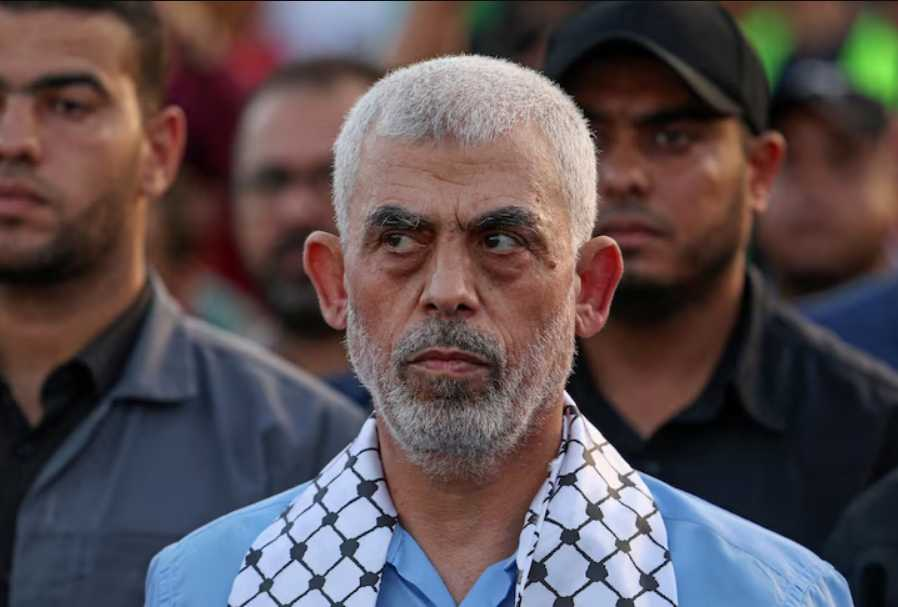
Israeli military released footage showing the moments before Hamas leader Yahya Sinwar was killed, after a group of IDF soldiers deployed a drone to check a building they had hit in Rafah on Thursday.

An injured Sinwar, who had his face covered and appeared to be missing his right hand, could be seen sitting alone on a chair in the destroyed building. The IDF soldiers were reportedly initially unaware of his identity.

As the drone hovers just a few feet from him, Sinwar finally notices it and struggles using his left hand to fling an object at the drone. The soldiers then reportedly called in a second airstrike on the building, killing the Hamas leader and two other militants who were traveling with him.

IDF spokesman Rear Adm. Daniel Hagari told reporters that Sinwar had likely been shot in his hand and taken refuge in the building when it was hit by the Israeli troops. He said the Hamas leader was likely on the move trying to escape north amid the Israeli military’s advance in Rafah, to which hundreds of thousands of Palestinians had fled earlier this year.

Israeli military officials later confirmned Sinwar's identity, after recovering his body and comparing the DNA samples with the ones retreived from him during his time as a prisoner.

Israeli and US officials hailed the death of Sinwar who Israel claim, had ordered the Oct. 7, 2023, terror attack on the Jewish state.

“To the people of Gaza, I have a simple message,” Israeli Prime Minister Benjamin Netanyahu said in a statement. “This war can end tomorrow. It can end if Hamas lays down its arms and returns our hostages. Israel will guarantee the safety of all those who return our hostages.”

Critics have accused Netanyahu and Israeli military of commiting genocide on the Palestinian people in the year-long war which has killed tens of thousands of children and women.


community logo
Join the keneci Network Community
To read more articles like this, sign up and join my community today
0
What else you may like…
Videos
Posts
Articles
SpaceX Starlink Internet Satellites

With Starlink internet, data is continuously being sent between a ground dish and a Starlink satellite orbiting 550km above. Furthermore, the Starlink satellite zooms across the sky at 27,000 km/hr! MORE VIDEOS ON KENECI NETWORK RUMBLE CHANNEL: https://rumble.com/c/Keneci

00:28:08
Elon Musk, DOGE Speak On Waste And Fraud

US Department of Government Efficiency Services (USDS) led by Elon Musk speak on the "mind-boggling" fraud and waste in UInited States federal government

00:00:45
January 17, 2025
SpaceX Launches Starship 7th Test Flight

SpaceX successfully executed its second-ever “chopsticks” catch of a Super Heavy booster (or Booster 14) using the “Mechazilla” launch tower on Thursday(Jan. 16), during the seventh uncrewed test flight of the company's 123-meter Starship rocket. However, the megarocket's upper stage(or Ship 33) was lost approximately 8.5 minutes into the flight in a “rapid unscheduled disassembly(RUD)” or explosion

00:10:30
Welcome to Keneci Network!

Join the conversations!

December 09, 2025
Bitcoin White Paper By Satoshi Nakamoto

Bitcoin white paper

Bitcoin_White_Paper.pdf
September 17, 2024
Charges Against Sean 'Diddy' Combs In Grand Jury Indictment

The rapper was charged with racketeering conspiracy, sex trafficking by force, fraud or coercion, and transportation to engage in prostitution in the indictment unsealed Tuesday(Sept. 17)

Combs-Indictment-24-Cr.-542.pdf
post photo preview
NROL-97: SpaceX Launches US Spy Satellite, Completes Tripleheader in 13 hours

SpaceX Falcon Heavy rocket launched the NROL-97 mission from Kennedy Space Center's Launch Complex 39A (LC-39A), at 0354 UTC on Friday (Oct. 2), carrying classified payload and marking the first time the heavy-lift vehicle has been used for the National Reconnaissance Office (NRO). This launch completed a historic "tripleheader" within 13 hours for SpaceX, following the earlier Crew-13 and Transporter-18 flights.

Falcon Heavy's two side boosters B1072 and B1104 came back to Earth for landing at Landing Zones 2 and 1 at Florida's Cape Canaveral Space Force Station about eight minutes after liftoff; while the rocket’s new center core, B1106 was intentionally expended to maximize energy for the classified payload.

The Falcon Heavy upper stage deployed the payload to a high-energy orbit likely intended for geostationary or highly elliptical paths, which require the Falcon Heavy’s superior lift capacity (63,800 kilograms to LEO) compared to the standard Falcon 9.

NROL-97 is the opening operational mission of the $13.7 billion NSSL Phase 3 Lane 2 contract, awarded in 2025, which formalizes SpaceX as a primary provider for U.S. national security launches through fiscal year 2029.

While specific details of the spy satellite remain classified, the use of the Falcon Heavy indicates a heavy or high-altitude payload that exceeded the capabilities of the NRO’s previous 22 Falcon 9 missions.

The NROL-97 mission patch features the phrase "Orbem mundi mutandum conservare," which is Latin for "to preserve a changing world" or "to preserve the world by transforming it." The emblem also memorializes the lives lost during the terrorist attacks of Sept. 11, 2001.

"The lighthouse characterizes enduring strength and the ability to provide information to those in need, even in difficult times," NRO officials wrote in a description of the patch. "The endpoints of the light beam align to the locations of 9 and 11 on a clock face in honor of the 25th anniversary of 9/11. Four prominent stars represent the four aircraft lost on 9/11, and the moon phase is shown as it appeared on September 11, 2026."

SpaceX has launched a "tripleheader" in such a short timeframe — in March 2025, when the company sent up three Falcon 9 rockets in a 12.5-hour span.

Read full Article
post photo preview
SpaceX Crew-13 Mission Astronauts Arrive At The ISS, In Fastest US Spaceflight To The Orbital Station

SpaceX Crew-13 mission's Crew Dragon Grace successfully docked to the forward-facing port of the International Space Station (ISS)'s Harmony module, at 2305 UTC on Thursday (Oct. 1), completing the fastest U.S. spaceflight to the station in history. Grace, launched from Florida’s Cape Canaveral Space Force Station at 1510 UTC, reached the ISS in just 7 hours and 55 minutes, breaking the previous record by approximately five hours.

The previous record was 12 hours and 33 minutes, set in November 2024 by SpaceX's Dragon cargo capsule during the robotic CRS-31 resupply flight. The fastest that astronauts had made the trip in a U.S. vehicle was 14 hours and 43 minutes, which was achieved by the Crew-11 mission in August 2025.

"We got lucky this time," Julianna Scheiman, director of NASA science and Dragon programs at SpaceX, said during Crew-13's post-launch press conference today.

"The space station was in an opportune spot in space, and the orbital mechanics, the physics of it all, worked out for it to be the shortest launch-to-docking time we've had to date," she said, adding that "this is close to the fastest it could be."

Crew-13 didn't set the overall speed record to the ISS, however — not even close. In May 2020, a Russian Soyuz spacecraft carrying three astronauts reached the orbiting lab just 3 hours and 3 minutes after lifting off from Baikonur Cosmodrome in Kazakhstan. The Soyuz caught up to the ISS after just two orbits of Earth.

The Soyuz isn't faster or more powerful than a cargo or crew-carrying Dragon capsule. Rather, the difference in chase-down times comes down primarily to choices made by mission controllers; Russia tends to target more aggressive "fast-track" trajectories.

Crew-13 mission crew consists of mission Commander and NASA astronaut Jessica Watkins, mission pilot and NASA astronaut Luke Delaney, mission pilot and Canadian Space Agency astronaut Joshua Kutryk and Roscosmos cosmonaut Sergey Teteryatnikov. They joined the Expedition 75 core crew and the departing SpaceX Crew-12 astronauts, temporarily raising the orbital station's population to 11.

Crew-13 astronauts' mission includes conducting scientific research on stem-cell derived tissues for Parkinson’s and heart disease, testing zero-g crop production, and performing routine station maintenance.

The new crew will relieve the four astronauts of Crew-12 mission, which launched in mid-February. NASA astronauts Jessica Meir and Jack Hathaway, the ESA's Sophie Adenot and cosmonaut Andrey Fedyaev, will return to Earth in their Crew Dragon capsule this month, according to NASA officials.

Read full Article
post photo preview
Transporter-18: SpaceX Launches Google AI Satellite, 129 Payloads In Rideshare Mission

SpaceX Falcon 9 launched its Transporter-18 rideshare mission from Vandenberg Space Force Base in California at 1832 UTC on Thursday (Oct. 1), deploying 130 payloads into a sun-synchronous orbit. The mission’s primary payload was a prototype satellite for Google’s Project Suncatcher, designed to test the resilience of Tensor Processing Units (TPUs) against space radiation and thermal challenges.

About 8 minutes after liftoff, the Falcon 9's first stage booster, B1082 came back to Vandenberg for a landing, completing its 25th flight to date. Meanwhile the rocket's upper stage powered its way to low Earth orbit (LEO), where it deployed the 130 payloads over a roughly 11-minute window starting about 54.5 minutes after liftoff, and bringing the total count for SpaceX’s Rideshare program to over 1,800 payloads.

The highest-profile payload on Transporter-18, is a pathfinder spacecraft for Project Suncatcher, the AI constellation that Google plans to build and operate in LEO, which explores scalable machine learning infrastructure.

This satellite will help the project team determine how TPUs — Google chips that are core Suncatcher hardware — perform in the space environment. Of particular importance are how the TPUs withstand space radiation, and how efficiently the heat they generate is dissipated.

Another company with AI data center ambitions flew on Transporter-18 as well: Cowboy Space put its Reason-1 satellite on the Falcon 9.

"Its job is to prove out power beaming: using a high-power laser to transfer energy from low Earth orbit to a receiver on the ground," Cowboy Space said of Reason-1 in a Sept. 28 X post. "If you want to build data centers in space, you have to master the optical systems between orbit and Earth. This is where that journey begins."

Transporter-18 also launched Starfish Space's first Otter servicing satellite.

"This is a big moment for Starfish Space," the Washington-based company said via X on Sept. 24. "We've spent years developing, iterating, and proving out the key technologies required for affordable, available satellite servicing. Now we’re launching Otters, putting our satellite servicing vehicles to work for customers in orbit."

The rest of the 130 payloads were a diverse lot, consisting of "cubesats, microsats, hosted payloads and two spacecraft with reentry vehicles and four orbital transfer vehicles carrying 41 of those payloads to be deployed at a later time," SpaceX wrote in its Transporter-18 mission description. The manifest included Carbon Mapper’s Tanager-2 satellites for methane monitoring, and spacecraft from Varda Space Industries featuring reentry vehicles.

Transporter-18 was part of a very busy day for SpaceX. The company also launched the Crew-13 astronaut mission for NASA earlier, and it aims to launch the NROL-97 flight for the U.S. National Reconnaissance Office later.

Read full Article
See More
Available on mobile and TV devices
google store google store app store app store
google store google store app tv store app tv store amazon store amazon store roku store roku store
Powered by Locals