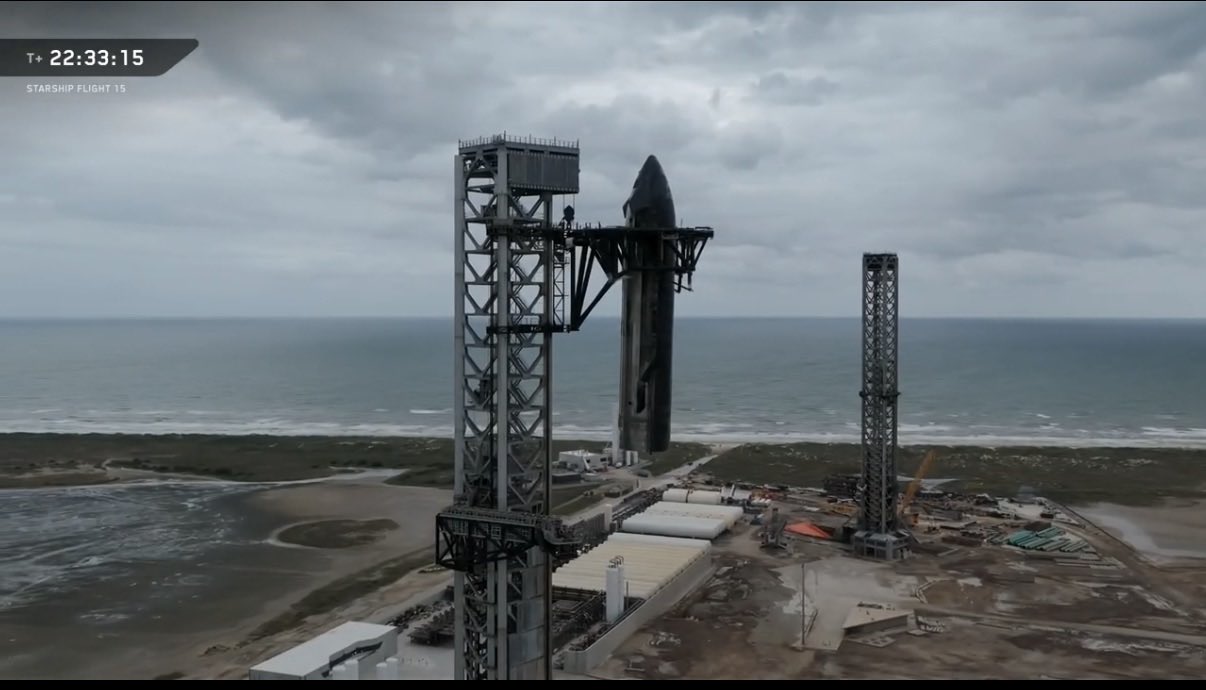
SpaceX's megarocket, Starship lifted off on its 15th flight from Starbase at 2247 UTC Friday (Nov. 13), and achieved a historic milestone by successfully capturing its upper stage, Ship 42, 22.5 hours after liftoff, with the launch tower arms or Mechazilla, marking the first time an orbital spacecraft has been caught mid-air.
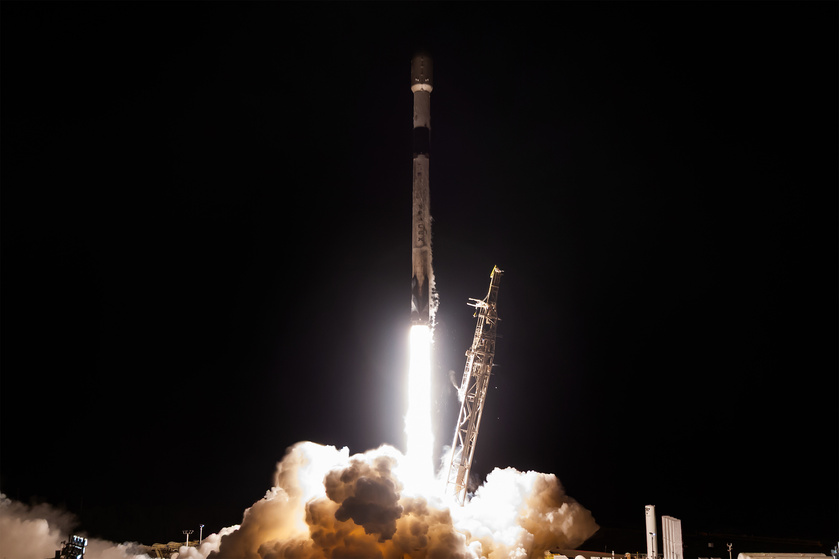
On liftoff of the 124.4-meter-tall vehicle, all 33 Raptor engines on the Super Heavy (or the Starship's first stage, Booster 22) ignited at 22:47:36 UTC. About 2.5 minutes later, hot-staging occured with the upper stage (or Ship 42) igniting its six Raptor engines and separating cleanly from the booster. The mission launched with the goal of recovering both stages.
However, Booster 22 suffered a partial failure during its boostback burn when one engine failed to relight. This resulted in slight underperformance that left the booster low on fuel, forcing the GNC (Guidance, Navigation and Control) system to trigger an automated abort of the catch attempt. Consequently, the the flight termination system(FTS) was triggered, the booster performed a controlled offshore splashdown and exploded in the water 6 minutes 40 seconds after liftoff, preventing the first full two-stage recovery.
While SpaceX previously caught three Super Heavy V1 boosters on Flights 5, 7, and 8, no organization had ever recovered an orbital rocket's upper stage upright at its launch pad. Eliminating heavy landing legs in favor of tower catches maximizes payload capacity and speeds up turnaround times.
"Yes, the green flame is caused by burning copper from depleting fuel in the regenerative cooling circuit and going oxygen-rich (closer to stoichiometric temperature) in the main combustion chamber," SpaceX CEO Elon Musk explained in an X post Saturday. "Slight underperformance of engines on this flight is the reason. The booster is meant to land with tiny residuals, so the solution is to improve engine performance and performance consistency (underway with Raptor V3.2), as well as adjust flight software to do MECO1 about one second earlier to ensure enough propellant for boostback and landing (tiny change). These early ships and boosters are already outdated by improved designs in production or on the test stand, so this booster loss does not change our timeline to reach high volume, fully reusable Starship flights."
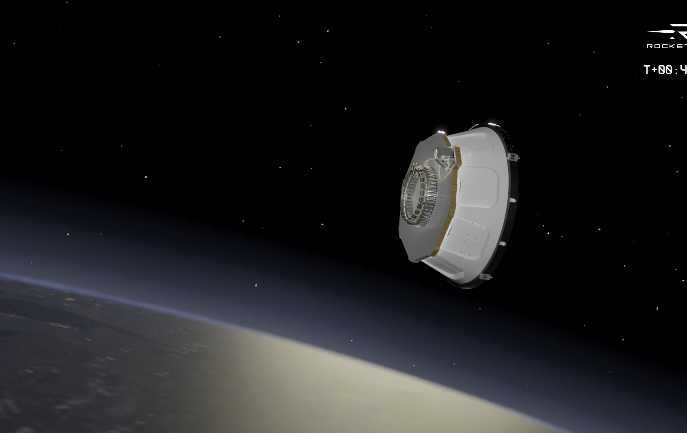
While the booster failed, Ship 42 successfully reached a low Earth orbit(LEO) at an altitude of 275 kilometers. About 34 minutes after liftoff, the spacecraft began deploying 26 Starlink V3 satellites, completing the payload delivery in about 42 minutes.
Some of those Starlink satellites took video and images of Ship 42's heat shield to check its health for today's landing attempt. Those images, combined with ground-based cameras, found Ship 42 to be in good shape and ready for its big moment.
Each Starlink V3 satellite adds roughly 1 Terabit per second of bandwidth to the network. The 26 satellites deployed on Flight 15 add 26 Tbps of capacity—matching the output of roughly 10 Falcon 9 launches carrying Starlink V2 Mini satellites.
After coasting in orbit for about 22.5 hours, Ship 42 returned to Earth, executed a precise belly-flop maneuver, and was caught by the Mechazilla arms at Starbase on Saturday(Nov. 14). This achievement validates the vehicle's reusability marking the first time the upper stage of a privately-built rocket was recovered.
"That was the missing link," SpaceX's Dan Huot said during the company's landing webcast today, his voice thick with emotion. "That was the holy grail of spaceflight, plummeting through fire to be snatched out of the air by steel. We caught a Starship, and now everything changes."
Many SpaceX employees went outside to watch the Ship 42 descend through the clouds. The space vehicle nestled gently into Mechazilla's waiting arms, while "Baby Come Back" played over SpaceX's landing webcast.
"This is so incredible to see," SpaceX's Jessie Anderson said during the livestream. "One of the most incredible and historic engineering feats of all time has just happened right in front of our eyes."
Recovering both stages is essential for SpaceX to achieve the high launch cadence needed for in-orbit propellant transfer. NASA relies on a lunar lander variant of Starship—which requires multiple orbital tanker refueling flights—for upcoming Artemis moon missions, including Artemis III's planned Earth-orbit docking tests and Artemis IV's lunar landing.
Ship 42 deployed 26 of SpaceX's next-gen Starlink V3 broadband satellites in low Earth orbit (LEO) on Flight 14, and it did so again on Flight 15. These 52 spacecraft are the first members of a constellation that will eventually consist of 100,000 satellites, if all goes according to SpaceX's plan.
SpaceX plans to use Starship to build an even bigger network in LEO than the Starlink V3 system — Starmind, an AI data-center constellation that will harbor a million spacecraft, according to Musk. (For context: SpaceX's current-gen Starlink network employs about 11,000 satellites at the moment).
Assembling these megaconstellations will require an incredible launch cadence making the double chopstick catch key to that vision, SpaceX says, to enable quicker inspection, refurbishment and reflight of Starship.