keneci Network
News • Science & Tech • Comedy
Republican Leaders Demand Biden's Physical Appearance Amid Health Speculations After His Withdrawal From 2024 Presidential Race
July 23, 2024
post photo preview

President Joe Biden in stunning X posts Sunday, announced his withdrawal from the 2024 presidential race and endorsed Vice President Kamala Harris as his replacement on the Democratic ticket to face former president Donald Trump in November's elections.
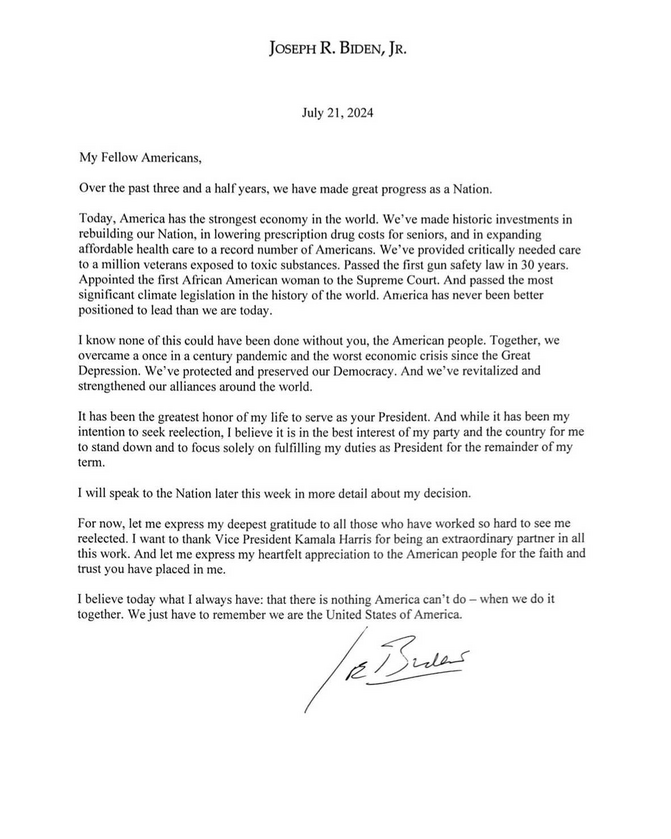
"My fellow Democrats, I have decided not to accept the nomination and to focus all my energies on my duties as President for the remainder of my term," Biden wrote in a follow-up X post. "My very first decision as the party nominee in 2020 was to pick Kamala Harris as my Vice President. And it’s been the best decision I’ve made. Today I want to offer my full support and endorsement for Kamala to be the nominee of our party this year. Democrats -- it’s time to come together and beat Trump. Let’s do this."

Accepting Biden's endorsement, Harris wrote on on X: "On behalf of the American people, I thank Joe Biden for his extraordinary leadership as President of the United States and for his decades of service to our country. I am honored to have the President’s endorsement and my intention is to earn and win this nomination."

In a statement posted on X, former President Obama didn't endorse Harris. "We will be navigating uncharted waters in the days ahead. But I have extraordinary confidence that the leaders of our party will be able to create a process from which an outstanding nominee emerges," he wrote in a letter.

But Obama and former First Lady Michelle Obama were among the scores of top Democrats praising Biden for withdrawing from the race. "Joe Biden has been one of America’s most consequential presidents, as well as a dear friend and partner to me. Today, we’ve also been reminded - again - that he’s a patriot of the highest order." Obamas wrote.

This decision came amid intense pressure from Democrat Party billionaire elites and politicians and party leaders, who had been urging him to step aside due to concerns about his apparent cognitive decline and perceived inability to mount a competitive campaign against Republican challenger and former president Donald Trump.

Democrat party leaders and their left-wing media allies panicked after Biden's performance in recent debate against Trump. Left-wing media talking heads and Democrat party leaders could no longer avoid addressing the president's cognitive decline which critics have accused them of covering up for years.

A concerted campaign to oust Biden was joined by Hollywood stars and billionaires including far-left tech entrepreneur Reid Hoffman who had to make a public apology after the 2020 elections for running a fake news propaganda operation across the country to sway voters in favor of Biden. Alex Soros, the son of controversial billionaire globalist George Soros, had also reportedly withdrawn his support for Biden’s campaign in recent weeks.

The controversy surrounding Biden’s withdrawal has sparked debate within the Democratic Party about the importance of a competitive nomination process and the role of donors in shaping the party’s direction.

Deposing a candidate elected by party's primary voters, over 14 million people, is a coup against Biden, and an undemocratic move, bypassing the usual nomination process, critics say. And many see his announcement made on X as bizarre and suspicious.

Opposition Republican Party leaders have called for Biden to address the nation in person and on camera, as speculations and conspiracy theories run wild on social media, with many saying the president is dead. "Who is running the country?" many Americans on social media are wondering.

Reacting to Biden's announcement Sunday, Trump wrote in a Truth Social post: "Crooked Joe Biden was not fit to run for President, and is certainly not fit to serve - And never was!"

Trump added that "we will suffer greatly because of his presidency, but we will remedy the damage he has done very quickly."

The third in the line of succession (after the president and vice president), and Speaker of the House of Representatives, Mike Johnson wrote on X: "At this unprecedented juncture in American history, we must be clear about what just happened. The Democrat Party forced the Democrat nominee off the ballot, just over 100 days before the election. Having invalidated the votes of more than 14 million Americans who selected Joe Biden to be the Democrat nominee for president, the self-proclaimed ‘party of democracy’ has proven exactly the opposite. The party’s prospects are no better now with Vice President Kamala Harris, who co-owns the disastrous policy failures of the Biden Administration. As second in command and a completely inept border czar, Harris has been a gleeful accomplice — not only in the destruction of American sovereignty, security, and prosperity, but also in the largest political coverup in U.S. history. She has known for as long as anyone of his incapacity to serve. Regardless of the chaos in the current White House, our adversaries around the globe should be reminded that the U.S. Congress, the U.S. military, and the American people are fully prepared and committed to defend our interests both at home and abroad. If Joe Biden is not fit to run for President, he is not fit to serve as President. He must resign the office immediately. November 5 cannot arrive soon enough."

Republican congresswoman Lauren Boebert wrote on X: "I demand proof of life from Joe Biden today by 5:00pm. He needs to get in front of some camera and discuss if he’s aware that he dropped out. Hiding is completely unacceptable."

The Democrat Party will formally nominate Harris at their convention in Chicago next month, to face Trump in November's elections.


community logo
Join the keneci Network Community
To read more articles like this, sign up and join my community today
0
What else you may like…
Videos
Posts
Articles
SpaceX Starlink Internet Satellites

With Starlink internet, data is continuously being sent between a ground dish and a Starlink satellite orbiting 550km above. Furthermore, the Starlink satellite zooms across the sky at 27,000 km/hr! MORE VIDEOS ON KENECI NETWORK RUMBLE CHANNEL: https://rumble.com/c/Keneci

00:28:08
Elon Musk, DOGE Speak On Waste And Fraud

US Department of Government Efficiency Services (USDS) led by Elon Musk speak on the "mind-boggling" fraud and waste in UInited States federal government

00:00:45
January 17, 2025
SpaceX Launches Starship 7th Test Flight

SpaceX successfully executed its second-ever “chopsticks” catch of a Super Heavy booster (or Booster 14) using the “Mechazilla” launch tower on Thursday(Jan. 16), during the seventh uncrewed test flight of the company's 123-meter Starship rocket. However, the megarocket's upper stage(or Ship 33) was lost approximately 8.5 minutes into the flight in a “rapid unscheduled disassembly(RUD)” or explosion

00:10:30
Welcome to Keneci Network!

Join the conversations!

December 09, 2025
Bitcoin White Paper By Satoshi Nakamoto

Bitcoin white paper

Bitcoin_White_Paper.pdf
September 17, 2024
Charges Against Sean 'Diddy' Combs In Grand Jury Indictment

The rapper was charged with racketeering conspiracy, sex trafficking by force, fraud or coercion, and transportation to engage in prostitution in the indictment unsealed Tuesday(Sept. 17)

Combs-Indictment-24-Cr.-542.pdf
post photo preview
British Royal Navy K3 Scout Drone Cameras Secretly Sent Data To China

Cameras on Royal Navy K3 Scout surveillance drones were discovered transmitting data to a Chinese IP address, raising significant security concerns despite official denials of a data breach.

The incident involves K3 Scout uncrewed surface vessels, a $16 million (£12 million) fleet supplied by British defense contractor Kraken Technology Group and used by the Royal Marines and Special Boat Service (SBS) since March 2026.

The K3 Scout model, designed to carry a 600 kilogram(kg) payload and operate continuously for 30 days, has also been purchased by the US Special Operations Command and has participated in Nato trials in the Baltic.

The vulnerability originated in third-party cameras containing Chinese-made components, which were sent to the drones with assurances of security and compliance with the US National Defense Authorization Act (NDAA).

During a routine cyber vulnerability assessment, analysts detected that these cameras were sending automated "heartbeat communications"—small data packets confirming the devices were online and functioning normally—to an unauthorized IP address in China. The Ministry of Defense (MoD) subsequently cut internet connectivity to the cameras to contain the breach.

An MoD spokesman said: “A routine cyber vulnerability assessment identified an issue affecting a Kraken Unmanned Surface Vessel sub-system used by the Royal Navy. A thorough investigation found no evidence of MoD data or systems being accessed, compromised or transmitted externally.

“Our assurance and testing processes are designed to identify and address potential vulnerabilities early, and we continue to undertake routine security activity across our systems and equipment.”

While the MoD and Kraken insist there is no evidence that sensitive military data, reconnaissance imagery, or classified systems were accessed or exfiltrated, the incident has exposed critical flaws in defense supply chain auditing.

A Kraken Technology Group spokesman said: “We are aware that some third-party, NDAA-compliant cameras had a small number of components originating from outside the UK.

“After a full audit by both Kraken and the Royal Navy we are confident no sensitive information has ever been shared outside of intended channels and any potential vulnerabilities have been identified and closed.”

The drones had operated near the SBS headquarters in Poole, Dorset, and were involved in preparations for potential missions in the Strait of Hormuz, leading to fears that metadata regarding operational schedules and locations may have been compromised.

A joint audit by Kraken and the Royal Navy confirmed no sensitive information left authorized channels, but the discovery has triggered calls for stricter component origin checks in military procurement.

Alicia Kearns, the shadow security minister, said: “If we cannot say with confidence what is inside our own military equipment, we cannot say it is ours, or that we are sovereign.

“When cameras built on Chinese parts are found recording our special forces – their faces, training and operations – we should not be surprised, we should be furious that we still haven’t woken up to the realities of the threat we face.”

UK has begun a diplomatic reset with China through a series of high-profile visits to the country, with the hope of lucrative trade agreements. Earlier this year, Downing Street approved plans for a Chinese super-embassy at Royal Mint Court in the heart of London, despite concerns about the site’s proximity to sensitive communication lines.

Read full Article
post photo preview
Michibiki 7: Japanese H3 Rocket Launches Navigation Satellite, QZS-7

Japan space agency, JAXA successfully launched the H3 rocket (Flight 9) from the Tanegashima Space Center at 1923 UTC, on Monday  (Aug. 11), carrying the 4,898-kilogram Michibiki 7 (QZS-7) navigation satellite.

The rocket launch which occurred after delays caused by Typhoon 13, utilized the standard H3-22 configuration (two LE-9 engines and two SRB-3 solid rocket boosters) and the upper stage successfully deployed the satellite into its target orbit about 29 minutes after liftoff.

This mission marks a critical milestone for Japan’s space program, as Michibiki 7 adds to the Quasi-Zenith Satellite System (QZSS) constellation.

"This system is compatible with GPS satellites and can be utilized with them in an integrated fashion," Japanese officials wrote in a description of the QZSS project. "QZSS can be used even in the Asia-Oceania regions with longitudes close to Japan, so its usage will be expanded to other countries in these regions as well."

The QZSS network will eventually consist of 11 satellites, if all goes according to plan. With seven satellites about to be in orbit following Monday's launch, QZSS transitions from a GPS augmentation service to a fully independent regional navigation system, ensuring at least four satellites are simultaneously visible over Japan at all times for high-precision positioning.

Michibiki 7 is carrying a payload for the United States as well — the Situational Awareness Camera Hosted Instrument (SÃCHI), which was developed for the U.S. Space Force by the MIT Lincoln Laboratory. This is the second of two SACHIs to go up on a QZSS satellite; Michibiki 6, which launched atop an H3 in February 2025, hosts the other one. (Yes, Michibiki 6 launched before Michibiki 5.)

"This program will allow the United States to monitor satellite behavior within the GEO belt over a very interesting part of the world," Mark Huber, a technical staff member in the Lincoln Laboratory's Space Systems and Technology Division, said in a statement in December 2020.

"It is also a pathfinder in several ways," he added. "The U.S. team is blueprinting methods to allow sensitive data sharing between the United States and Japan."

The H3 — which stands 57 or 63 meters tall, depending on what type of payload fairing it employs — debuted in March 2023 and had eight liftoffs under its belt before today's launch which serves as the second consecutive success for the H3 rocket following a major setback in December 2025.

That December 2025 failure, which involved the launch of Michibiki 5 mission, was caused by an anomaly in the second-stage engine that prevented the satellite from reaching orbit. The June 2026 return-to-flight mission--which successfully delivered 6 satellites--tested a new low-cost H3-30S variant, while Monday's flight confirmed the reliability of the standard configuration, restoring Japan’s primary launch capability after last year's retirement of the workhorse H-2A rocket.

Read full Article
post photo preview
China's Long March 7A Rocket Explodes 85 Seconds After Liftoff During CASC Mission

The Long March 7A rocket launched at 1200 UTC, Monday, (Aug. 10), by China Aerospace Science and Technology Corporation (CASC) from the Wenchang Space Launch Site in Hainan, China, suffered a catastrophic failure about 85 seconds after liftoff. Video reposted to social media captured the shock of onlookers the moment that the rocket burst into flames.

The failure occurred during the joint burn phase of the first stage and boosters, specifically involving the YF-100 engines, which has triggered a fleet-wide investigation potentially impacting other missions like Chang'e 7.

The explosion generated a massive fireball and debris cloud over the South China Sea, resulting in the total loss of the vehicle and its payload, the China's Zhongxing-4B communications satellite, presumably bound for geostationary transfer orbit(GTO). China's Zhongxing satellites provide telecommunications and broadband internet services and are also thought to provide services for China's military.

The Long March 7A's four side boosters and core stage detach as a full cluster during first stage separation, which typically occurs just under three minutes after liftoff. As today's incident occurred just 85 seconds into flight, the rocket was still engaged in the main stage's initial engine burn to escape Earth's atmosphere.

Monday's incident marks the second in-flight failure for the Long March 7A since its debut in 2020, ending a streak of 16 consecutive successful missions. The debut launch also ended with the vehicle's explosion. China traced that mishap to an engine malfunction that occurred shortly after first-stage separation. This morning's launch, however, didn't get that far.

A Chinese Zhuque-3 rocket is scheduled for liftoff Monday evening to fly from China's Jiuquan Satellite Launch Center, 2,415 kilometers from Wenchang, at 2345 UTC, and is expected to feature a first-stage landing attempt. It is unclear what repercussions Monday's explosion may have on the mission.

CASC uses the standard Long March 7 rocket, which shares its core stage with the 7A, as its launch vehicle for delivering cargo to the Tiangong space station in low Earth orbit about every eight months. The most recent of those missions launched in May, putting the next resupply launch sometime around January 2027 which may face delays due to Monday's explosion.

Read full Article
See More
Available on mobile and TV devices
google store google store app store app store
google store google store app tv store app tv store amazon store amazon store roku store roku store
Powered by Locals