


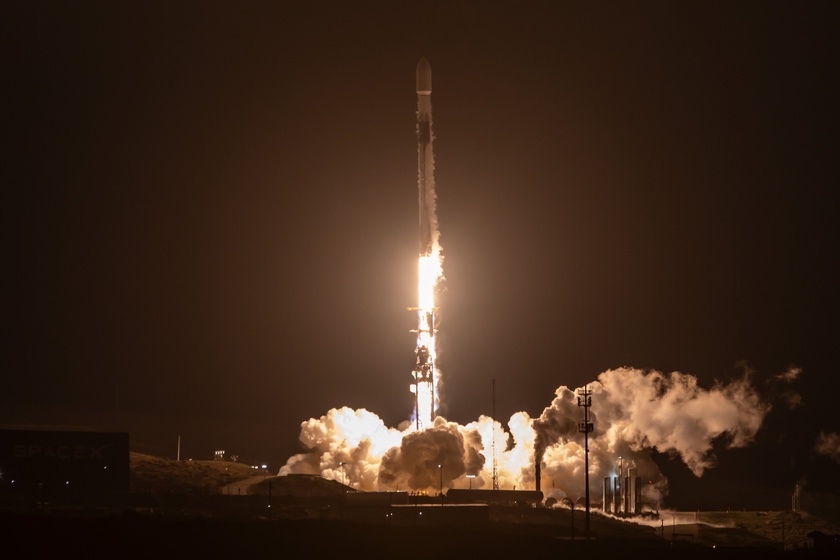
SpaceX Falcon 9 launched 21 data transport satellites for the U.S. military on Saturday (Oct. 10), at 0739 UTC from Space Launch Complex 4E, Vandenberg Space Force Base, on the SDA T1TL-A mission, the fourth dedicated to assembling the Space Development Agency’s Tranche 1 architecture, part of the broader Proliferated Warfighter Space Architecture network.
This mission marked the sixth flight of the first-stage booster, B1103, which successfully landed as planned at Landing Zone 4 approximately seven minutes after liftoff. This was the 111th Falcon 9 flight of the year. The vast majority of these — more than 70% — have helped build out SpaceX's Starlink broadband megaconstellation, which currently consists of more than 11,000 satellites.
The 21 satellites on Saturday's mission, manufactured by Northrop Grumman, were deployed into low Earth orbit to expand the mesh network of optically connected satellites that provide global military tactical communications and missile warning capabilities.
Today's launch helps build out the SDA's Proliferated Warfighter Space Architecture (PWSA), which SpaceX describes as "a mesh network of optically connected satellites in low Earth orbit [LEO] that enable global military tactical communications and missile warning, indication and tracking capabilities."
The liftoff was the fourth of nine that SpaceX will conduct to help assemble the architecture's Tranche 1 — the "initial warfighting capability tranche," according to the SDA.
Tranche 1 will eventually consist of 154 operational satellites in LEO — 126 data-transport spacecraft and 28 missile-tracking vehicles. There will also be four missile-defense test satellites, which will sport a "higher fidelity" infrared sensor than their tracking counterparts, SDA officials wrote. (Missile-tracking satellites generally hunt for the heat signatures these weapons produce during flight).
Eighty-four of the 126 data-transport satellites for Tranche 1 have now launched to date, all of them on Falcon 9s, which lifted off from Vandenberg in September 2025, October 2025, July of this year and today.
Saturday's deployment advances the U.S. Space Force’s goal of establishing a resilient, proliferated satellite infrastructure for missile tracking and data relay.
"SDA leverages spiral development to deploy and proliferate new capability into a new generation of the PWSA every two years, called a 'tranche,' to continually increase capability used by the warfighter," SDA officials wrote in a Tranche 1 fact sheet.