keneci Network
News • Comedy • Science & Tech
Trump Secretly Switched Planes In Turkey Over Iran Assassination Threat Following NATO summit: Report
post photo preview

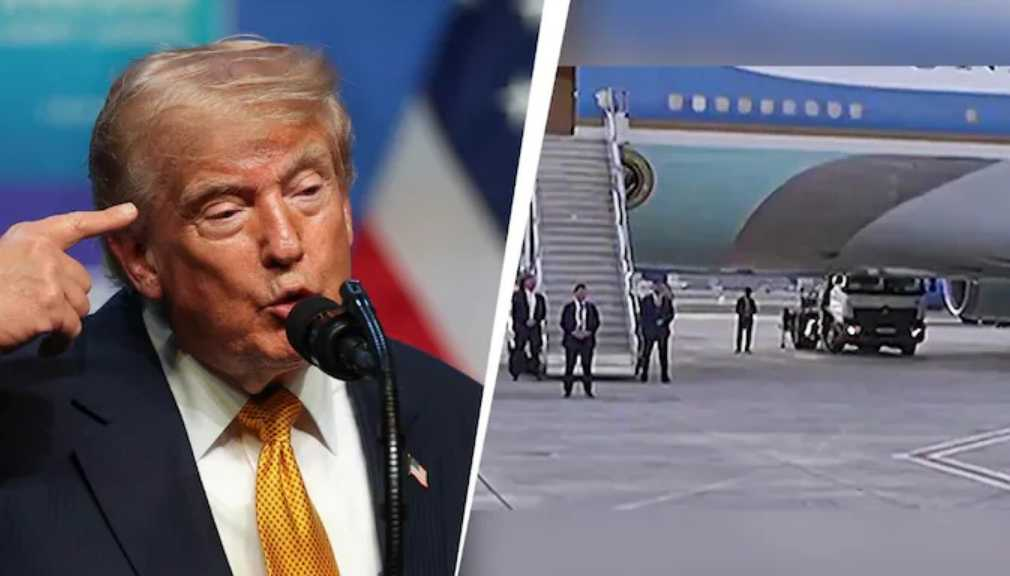
At the end of the NATO summit on July 8, 2026, U.S. President Donald Trump secretly departed Turkey, aboard a small military jet reportedly after being smuggled off Air Force One in an airport catering truck, an elaborate deception operation triggered by an Iranian assassination threat.

"I go by Secret Service and the military" Trump told the media Tuesday responding to the reports. "They wanted me to go on a different flight, a different plane... I do what they say... I guess there was a threat out there. I didn't really ask too much about it. I get a lot of threats."

Unconfirmed intelligence reportedly shared by Israel indicated a plot to shoot down the presidential plane using shoulder-fired missiles, prompting the Secret Service to move the president to an unmarked Air Force C-32A while the older Air Force One served as a decoy with journalists and staff still on board.

Footage captured by the news media at the Ankara Esenboga Airport shows a staircase on one side of the legacy Air Force One and the catering truck on the other, with its container elevated to the level of the plane. Trump arrived in a limousine, climbed the staircase and waved toward the tarmac as he boarded.

After publicly boarding the legacy blue Air Force One in view of cameras and speaking to reporters, Trump and a small group of aides entered a hydraulic catering vehicle raised to a rear door on the opposite side of the aircraft.

The catering truck drove across the tarmac to the waiting C-32A, which flew under the call sign "Reach 18" with its transponders off to RAF Mildenhall in the UK. Upon landing, Trump was secretly transferred back to the main Air Force One to disembark in front of photographers, maintaining the illusion that he had flown on the decoy plane the entire time.

The blue-and-white C-32A, a modified Boeing 757 used to transport U.S. government officials, had been flown to Turkey along with the legacy Air Force One and the former Qatari jet to support the president’s visit. Like Air Force One jumbo jets, it is emblazoned with the words “United States of America” and can be used to transport the president or vice president. But it typically does so with the “Air Force One” or “Air Force Two” call sign, not a nondescript moniker.

Defense Secretary Pete Hegseth boarded the C-32A separately using external stairs, reportedly part of an attempt to make the flight appear typical. Hegseth flew with Trump to Britain on the same plane.

The assassination threat emerged during heightened hostilities between the U.S. and Iran following American strikes inside Iran, with Trump previously saying he was Iran's "number one target."

Although the president had announced on Truth Social that he would fly the older jet "for old time's sake" instead of the new Boeing 747-8 gifted by Qatar, the actual switch to the smaller military aircraft was kept secret from most White House staff and the traveling press corps, who were asked to lower window shades during the departure.

After greeting U.S. service members at RAF Mildenhall, the president embarked on the newly gifted Air Force One to travel back to Washington, with staff and press aboard after a transfer from the legacy Air Force One, at about 11:01 p.m. A social media post from the White House posted that night said that Trump had landed at the British base “aboard the former Air Force One,” and included a picture of the legacy plane.

Aboard the new Air Force One, Trump spoke to journalists for about 15 minutes, highlighting the threat Iran poses but not acknowledging the deception operation that had occurred earlier.

Though the 747 jumbo jets that carry the president are commonly referred to as “Air Force One,” the term is technically an air-traffic-control call sign for any plane on which the president is aboard. In this instance, however, the president’s whereabouts were obscured on the C-32A flight to Britain using the nondescript call sign “Reach 18” or “RCH18.”

Asked why reporters had been instructed to lower the window shades on the plane in Turkey, Trump said that it was “because you’re probably on a dangerous flight because of the sleaze bags that we have to deal with.” The president said that he has a “threat all the time” against his life, and that he is “number one” on Iran’s “list.”

“But if I go, you go. Right?” Trump suggested to reporters. “Perhaps someday you want to change professions.”

“As the President has said recently, there are many enemies of America who have their sights on him, and we use every tool at our disposal to address those threats,” White House communications director Steven Cheung said in part in a statement.

Ronald L. Rowe Jr., a former acting director of the Secret Service, said that the president’s protection is paramount and that the details of his movements are shielded for good reason. “We need to keep the ‘secret’ in Secret Service,” Rowe said, now with the Chertoff Group, a security advisory firm. “The public should know what the president is doing on a daily basis, but when it comes to the methods by which the Secret Service keeps the president safe, that should remain out of public view.”

According to former US officials, there have been other times in the last 30 years when Air Force One served as a decoy for the president because of a serious threat or because he was flying to a dangerous location. The legacy jet is highly secure, but also highly visible, so putting the president on an alternate plane instead can be considered safer, officials say.


community logo
Join the keneci Network Community
To read more articles like this, sign up and join my community today
0
What else you may like…
Videos
Posts
Articles
SpaceX Starlink Internet Satellites

With Starlink internet, data is continuously being sent between a ground dish and a Starlink satellite orbiting 550km above. Furthermore, the Starlink satellite zooms across the sky at 27,000 km/hr! MORE VIDEOS ON KENECI NETWORK RUMBLE CHANNEL: https://rumble.com/c/Keneci

00:28:08
Elon Musk, DOGE Speak On Waste And Fraud

US Department of Government Efficiency Services (USDS) led by Elon Musk speak on the "mind-boggling" fraud and waste in UInited States federal government

00:00:45
January 17, 2025
SpaceX Launches Starship 7th Test Flight

SpaceX successfully executed its second-ever “chopsticks” catch of a Super Heavy booster (or Booster 14) using the “Mechazilla” launch tower on Thursday(Jan. 16), during the seventh uncrewed test flight of the company's 123-meter Starship rocket. However, the megarocket's upper stage(or Ship 33) was lost approximately 8.5 minutes into the flight in a “rapid unscheduled disassembly(RUD)” or explosion

00:10:30
Welcome to Keneci Network!

Join the conversations!

December 09, 2025
Bitcoin White Paper By Satoshi Nakamoto

Bitcoin white paper

Bitcoin_White_Paper.pdf
September 17, 2024
Charges Against Sean 'Diddy' Combs In Grand Jury Indictment

The rapper was charged with racketeering conspiracy, sex trafficking by force, fraud or coercion, and transportation to engage in prostitution in the indictment unsealed Tuesday(Sept. 17)

Combs-Indictment-24-Cr.-542.pdf
post photo preview
British Royal Navy K3 Scout Drone Cameras Secretly Sent Data To China

Cameras on Royal Navy K3 Scout surveillance drones were discovered transmitting data to a Chinese IP address, raising significant security concerns despite official denials of a data breach.

The incident involves K3 Scout uncrewed surface vessels, a $16 million (£12 million) fleet supplied by British defense contractor Kraken Technology Group and used by the Royal Marines and Special Boat Service (SBS) since March 2026.

The K3 Scout model, designed to carry a 600 kilogram(kg) payload and operate continuously for 30 days, has also been purchased by the US Special Operations Command and has participated in Nato trials in the Baltic.

The vulnerability originated in third-party cameras containing Chinese-made components, which were sent to the drones with assurances of security and compliance with the US National Defense Authorization Act (NDAA).

During a routine cyber vulnerability assessment, analysts detected that these cameras were sending automated "heartbeat communications"—small data packets confirming the devices were online and functioning normally—to an unauthorized IP address in China. The Ministry of Defense (MoD) subsequently cut internet connectivity to the cameras to contain the breach.

An MoD spokesman said: “A routine cyber vulnerability assessment identified an issue affecting a Kraken Unmanned Surface Vessel sub-system used by the Royal Navy. A thorough investigation found no evidence of MoD data or systems being accessed, compromised or transmitted externally.

“Our assurance and testing processes are designed to identify and address potential vulnerabilities early, and we continue to undertake routine security activity across our systems and equipment.”

While the MoD and Kraken insist there is no evidence that sensitive military data, reconnaissance imagery, or classified systems were accessed or exfiltrated, the incident has exposed critical flaws in defense supply chain auditing.

A Kraken Technology Group spokesman said: “We are aware that some third-party, NDAA-compliant cameras had a small number of components originating from outside the UK.

“After a full audit by both Kraken and the Royal Navy we are confident no sensitive information has ever been shared outside of intended channels and any potential vulnerabilities have been identified and closed.”

The drones had operated near the SBS headquarters in Poole, Dorset, and were involved in preparations for potential missions in the Strait of Hormuz, leading to fears that metadata regarding operational schedules and locations may have been compromised.

A joint audit by Kraken and the Royal Navy confirmed no sensitive information left authorized channels, but the discovery has triggered calls for stricter component origin checks in military procurement.

Alicia Kearns, the shadow security minister, said: “If we cannot say with confidence what is inside our own military equipment, we cannot say it is ours, or that we are sovereign.

“When cameras built on Chinese parts are found recording our special forces – their faces, training and operations – we should not be surprised, we should be furious that we still haven’t woken up to the realities of the threat we face.”

UK has begun a diplomatic reset with China through a series of high-profile visits to the country, with the hope of lucrative trade agreements. Earlier this year, Downing Street approved plans for a Chinese super-embassy at Royal Mint Court in the heart of London, despite concerns about the site’s proximity to sensitive communication lines.

Read full Article
post photo preview
Michibiki 7: Japanese H3 Rocket Launches Navigation Satellite, QZS-7

Japan space agency, JAXA successfully launched the H3 rocket (Flight 9) from the Tanegashima Space Center at 1923 UTC, on Monday  (Aug. 11), carrying the 4,898-kilogram Michibiki 7 (QZS-7) navigation satellite.

The rocket launch which occurred after delays caused by Typhoon 13, utilized the standard H3-22 configuration (two LE-9 engines and two SRB-3 solid rocket boosters) and the upper stage successfully deployed the satellite into its target orbit about 29 minutes after liftoff.

This mission marks a critical milestone for Japan’s space program, as Michibiki 7 adds to the Quasi-Zenith Satellite System (QZSS) constellation.

"This system is compatible with GPS satellites and can be utilized with them in an integrated fashion," Japanese officials wrote in a description of the QZSS project. "QZSS can be used even in the Asia-Oceania regions with longitudes close to Japan, so its usage will be expanded to other countries in these regions as well."

The QZSS network will eventually consist of 11 satellites, if all goes according to plan. With seven satellites about to be in orbit following Monday's launch, QZSS transitions from a GPS augmentation service to a fully independent regional navigation system, ensuring at least four satellites are simultaneously visible over Japan at all times for high-precision positioning.

Michibiki 7 is carrying a payload for the United States as well — the Situational Awareness Camera Hosted Instrument (SÃCHI), which was developed for the U.S. Space Force by the MIT Lincoln Laboratory. This is the second of two SACHIs to go up on a QZSS satellite; Michibiki 6, which launched atop an H3 in February 2025, hosts the other one. (Yes, Michibiki 6 launched before Michibiki 5.)

"This program will allow the United States to monitor satellite behavior within the GEO belt over a very interesting part of the world," Mark Huber, a technical staff member in the Lincoln Laboratory's Space Systems and Technology Division, said in a statement in December 2020.

"It is also a pathfinder in several ways," he added. "The U.S. team is blueprinting methods to allow sensitive data sharing between the United States and Japan."

The H3 — which stands 57 or 63 meters tall, depending on what type of payload fairing it employs — debuted in March 2023 and had eight liftoffs under its belt before today's launch which serves as the second consecutive success for the H3 rocket following a major setback in December 2025.

That December 2025 failure, which involved the launch of Michibiki 5 mission, was caused by an anomaly in the second-stage engine that prevented the satellite from reaching orbit. The June 2026 return-to-flight mission--which successfully delivered 6 satellites--tested a new low-cost H3-30S variant, while Monday's flight confirmed the reliability of the standard configuration, restoring Japan’s primary launch capability after last year's retirement of the workhorse H-2A rocket.

Read full Article
post photo preview
China's Long March 7A Rocket Explodes 85 Seconds After Liftoff During CASC Mission

The Long March 7A rocket launched at 1200 UTC, Monday, (Aug. 10), by China Aerospace Science and Technology Corporation (CASC) from the Wenchang Space Launch Site in Hainan, China, suffered a catastrophic failure about 85 seconds after liftoff. Video reposted to social media captured the shock of onlookers the moment that the rocket burst into flames.

The failure occurred during the joint burn phase of the first stage and boosters, specifically involving the YF-100 engines, which has triggered a fleet-wide investigation potentially impacting other missions like Chang'e 7.

The explosion generated a massive fireball and debris cloud over the South China Sea, resulting in the total loss of the vehicle and its payload, the China's Zhongxing-4B communications satellite, presumably bound for geostationary transfer orbit(GTO). China's Zhongxing satellites provide telecommunications and broadband internet services and are also thought to provide services for China's military.

The Long March 7A's four side boosters and core stage detach as a full cluster during first stage separation, which typically occurs just under three minutes after liftoff. As today's incident occurred just 85 seconds into flight, the rocket was still engaged in the main stage's initial engine burn to escape Earth's atmosphere.

Monday's incident marks the second in-flight failure for the Long March 7A since its debut in 2020, ending a streak of 16 consecutive successful missions. The debut launch also ended with the vehicle's explosion. China traced that mishap to an engine malfunction that occurred shortly after first-stage separation. This morning's launch, however, didn't get that far.

A Chinese Zhuque-3 rocket is scheduled for liftoff Monday evening to fly from China's Jiuquan Satellite Launch Center, 2,415 kilometers from Wenchang, at 2345 UTC, and is expected to feature a first-stage landing attempt. It is unclear what repercussions Monday's explosion may have on the mission.

CASC uses the standard Long March 7 rocket, which shares its core stage with the 7A, as its launch vehicle for delivering cargo to the Tiangong space station in low Earth orbit about every eight months. The most recent of those missions launched in May, putting the next resupply launch sometime around January 2027 which may face delays due to Monday's explosion.

Read full Article
See More
Available on mobile and TV devices
google store google store app store app store
google store google store app tv store app tv store amazon store amazon store roku store roku store
Powered by Locals