Donald Trump Monday, announced on Truth Social that the U.S. is reinstating the "Iranian Blockade" on the Strait of Hormuz, declaring the waterway "OPEN, and will remain OPEN, with or without Iran." The President stated the measure targets only Iranian ships or customers, while all other nations retain "fair and open use" of the strategic corridor.
The president declared the U.S. will act as the "Guardian of the Hormuz Strait" and demanded a 20% reimbursement on all cargo shipped to cover security costs, asserting the process would begin immediately. However critics point out that Iran's Revolutionary Guards Corp (IRGC) controls ship transit through the strait by firing missiles on ships that try to take the US-supported route off the Omani coast.
"The Hormuz Strait is OPEN, and will remain OPEN, with or without Iran. We are reinstating THE IRANIAN BLOCKADE, so named because it is only stopping Iran's ships or customers from entering or leaving. All other countries will have fair and open use of the Strait," Trump wrote on Truth Social. "The U.S.A. will be, from this point forward, known as 'THE GUARDIAN OF THE HORMUZ STRAIT,' but as such, and as a matter of FAIRNESS, will be reimbursed, at the rate of 20% on all cargo shipped, for any and all costs necessary to do the job of providing safety and security to this very volatile section of the World. The process and formation will begin immediately."
Earlier in the day, during a phone interview on Fox News, Trump claimed, "We’re taking over the strait... We’re going to get paid for guarding it—a lot of money," suggesting wealthy Gulf nations should reimburse the U.S. for keeping the channel secure.
The reinstatement follows a breakdown in a 60-day truce and a weekend of intensified tit-for-tat missile and drone strikes between the U.S. and Iran, sparked by attacks on commercial shipping off the coast of Oman. Sunday's strikes marks the first combat use of U.S. unmanned surface vessels (Corsair drones) to strike facilities at the Bandar Abbas Naval Base.
In response, Iran declared the Strait closed, with the Revolutionary Guard vowing to prevent "illegal interference" by U.S. forces, while Iranian Foreign Ministry officials accused Washington of undermining the interim peace agreement.
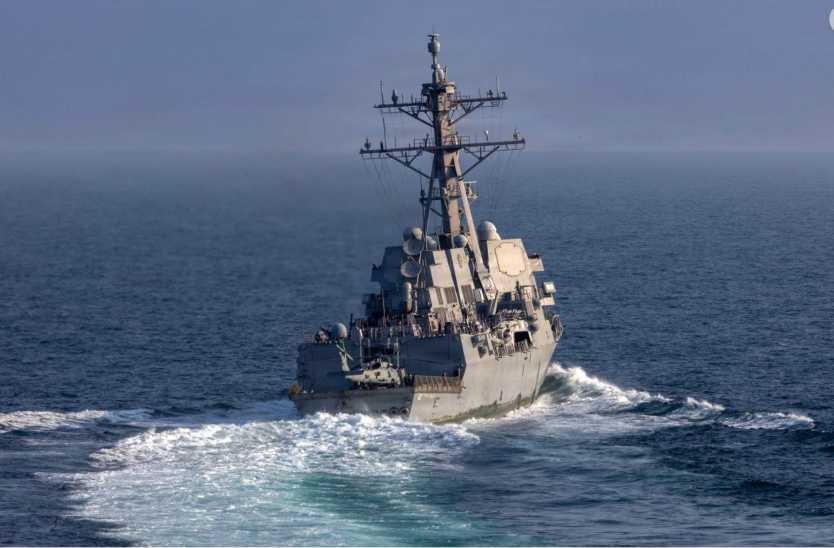
The U.S. Central Command (CENTCOM) confirmed via X post, that enforcement of the naval blockade against all Iranian ports and coastal areas will commence on Tuesday, July 14, at 4 p.m. ET (2000 UTC). The military command warned that neutral vessels must depart the blockaded zone before the deadline, stating that any ship suspected of entering or leaving without authorization faces interception, diversion, and capture.
CENTCOM emphasized that the Strait of Hormuz is a vital maritime corridor for global trade and that Iran does not control it, following recent U.S. strikes on Iranian air-defense systems, radar sites, and drone capabilities.
TThe Strait of Hormuz is the most vital chokepoint in the global energy market, carrying roughly 20% of the world's petroleum and liquefied natural gas (LNG).
Iranian Foreign Minister Abbas Araghchi responded with dry sarcasm on social media. While mockingly agreeing that safe passage "should be compensated," he declared that Iran is and will remain the sole "GUARDIAN of the Strait". He added that Trump's proposed "20% is of course too much." Meanwhile, Iranian military commanders warned Gulf nations that providing logistical support to the U.S. blockade would be treated as "an act of war."
Maritime legal experts and international allies have raised concerns over Trump's plan to levy a 20% fee on transiting cargo. Historically, the U.S. has fiercely defended the Strait as an open international waterway free of transit fees. Implementation of a toll would likely trigger immense legal battles and push global energy prices higher.
However political observers and critics say that Trump appear to be flailing and "stuck" in the messy conflict with Iran, dismissing his social media post about a 20% transit fee as a desperate and provoctive rhetoric aimed at making the president appear in control of events on the ground in the strait.
Key importing nations in Asia, such as India, South Korea, and Thailand, are highly vulnerable to prolonged disruptions in the Strait. Previous weeks of the blockade in the spring of 2026 reportedly cost the Iranian economy billions, but also drove up global shipping insurance and fuel prices.