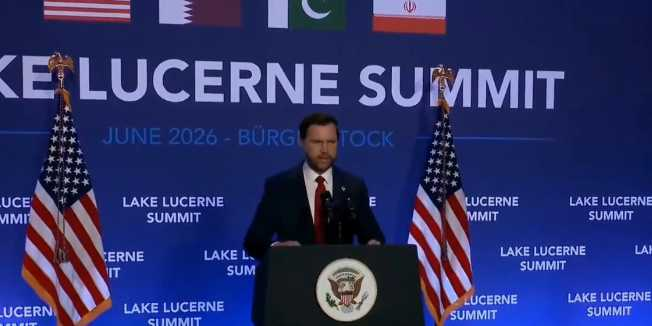
Vice President JD Vance declared "great progress" in U.S.-Iran talks held in Switzerland, confirming that Tehran agreed to allow International Atomic Energy Agency (IAEA) inspectors back into the country as a "major milestone" toward ending its nuclear weapons program. He said his team unsuccessfully attempted to call nuclear inspectors at 2:00 AM during the crunch talks.
Despite acknowledging "threatening and whining" from Iranian officials and social media threats to walk out over President Trump's threat on social media, Vance said negotiations continued past 1:00 AM, laying a "very good foundation" for a final deal within 60 days.
Vance declared that the two sides have established a "very good foundation" for a permanent settlement within a 60-day negotiating window, as he outlines the following four significant breakthroughs and systemic milestones achieved during the initial round of talks.
Return of IAEA Nuclear Inspectors: In what Vance called a "major milestone" and the first step toward permanent denuclearization, Iran formally agreed to invite International Atomic Energy Agency (IAEA) inspectors back to its nuclear sites. Inspections could resume immediately to identify and monitor enriched materials.
The "Kushner Plan" for Unfrozen Assets: Addressing Iran’s core demand to unfreeze billions in foreign assets, U.S. negotiator Jared Kushner (working alongside Qatari officials) proposed a strict conditional mechanism. Under this framework, released funds cannot be used to fund terrorism; instead, they will be legally restricted to purchasing U.S. agricultural exports—specifically soybeans, wheat, and corn—to directly benefit the Iranian civilian population.
Securing the Strait of Hormuz: De-escalation mechanisms were locked in to ensure that the vital maritime trade route remains open to international shipping, rolling back global economic shockwaves caused by its earlier closure.
Establishment of a 60-Day Technical Roadmap & Deconfliction: The nations agreed to form a High-Level Committee for political oversight and a technical "deconfliction cell." This framework sets a firm 60-day timeline (extending to August 16) to finalize a durable treaty, handle the termination of military operations in Lebanon, and iron out the fine details of sanctions relief.
Allegations that Qatari Prime Minister Sheikh Mohammed bin Abdulrahman Al Thani snubbed Vance by greeting Pakistan's Prime Minister Shehbaz Sharif but ignoring the Vice President were dismissed by U.S. officials as "complete nonsense."
The brief footage captured Prime Minister Al Thani and Iranian Foreign Minister Abbas Araghchi entering a room and warmly embracing Pakistani Prime Minister Shehbaz Sharif, while completely bypassing Vance, who was standing toward the back of the room. No joint four-way photo-op was held, adding fuel to the social media narrative.
Officials including Vance and Al Thani clarified that the interaction was impromptu and that the delegations had already spent hours together, negating the need for a staged re-greeting.
US Temporarily Lifts Sanctions On Iran's Oil Sales Amid Peace Talks
The U.S. Department of the Treasury issued a temporary 60-day general license on Monday, authorizing the production, delivery, sale, and import of Iranian crude oil, petroleum products, and petrochemicals. This waiver, effective until 12:01 a.m. EDT on August 21, 2026, is part of an interim agreement reached during talks in Switzerland.
Treasury Secretary Scott Bessent announced the decision on X saying: "In line with the ongoing productive talks in Switzerland, Iran has committed to free and open transit in the Strait of Hormuz and to permit International Atomic Energy Agency (IAEA) inspectors into their country. As part of the framework, Treasury has issued a temporary 60-day general license authorizing the production, delivery, and sale of Iranian oil."
The license also permits U.S. dollar-denominated payments to Iran for these transactions and covers essential support services like maritime transport, insurance, and financial processing. However, the exemptions do not extend to North Korea, Cuba, or Crimea, which remain under strict sanctions.
The waiver fulfills a pledge in a memorandum of understanding signed the previous week between Washington and Tehran, following mediation by Qatar and Pakistan at the "Lake Lucerne Summit" in Buergenstock, Switzerland.
In exchange for sanctions relief, Iran agreed to ensure free transit through the Strait of Hormuz and allow IAEA inspectors back into the country.
Prior to the waiver, Iranian oil exports had cratered from 1.5 million barrels per day to roughly 260,000 barrels per day due to a U.S. naval blockade; the announcement contributed to a drop in global oil prices.
This marks a significant shift, as the U.S. has not meaningfully imported Iranian oil since sanctions were first imposed following the 1979 revolution.