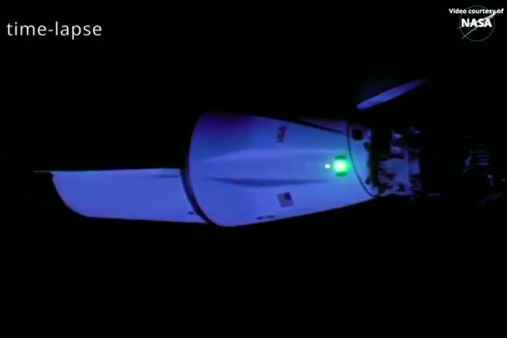
SpaceX CRS-34 delivered 6,500 pounds of cargo to the International Space Station on Sunday (May 17), after launching on May 15 from Cape Canaveral. The Cargo Dragon C209 spacecraft autonomously docked to the Harmony module’s forward port at 1037 UTC, with the arrival monitored by NASA astronaut Jack Hathaway and ESA astronaut Sophie Adenot from inside the space station Cupola.
"Dragon contact and soft capture complete," Hathaway reported to Mission Control.
Hathaway and Adenot, together with their Expedition 74 crewmates, will spend the next few weeks unpacking the craft of its nearly 6,500 pounds of cargo and then repacking it with science results, returning hardware and refuse for the trip back to Earth in mid-June.
Key CRS-34 Dragon scientific payloads include STORIE, a joint NASA-U.S. Space Force instrument to study ring currents and space weather impacts on power grids; Green Bone, which tests a rattan wood scaffold for osteoporosis treatments in microgravity; and SPARK, which investigates red blood cell and spleen changes to understand space anemia.
Among the science delivered include "a project to determine how well Earth-based simulators mimic microgravity conditions; a bone scaffold made from wood that could produce new treatments for fragile bone conditions like osteoporosis; and equipment to help researchers evaluate how red blood cells and the spleen change in space," according to a NASA media advisory.
CRS-34 Dragon will remain docked for approximately one month, after which it will splashed down in the Pacific Ocean in mid-June. It will return critical science results, including an ocular imaging device, a sorbent bed for air filtration, and the Advanced Plant Habitat for museum display, alongside other returned hardware.
This mission marks the 34th Commercial Resupply Services (CRS) flight for SpaceX and sets a new record as the sixth flight for the C209 capsule.
=================
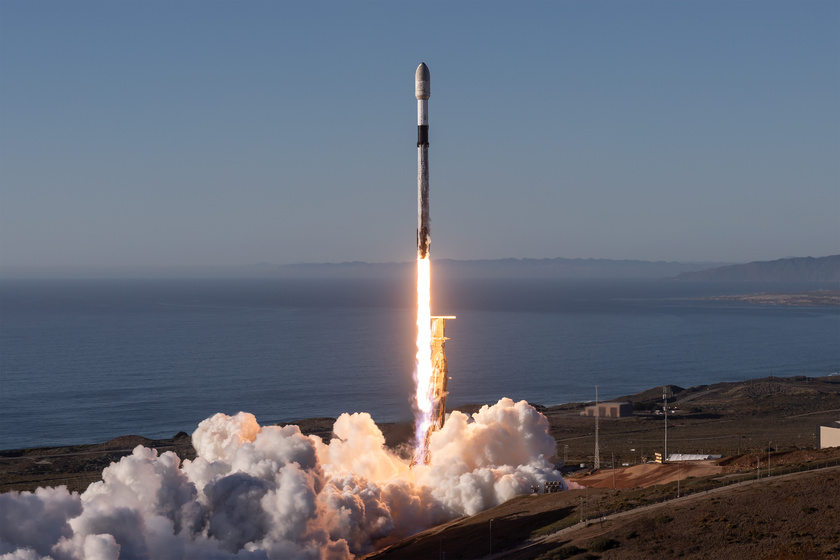
SpaceX launched a Falcon 9 topped by a Cargo Dragon spacecraft with 6,500 pounds (2,950 kilograms) of supplies and science experiments, on Friday, (May 15), at 2205 UTC from Launch Complex 40 at Cape Canaveral Space Force Station on the CRS-34 mission to the International Space Station (ISS) for the Expedition 74 crew.
The Falcon 9 first stage separated two and a half minutes after liftoff and landed at Landing Zone 40 near the launch pad. The Dragon spacecraft separated from the second stage 9 minutes and 20 seconds after launch. The spacecraft is expected reach the ISS at about 1100 UTC on Sunday, May 17, 2026, where it will perform an automated rendezvous, docking with the forward port of the Harmony module.
CRS-34 is the sixth spaceflight for this particular Dragon capsule — a new record for a SpaceX cargo craft. One of the company's astronaut-carrying Crew Dragon capsules, named Endeavour, also has six missions under its belt. CRS-34 mission is so named because it's the 34th flight that SpaceX has conducted for NASA's Commercial Resupply Services program.
Dragon is loaded up with about 2,950 kilograms of supplies, hardware and scientific experiments for CRS-34. Among the scientific gear are "a project to determine how well Earth-based simulators mimic microgravity conditions, a bone scaffold made from wood that could produce new treatments for fragile bone conditions like osteoporosis, and equipment to evaluate how red blood cells and the spleen change in space to protect future astronauts," NASA officials wrote in a CRS-34 media advisory.
The capsule will stay attached to the ISS for just a month, coming back down to Earth in mid-June "with time-sensitive research and cargo, ahead of splashing down off the coast of California," NASA officials wrote. Dragon is the only ISS resupply ship that can haul material down to Earth. The other three operational robotic freighters — Japan's HTV-X, Russia's Progress and Northrop Grumman's Cygnus — are all designed to burn up in Earth's atmosphere when their time in orbit is up.
CRS-34 launch was delayed by three days due to inclement weather, including thunderstorms and anvil cloud violations that scrubbed attempts on Tuesday, May 12, and Wednesday, May 13. The successful Friday launch allowed ground crews to reload "late load" items with short shelf lives and provided a fresh phasing opportunity for the spacecraft to rendezvous with the station.