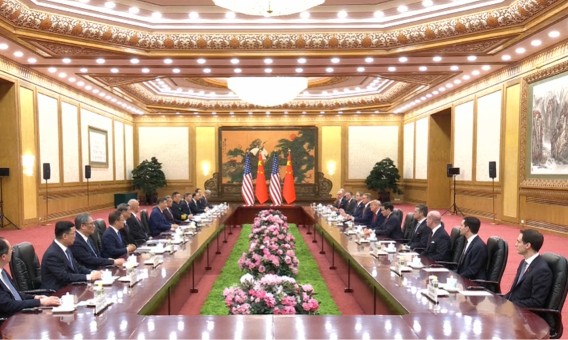
President Donald Trump and Chinese President Xi Jinping concluded their summit at Zhongnanhai on Friday, with Trump calling the talks “very successful, world-renowned, and unforgettable,” while Chinese state media described the visit as “historic and landmark.” The two leaders held a final bilateral meeting over tea and a working lunch among the rose gardens of Zhongnanhai, the secluded leadership compound in Beijing, before Trump departed from Beijing Capital International Airport following a brief tarmac ceremony.
Trade, Iran, and the Strait of Hormuz were central themes, though few concrete agreements were disclosed. Trump claimed the U.S. and China had reached “fantastic trade deals,” including a Chinese commitment to purchase 200 Boeing jets and increased imports of American oil and agricultural goods. However, Beijing did not confirm these deals, and markets reacted negatively, with Chinese stocks falling over 1%.
On Iran, Trump claimed the two leaders “feel very similar” about ending the conflict, opposing Iran’s pursuit of nuclear weapons, and reopening the Strait of Hormuz, a critical oil shipping lane currently closed due to the war. The U.S. president added that Xi had pledged not to supply Iran with military equipment, calling it a “big statement,” while acknowledging China’s continued interest in buying Iranian oil.
"We did discuss Iran, Trump said. "We feel very similar about [how] we want it to end. We don’t want them to have a nuclear weapon. We want the straits open... We want them [Iran] to get it ended because it’s a crazy thing there." He noted Xi offered to help broker peace if possible and claimed that China opposes militarization or tolls on the strait.
Xi delivered a stark warning on Taiwan, saying in a closed-door session that mishandling the issue could push U.S.-China relations into “a very dangerous place” and result in “clashes and even conflicts.” This was echoed by China’s foreign ministry, which emphasized that the Taiwan issue must be “handled properly” to avoid jeopardizing bilateral ties.
Despite the tension, both leaders projected camaraderie, with Trump calling Xi a “great leader” and “friend,” and Xi suggesting that “Make America Great Again” could align with China’s “great rejuvenation.” No breakthroughs were announced on AI or semiconductor exports, and analysts noted the summit’s main achievement may have been maintaining a fragile trade truce rather than forging new agreements.
Trump departed Beijing after the formal airport ceremony with honor guard and send-off. He continued engaging with press en route and after he arrived in Washington D.C. The summit included other events like a Temple of Heaven visit and state banquet. The U.S. delegation included business leaders.
Both sides framed the visit positively for stabilizing relations, though analysts noted limited tangible progress on high-tension issues like Taiwan (where Xi warned of potential clashes) and no major AI or arms deal resolutions. Trump invited Xi to Washington; further follow-ups are expected.
=================
Chinese officials welcomed President Donald Trump with full state honors during his Wednesday visit to Beijing, including a red-carpet arrival ceremony at the airport led by Chinese Vice President Han Zheng, military bands, and around 300 students waving American and Chinese flags chanting "welcome" in Mandarin.
Trump, flanked by Defense Secretary Pete Hegseth, Secretary of State Marco Rubio, Treasury Secretary Scott Bessent, and family members including Eric and Lara Trump, was greeted with a 21-gun salute, goose-stepping honor guards, and a formal welcome at the Great Hall of the People in Tiananmen Square.
Top U.S. business leaders on the trip included Elon Musk (Tesla, SpaceX), Tim Cook (Apple), Larry Fink (BlackRock), and Jensen Huang (Nvidia), all present at the state banquet. Musk was seated prominently and attended with his son X Æ A-12. The delegation underscored the economic focus of the summit, with Trump emphasizing trade and investment.
At the welcoming banquet, Xi Jinping called the visit "historic" and stated that "the great rejuvenation of the Chinese nation" and "Make America Great Again" can go hand in hand, describing U.S.-China relations as the world’s most important bilateral relationship. Trump praised the "magnificent welcome like no other", called Xi a "great leader", and invited him and his wife Peng Liyuan to the White House on September 24, 2026.
Highlights of the ceremonies included a military band playing the U.S. national anthem, a troop review, cannon salutes, and a visit to the Temple of Heaven, where Trump called the site "great" and "incredible." Both leaders delivered cordial opening remarks, with Trump noting that he and Xi resolved past issues quickly via phone calls.
The summit focused on Iran war diplomacy, reopening the Strait of Hormuz, AI chip exports, and potential Boeing aircraft deals, though no sweeping trade agreement was announced.
During the visit on Thursday, a tense security dispute occurred when Chinese officials blocked an armed U.S. Secret Service agent from entering the Temple of Heaven, sparking an "intense standoff" that delayed access for nearly 30 minutes.
According to reports from journalists traveling with Trump, including AFP correspondent Danny Kemp and Fox News’ Peter Doocy, the confrontation involved "heated and physical" exchanges between U.S. and Chinese security personnel, with Doocy describing "one very physical standoff" over the agent’s firearm. A compromise was eventually reached, though details were not disclosed, and Trump’s schedule proceeded unchanged.
American reporters and staff also faced repeated clashes with Chinese officials, being briefly detained both during entry to the Temple of Heaven and after the event when attempting to rejoin the presidential motorcade. Chinese security reportedly tried multiple times to block U.S. press and White House staff from leaving designated areas, prompting a "spirited debate" and leading one American official to remark, “You guys have been terrible hosts.”
The incidents unfolded amid heightened security protocols, with U.S. officials operating under concerns of surveillance—many traveled with stripped-down devices, assuming all communications in China could be monitored.
The standoff revived memories of a 2017 incident during Trump’s earlier visit, when Chinese security blocked a U.S. military aide carrying the "nuclear football" from entering the Great Hall of the People, reportedly leading to brief shoving.
The White House and Secret Service did not comment, but former officials confirmed that U.S. personnel are routinely briefed that "everything is monitored" in China.
Despite the tensions, the summit continued as planned, with Trump and Xi discussing trade, Iran, Taiwan, and energy security, while projecting diplomatic pageantry.