keneci Network
News • Science & Tech • Comedy
Putin Offered Peace Deal With Ukraine At Alaska Summit With Trump, In Exchange For Donetsk Region, Ahead Of Zelensky's White House Visit
August 16, 2025
post photo preview

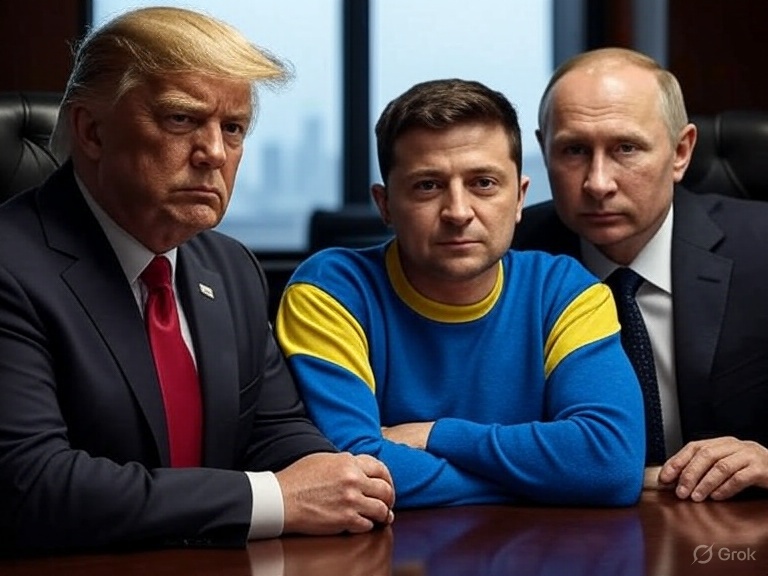
President Vladimir Putin reportedly told Donald Trump during their Alaska summit that Russia would agree to a peace agreement, rather than a temporary ceasefire, if Ukraine surrendered control of the Donetsk region, a demand that would require Kyiv to cede territory not currently under Russian occupation.

Putin reportedly offered to freeze the frontlines in Ukraine's south and make unspecified territorial concessions in the Sumy and Kharkiv regions in exchange for Ukraine ceding the entire Donetsk region, which is 70% occupied by Russia. He described the Alaska meeting as a "starting point for resolution" and emphasized Russia's "sincere interest" in ending the conflict.

Following the summit, Trump called Ukrainian President Volodymyr Zelensky and European leaders, and indicated that a trilateral meeting between himself, Zelenskyy, and Putin is forthcoming.

Zelensky, who was not invited to the summit, has made it clear he is not willing to discuss ceding any territory, especially land not already controlled by Russian forces, as he believes such a move would embolden further Russian aggression. He has demanded that any future negotiations include Ukraine and that Russia be held accountable.

The Ukrainian leader said he will meet with Trump in Washington, D.C., on Monday, and has warned that sanctions on Russia should be strengthened if a trilateral meeting does not occur or if Russia attempts to evade a genuine peace process.

Trump confirmed Zelensky's upcoming visit and declared that the best path to ending the war is a direct peace agreement, instead of a ceasefire.

"A great and very successful day in Alaska!" Trump wrote on Truth Social early Saturday. "The meeting with President Vladimir Putin of Russia went very well, as did a late night phone call with President Zelenskyy of Ukraine, and various European Leaders, including the highly respected Secretary General of NATO. It was determined by all that the best way to end the horrific war between Russia and Ukraine is to go directly to a Peace Agreement, which would end the war, and not a mere Ceasefire Agreement, which often times do not hold up. President Zelenskyy will be coming to D.C., the Oval Office, on Monday afternoon. If all works out, we will then schedule a meeting with President Putin. Potentially, millions of people’s lives will be saved. Thank you for your attention to this matter!"

On his part, Zelensky wrote on X"We had a long and substantive conversation with @POTUS. We started with one-on-one talks before inviting European leaders to join us. This call lasted for more than an hour and a half, including about an hour of our bilateral conversation with President Trump.

"Ukraine reaffirms its readiness to work with maximum effort to achieve peace. President Trump informed about his meeting with the Russian leader and the main points of their discussion. It is important that America’s strength has an impact on the development of the situation.

"We support President Trump’s proposal for a trilateral meeting between Ukraine, the USA, and Russia. Ukraine emphasizes that key issues can be discussed at the level of leaders, and a trilateral format is suitable for this.

"On Monday, I will meet with President Trump in Washington, D.C., to discuss all of the details regarding ending the killing and the war. I am grateful for the invitation.

"It is important that Europeans are involved at every stage to ensure reliable security guarantees together with America. We also discussed positive signals from the American side regarding participation in guaranteeing Ukraine’s security. We continue to coordinate our positions with all partners. I thank everyone who is helping."

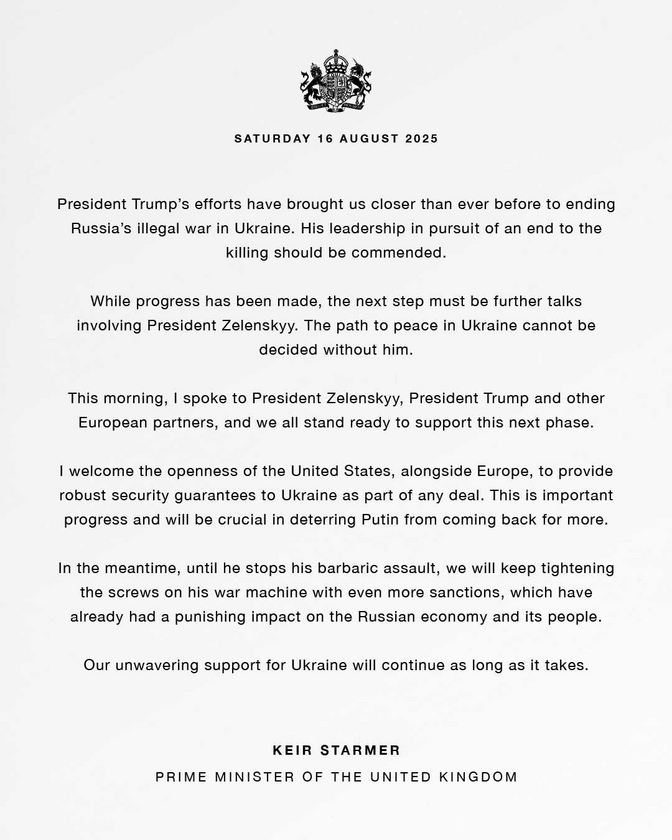
UK Prime Minister Keir Starmer in a statement Saturday also praised Trunp's effort to end the Ukraine-Russia war, and called for talks involving Zelensky.
 
Melania Trump's 'Peace Letter' To Putin

First Lady Melania Trump wrote a "peace letter" to Putin ahead of his meeting with her husband in Anchorage, Alaska, the first U.S.-Russia summit since June 2021, which was under former President Joe Biden’s administration and only eight months before Putin invaded Ukraine.

"Dear President Putin," the first lady’s letter begins. "Every child shares the same quiet dreams in their heart, whether born randomly into a nation’s rustic countryside or a magnificent city-center. They dream of love, possibility, and safety from danger."

"As parents, it is our duty to nurture the next generation’s hope," the letter continued. "As leaders, the responsibility to sustain our children extends beyond the comfort of a few."

"Undeniably, we must strive to paint a dignity-filled world for all—so that every soul may wake to peace, and so that the future itself is perfectly guarded," read the letter. "A simple yet profound concept, Mr. Putin, as I am sure you agree, is that each generation’s descendants begin their lives with a purity—an innocence which stands above geography, government, and ideology."

The first lady continued that "in today’s world, some children are forced to carry a quiet laughter, untouched by the darkness around them—a silent defiance against the forces that can potentially claim their future."

"Mr. Putin, you can singlehandedly restore their melodic laughter," the first lady wrote. "In protecting the innocence of these children, you will do more than serve Russia alone—you serve humanity itself."
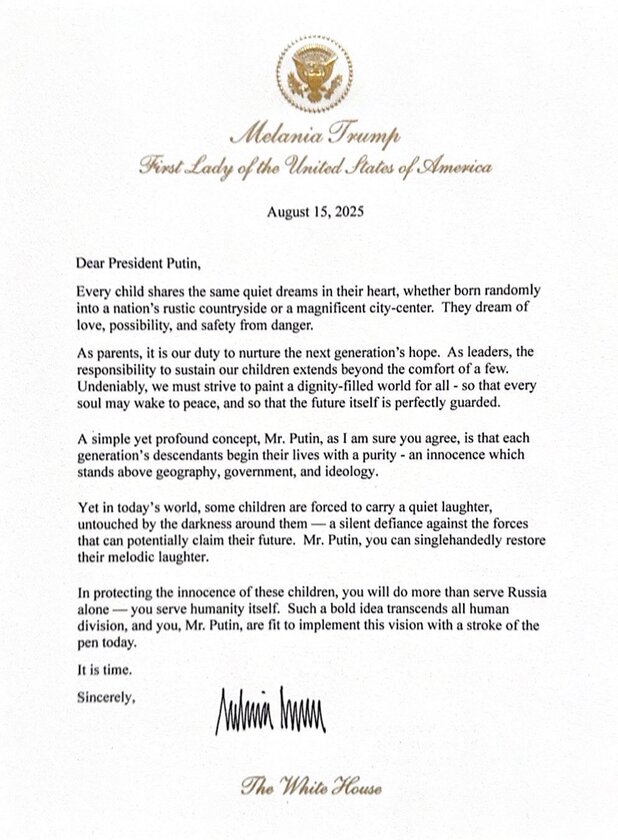
"Such a bold idea transcends all human division, and you, Mr. Putin, are fit to implement this vision with a stroke of the pen today," she wrote. "It is time."

=================

President Trump and Russian President Vladimir Putin held a summit on Friday, at Joint Base Elmendorf-Richardson in Anchorage, Alaska, for high-stakes discussions on Russia's war in Ukraine. The meeting lasted approximately three hours, beginning after 3 p.m. EDT when the two leaders greeted each other on the airport tarmac, and concluded around 7 p.m. EDT with a joint press appearance.

Trump described the talks as "very profound" and "extremely productive," stating that "many points were agreed to" and that he and Putin were in agreement on "most points". He acknowledged that "a couple of big ones" remained unresolved but expressed optimism, saying, "We have a very good chance of getting there". Trump emphasized, "There's no deal until there's a deal," and noted he would contact NATO leaders and Ukrainian President Volodymyr Zelenskyy to brief them on the discussions.

Putin also struck a positive tone, hinting that the two sides had reached "agreements," though he did not specify their nature. He stated that U.S.-Russia relations have "fallen to the lowest point since the Cold War" and claimed Trump wanted to address the "crux of the matter" in Ukraine.

The Russian leader asserted that the conflict relates to "fundamental threats to our security" and argued that lasting peace requires eliminating the conflict's root causes. He expressed hope that the agreements reached would serve as a starting point not only for resolving the Ukrainian issue but also for restoring "business-like and pragmatic relations" between the two nations.

Putin confirmed that the war in Ukraine would not have started if Trump had been president in 2022. He stated, "Today, when President Trump says that if he was President back then, there would be no war. And I'm quite sure that it would indeed be so. I can confirm that," adding that he had previously warned the Biden administration against allowing the situation to escalate to hostilities.

Neither leader took questions from reporters at the  Alaska press conference. Zelenskyy, who was not invited to the summit, had previously warned that "talks about us, without us, will not work" and told Western leaders he believed Putin was "bluffing" and did not genuinely seek peace. No plans for a follow-up meeting involving Ukraine were announced.

Speaking to Fox News' Sean Hannity after the press conference with Putin, Trump said Ukraine could possibly not agree to a deal with Russia because former President Joe Biden “handed out money like it was candy,” referring to the billions of dollars in military aid.

“I think we're pretty close to it. And look, Ukraine has agreed to it," Trump told Hannity. "Maybe they'll say no because Biden handed out money like it was candy. And Europe gave them a lot of money. You know, we gave $350 billion. Europe gave them much less, but still a lot. $100 billion.”

The United States has given Ukraine billions in military aid, weapons and training as since the war started. Ukrainian forces continue to battle Russian's military.

Trump said he believed the deal was close to being agreed upon but that “so many things can happen.”

“But I think President Putin would like to solve the problem," he said. "And it was a problem that should have never happened.”


community logo
Join the keneci Network Community
To read more articles like this, sign up and join my community today
0
What else you may like…
Videos
Posts
Articles
SpaceX Starlink Internet Satellites

With Starlink internet, data is continuously being sent between a ground dish and a Starlink satellite orbiting 550km above. Furthermore, the Starlink satellite zooms across the sky at 27,000 km/hr! MORE VIDEOS ON KENECI NETWORK RUMBLE CHANNEL: https://rumble.com/c/Keneci

00:28:08
Elon Musk, DOGE Speak On Waste And Fraud

US Department of Government Efficiency Services (USDS) led by Elon Musk speak on the "mind-boggling" fraud and waste in UInited States federal government

00:00:45
January 17, 2025
SpaceX Launches Starship 7th Test Flight

SpaceX successfully executed its second-ever “chopsticks” catch of a Super Heavy booster (or Booster 14) using the “Mechazilla” launch tower on Thursday(Jan. 16), during the seventh uncrewed test flight of the company's 123-meter Starship rocket. However, the megarocket's upper stage(or Ship 33) was lost approximately 8.5 minutes into the flight in a “rapid unscheduled disassembly(RUD)” or explosion

00:10:30
Welcome to Keneci Network!

Join the conversations!

December 09, 2025
Bitcoin White Paper By Satoshi Nakamoto

Bitcoin white paper

Bitcoin_White_Paper.pdf
September 17, 2024
Charges Against Sean 'Diddy' Combs In Grand Jury Indictment

The rapper was charged with racketeering conspiracy, sex trafficking by force, fraud or coercion, and transportation to engage in prostitution in the indictment unsealed Tuesday(Sept. 17)

Combs-Indictment-24-Cr.-542.pdf
post photo preview
Netanyahu Rejects Trump's Gaza Plan, As US Pushes To End Wars In Gaza, Iran, Lebanon

Israeli Prime Minister Benjamin Netanyahu has explicitly rejected US President Donald Trump's 15-point Gaza peace plan, declaring that the Israel Defense Forces (IDF) will not withdraw from any part of the Gaza Strip until Hamas is "genuinely disarmed."

Speaking at a cabinet meeting on Sunday, Netanyahu said, "Israel rejects the 15-point document," emphasizing that any disarmament must include "heavy weapons, lighter weapons, all weapons" and cannot be "fictitious."

Netanyahu also vowed that "as long as I am prime minister, no Palestinian state will be established," rejecting the plan's implications for governance in both Gaza and the West Bank.

The core disagreement centers on the sequence of actions outlined in the proposal by Trump's "Board of Peace." The US-backed plan envisioned a phased process where Hamas would surrender weapons to a new Palestinian technocratic administration in tandem with a gradual Israeli withdrawal.

Netanyahu adamantly opposes this simultaneity, insisting that no reconstruction or withdrawal can begin before the "complete dismantling and demobilization" of Hamas. While Hamas agreed to the roadmap to spare Gaza further war, it conditioned its implementation on Israel first halting attacks and withdrawing forces.

Political and diplomatic tensions inform Netanyahu's decision as he faces pressure from his Zionist extremist coalition ahead of October elections, political observers say.

Despite calling Trump a friend, Netanyahu asserted Israel's independence, stating, "We know how to stand our ground" on matters where US ideas are unacceptable to Israel.

Following Israel's pushback, the Board of Peace reportedly adjusted its language to suggest Israeli withdrawal would occur only after Hamas's disarmament is completed, though Netanyahu maintains the current document is still rejected. Hamas called on Trump to pressure Netanyahu to abide by the originally plan.

The disagreement comes as the gaps between Israeli and US interests widen. CENTCOM Commander Brad Cooper on his recent visit to the region, reportedly conveyed to Israeli leaders that the US is interested in ending the war in the three active theaters - Iran, Lebanon, and Gaza.

In Lebanon, the US reportedly wants the IDF to withdraw from additional points in the security zone in the south of the country, and in Gaza, to see progress, an end to assassinations and the entry of the multinational force, which now includes several hundred soldiers from Morocco and Uganda.

Netanyahu reportedly spoke on the phone with President Trump's envoy Jared Kushner and promised to give the 15-point plan a chance despite his skepticism and curb attacks on Gaza so that the process of demilirarization of Gaza can begin. Since then Israeli attacks on Gaza have decreased and the IDF is reportedly gradually moving back to the Yellow Line.

The Whote House is reportedly "not bothered" by Netanyahu's statement on the Gaza plan and sees it as part of the election season in Israel, saying they "have no problem with it as long as he continues to do what we ask - especially regarding restraining attacks in Gaza."

Read full Article
post photo preview
Iran Issues Sweeping Demands Before It Opens Strait Of Hormuz: US Must 'Correct Its Behavior'

Iran’s Supreme National Security Council (SNSC), led by Secretary Mohammad Bagher Zolghadr, on Saturday, issued a sweeping list of demands declaring that the Strait of Hormuz will not reopen until the United States "corrects its behavior."

These demands, published by Iranian state media, include permanently ending threats and hostilities against Iran and its regional allies, withdrawing all U.S. military forces from the region, lifting the naval blockade and sanctions, paying full war reparations, and unconditionally releasing frozen Iranian assets.

Iran effectively closed the Strait in retaliation for attacks by the U.S. and Israel, halting critical maritime trade and causing global energy prices to spike, with U.S. gas prices averaging $4.02. A temporary ceasefire memorandum signed in June collapsed over U.S. military interference. Tehran claims that after shipping restored to roughly 60% of pre-war capacity, the U.S. sought to establish unauthorized alternative routes and challenge Iranian management of the channel.

Iranian military continue to 'violating' vessels—including a Saturday Iranian missile strike on an Emirati-flagged tanker—underscoring the volatile environment surrounding the Strait of Hormuz through which roughly 20% of the world’s petroleum and natural gas normally flows.

SNSC's stated conditions include,

  1. A permanent cessation of U.S. threats and military actions directed at Iran probably directed at President Donald Trump who regularly threatens the Iranian government in apocalyptic terms.

  2. An immediate end to strikes and offensive military operations targeting Iran's allies across Lebanon, Palestine, Yemen, and Iraq.

  3. Complete termination of the U.S. naval blockade restricting Iranian ports.

  4. Full pullout of U.S. naval and air forces deployed in the immediate vicinity of Iran.

  5. Financial compensation paid by Washington for damages inflicted during the war.

  6. Complete lifting of economic sanctions and the immediate release of frozen Iranian assets abroad.

"Until America corrects its behavior, the Strait of Hormuz will not open," Zolghadr declared, emphasizing that Tehran views control over the waterway not merely as an economic mechanism, but as a core pillar of its geographic and strategic power.

Meanwhile, Iranian Foreign Minister Abbas Araghchi said Saturday, that negotiations with Oman are in the "final stages" and close to an agreement on managing shipping traffic, specifically regarding the determination of new transit routes.

Araghchi noted that the historical Traffic Separation Scheme (TSS) in the strait is no longer acceptable to Tehran. Iranian and Omani naval delegations have drafted maps for a temporary route along Oman's coast to serve as a bridge toward a permanent framework.

However, Araghchi cautioned that this bilateral deal alone is insufficient; the full reopening of the waterway remains contingent on the U.S. meeting Tehran’s conditions, which he attributed to Washington's alleged violation of the interim ceasefire memorandum signed in June.

Oman described talks as "positive and constructive" but warned that ongoing attacks on commercial vessels, such as the recent missile strike on UAE-owned ship, could derail progress.

The Trump administration has insisted on the complete, unhindered reopening of the Strait and rejected Iran’s attempts to charge transit fees or exercise unilateral control, viewing the Iranian demands as unlikely to be agreed upon.

While U.S. officials expressed optimism over a potential 30- to 60-day maritime truce, they warned that sanctions relief and unfreezing assets remain strictly tied to a broader peace agreement and nuclear compliance.

Zolghadr’s public hardline stance Saturday, follows unconfirmed reports of internal debates within Tehran. Reformist President Masoud Pezeshkian had supported the Omani diplomatic track to resolve the crisis and end economic isolation. However, hardline factions led by Zolghadr and Islamic Revolutionary Guard Corps (IRGC) commanders insist that the strait remain closed as leverage against U.S. pressure.

U.S. Vice President JD Vance told Fox News on Saturday: "We're talking to the Iranians, of course. We're trying to maximize the amount of oil and gas that is coming out of the Strait of Hormuz. We're just trying to make sure that we get what we need out of this particular conflict.

"We've destroyed their nuclear program, we've destroyed their conventional military, we've radically reduced their asymmetric military abilities, and right now, we're trying to see if they're willing to make the kind of long-term changes that would be necessary to have a better relationship with the United States—and if not, that's fine too. We're just going to keep on applying the pressure that we can apply and getting as much oil and gas out of the Middle East so that Americans can enjoy lower gas and energy prices."

Read full Article
post photo preview
Top US General Urges Trump To Seek Off-ramp From Iran War, Warns Escalation Risks Backfiring

General Dan Caine, Chairman of the Joint Chiefs of Staff, is reportedly privately seeking an "off-ramp" from the war with Iran, arguing that U.S. airpower alone cannot achieve President Donald Trump's objectives and that further escalation risks backfiring due to depleted munitions stockpiles, and the high probability of Iranian retaliation against U.S. forces and regional allies.

Caine reportedly coordinated with Vice President JD Vance, Secretary of State Marco Rubio, and CIA Director John Ratcliffe to present a unified view to Trump in a recent meeting, that the military conflict has reached a crossroads, prompting the administration to focus on a diplomatic solution that offers the president a "symbolic" win.

In a statement to CNN, a spokesperson for Caine said, “General Caine is an incredible asset to President Trump’s national security team, and the overwhelming success of Operations Epic Fury, Midnight Hammer, and Absolute Resolve speaks for itself.”

Caine and other administration officials were skeptical of a series of U.S. strikes on Iran late last month, where the U.S. bombed the country for at least 12 straight days.

“The only ones in favor of the operation were elements of CENTCOM,” a U.S. official reportedly said, noting that Israel also supported the effort to escalate hostilities. Eventually, the U.S. eased up on the strikes after Middle East allies told Trump the bombings were endangering the region.

In meetings with the president, Caine has made clear the potential downsides of continued U.S. actions in Iran, but he also reassured Trump that “we could absolutely wreck” the Iranians if he would like to proceed.

This push for disengagement comes as Iran and Oman finalize a deal to reopen the Strait of Hormuz, a strategic waterway Iran has restricted since the war began in February 2026. The Trump administration aims to transition from a military stalemate to a diplomatic breakthrough, using the reopening of the Strait as a tangible victory to justify ending the conflict to the American public.

The proposed Iran-Oman agreement establishes temporary inbound and outbound shipping lanes and sets a 60-day period for further negotiations, with the U.S. pledging to lift its blockade on Iranian ports once the deal is implemented. Under the plan, commercial vessels would enter the Persian Gulf via an Iranian-controlled route and exit through an Omani-controlled route.

The negotiations have resulted in broad agreement on a new transit framework, which Trump said on Friday,, could be announced "soon" as a pathway to ending hostilities.

The conflict, launched via Operation Epic Fury in February 28, has dragged on for nearly six months with no clear military resolution; ground invasion is rejected by Trump, while airstrikes have failed to force a favorable deal.

Read full Article
See More
Available on mobile and TV devices
google store google store app store app store
google store google store app tv store app tv store amazon store amazon store roku store roku store
Powered by Locals