

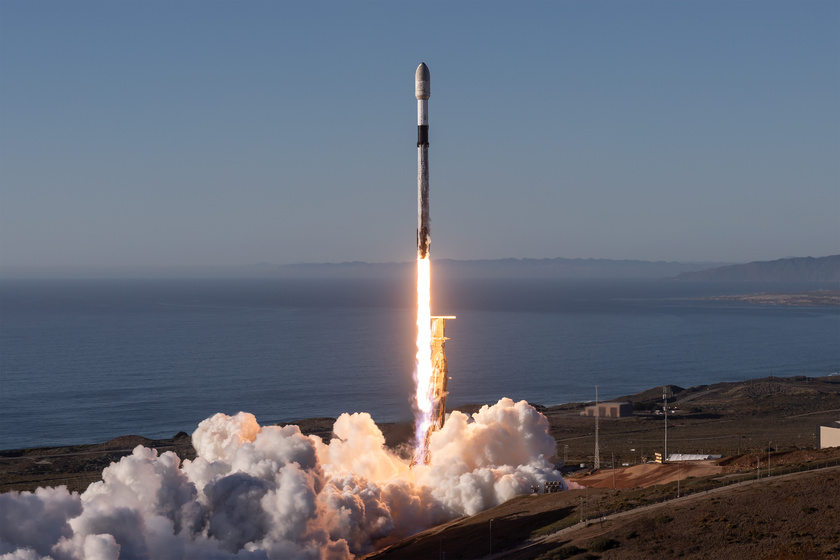
A SpaceX Falcon 9 launched the classified USSF-481 mission from Space Launch Complex 4 East (SLC-4E) at Vandenberg Space Force Base in California, at 0001 UTC on Friday (Oct. 16), carrying a classified payload to a polar low-Earth orbit, for the United States Space Force. The rocket followed a southerly trajectory, reaching a low-Earth orbit inclined approximately 80 degrees to the Equator, a path necessary for polar coverage without overflying populated land.
Vandenberg SLC-4E is the only U.S. launch pad permitting southward polar departure azimuths, making it critical for national security satellites requiring global coverage.
About 8.5 minutes after launch, the first stage booster, B1081 landed on the autonomous droneship Of Course I Still Love You in the Pacific Ocean as scheduled. This recovery marked the 228th booster landing on a droneship and the 671st total Falcon booster landing. This marks the 28th flight for B1081 which has flown previous missions including Crew-7, CRS-29, PACE, Transporter-10, EarthCARE, NROL-186, Transporter-13, TRACERS, NROL-48, COSMO-SkyMed Second Generation FM3, and 16 Starlink deployments.
The USSF-481 mission cargo remains classified, but public notices identify the mission as TH-2 (Task Order 2) under the Space-Based Sensing and Targeting (SBST) contract.
USSF-481 is part of a roughly $1.6 billion Pentagon contract for 18 Falcon 9 launches through the end of 2027, supporting the Proliferated Warfighter Space Architecture (PWSA) and missile-defense initiatives.
Friday's mission wmarks the 114th Falcon 9 launch of 2026, highlighting SpaceX's high-frequency launch rate. The launch was preceded by a formal ceremony at Vandenberg, featuring the five o'clock bugle call "Retreat" and the U.S. National Anthem.