

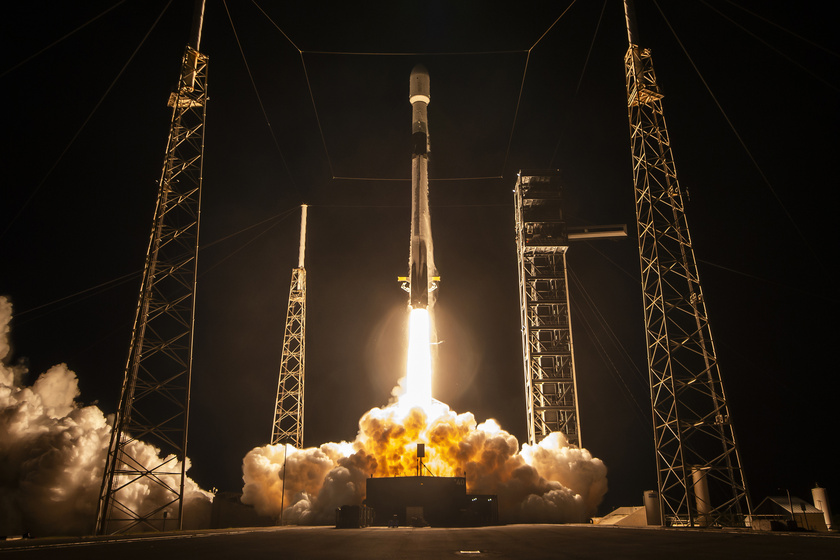
SpaceX Falcon 9 launched the Bandwagon-5 rideshare mission on Tuesday (Oct. 20), at 1104 UTC from Space Launch Complex 40 (SLC-40) at Cape Canaveral Space Force Station, Florida, carrying 32 payloads, including the company’s own Starfall reentry capsule.
The Falcon 9 first stage booster B1085 landed on the droneship A Shortfall of Gravitas** in the Atlantic Ocean about nine minutes after liftoff as planned. B1085 previously supported 18 missions including Crew-9, RRT-1, Blue Ghost M1, Fram2, SXM-10, MTG-S1, EchoStar XXV, SXM-11 and 10 Starlink missions.
About 57 minutes after liftoff, the Falcon 9 upper stage started deploying the 32 payloads, with Starfall separating from the upper stage 2 hours and 48 minutes after launch. The payloads include a mix of cubesats and microsats for commercial, government, and research customers across a mid-inclination low Earth orbit.
Standing 0.75 meters tall and 3.1 meters wide, Starfall is a 2,100-kilogram disk-shaped, uncrewed reentry vehicle designed for affordable point-to-point cargo delivery and returning microgravity-manufactured goods. It can return up to 1,000 kilograms of payload to Earth. This flight marked the capsule's second demonstration mission, following its debut on June 23, 2026.
"Starfall enables affordable, routine access to a microgravity environment, providing unique opportunities for on-orbit manufacturing, scientific research, and testing," SpaceX wrote on X.
Starfall wasn't the only reentry capsule on Bandwagon-5. Among the other 31 payloads, was W-Series 7, the latest orbital "mini-factory" built and operated by the California company Varda Space Industries. The W-Series spacecraft are designed to both host the production of valuable goods such as pharmaceuticals and bring them safely down to Earth, the company has said.
The other payloads on Bandwagon-5 are a mix of "cubesats and microsats," according to SpaceX's mission description. Among them are Pelican-12, a sharp-eyed Earth-observation satellite built by the San Francisco company Planet; and payloads from operators such as Tomorrow.io, Capella Space, Umbra Lab, HawkEye 360 (radio-frequency monitoring), Iceye, and Xona Space Systems.
Bandwagon is one of two SpaceX rideshare programs that deploy several payloads at a time for various customers. The other, known as Transporter, has been busier, flying 18 missions to date.