

A missile strike on King Khalid International Airport in Riyadh over the weekend killed 12 people and injured over 309, including one American citizen confirmed by U.S. Secretary of State Marco Rubio. The dead included four Saudis, two Bangladeshis, and one each from the US, Egypt, Jordan, Syria, Palestine, and Sudan.
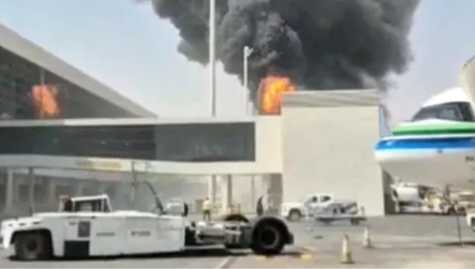
The blast struck inside the main Terminal 3 building with no prior warning from Saudi threat systems. Witnesses described an explosion, a collapsed ceiling near a departure gate, and people injured on the ground.
Thick smoke and fires were observed across the airfield, and flight operations were suspended while damages to passenger terminals and airside infrastructure were assessed. It was the deadliest attack on a Gulf Arab country since the U.S.-Israeli war with Iran began in February 2026.
Dozens of ambulances rushed to the scene; hospitals were flooded with wounded, some in critical condition. All flights were diverted or cancelled, and operations were suspended. Western governments including US, UK, Germany, Australia, Canada immediately warned citizens to avoid the airport.
The EU Aviation Safety Agency expanded its guidance on Saudi airspace, noting the Houthis' demonstrated ability to strike deep inside the kingdom.
The Houthis (Ansar Allah) had not formally claimed Saturday's strike by the time reports were filed, though a senior Houthi official said the militia was responsible. The Saudi-led coalition blamed the Houthis and called it a "full-fledged war crime."
The Saudi-led coalition vowed a "firm" response. Major General Turki al-Maliki, spokesperson for the Saudi-led coalition, confirmed counter-strikes targeting Houthi weapons depots, launch pads, and ballistic missile storage sites across Yemen, including Saada, Hodeidah, and Marib.
The Houthis had already claimed two earlier strikes on the same airport that week — one on Wednesday that killed three and wounded 36, and one on Thursday, a ballistic missile attack announced by Houthi spokesman Yahya Saree, that killed three Saudis including a Saudia Airlines captain and heavily damaged a parked commercial aircraft.
The Iran-backed Yemeni group launched their intensified campaign against Saudi targets -- airports, oil facilities, tankers -- after a truce in Yemen's civil war unraveled in July 2026. On October 5, the Houthis declared Saudi airspace a military zone, warning that civilian aircraft were no longer safe.
The Saudi-led coalition launched a major military offensive against the Houthis on Monday, October 6, in support of the Yemeni government's ground war. The Houthis responded with the escalating missile campaign.
The Houthis had seized control of the Bab al-Mandab Strait two weeks prior, blocking Saudi-linked commercial traffic.
UN envoy Hans Grundberg told the Security Council that Yemen had lapsed back into "full-scale war." President Donald Trump said he was evaluating whether the U.S. should join Saudi strikes against the Houthis, saying "We may. We move very quickly."
Rubio condemned Saturday's attacks and confirmed the American death.
“The United States strongly condemns the recent attacks on the Kingdom of Saudi Arabia by the terrorist Houthis, including today’s strike on King Khalid International Airport in Riyadh that took numerous innocent lives, including an American citizen,” he wrote on X. “These reprehensible attacks demonstrate a blatant disregard for innocent civilian life. They must stop now. We stand with the Kingdom of Saudi Arabia and its people and extend our condolences to the victims and their families.”
The attack exposed significant vulnerabilities in Saudi air defense and is expected to increase pressure on allies, particularly the United States, to provide direct military support.
The strike on Riyadh comes amid a severe escalation across the Middle East involving the United States, Iran, and regional proxy networks. The Houthis have intensified long-range ballistic missile and drone operations against cross-border Gulf infrastructure and maritime traffic passing through regional waterways.