keneci Network
News • Science & Tech • Comedy
Muslim Mayor of the only majority-Muslim city in U.S. edorses Donald Trump in 2024 presidential elections
September 22, 2024
post photo preview

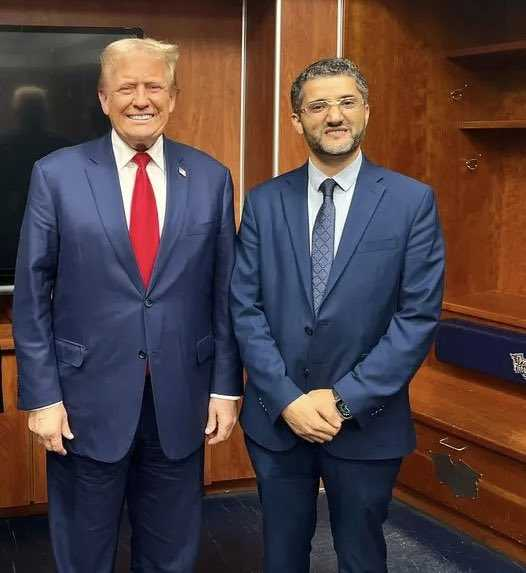
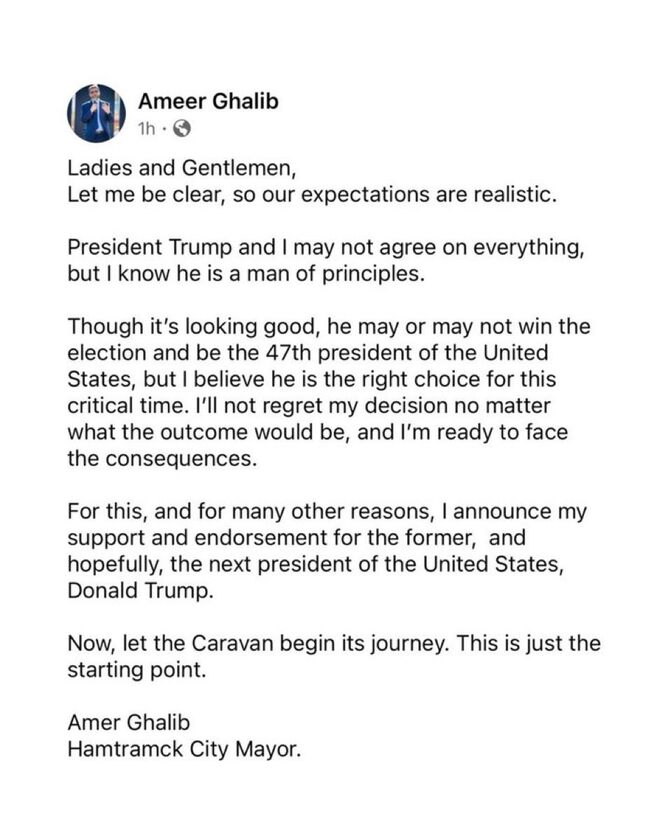
Left-wing Democrat Mayor of Hamtramck, Michigan, Ameer Ghalib, said in a statement endorsing the former president: "President Trump and I may not agree on everything, but I know he is a man of principles. I believe he is the right choice for this critical time."
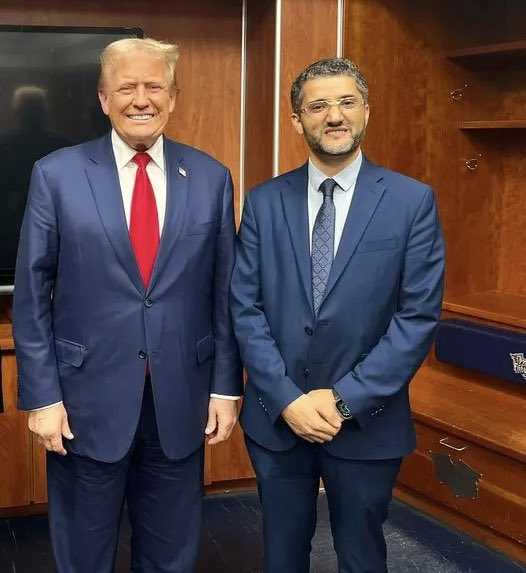
Many traditional Muslim Democrats have in recent years grown frustrated with the left-wing party's aggressive promotion of LGBTQ degeneracy, abortion and racist anti-White policies and cultural issues antithetical to the more conservative Muslim community. Political observers say the shift towards far-left 'woke' extremism has triggered a growing backlash against the Democrat party, from many traditional party faithfuls who feel alienated by the radically degenerate cultural issues supported by the party's wealthy liberal elite


community logo
Join the keneci Network Community
To read more articles like this, sign up and join my community today
0
What else you may like…
Videos
Posts
Articles
SpaceX Starlink Internet Satellites

With Starlink internet, data is continuously being sent between a ground dish and a Starlink satellite orbiting 550km above. Furthermore, the Starlink satellite zooms across the sky at 27,000 km/hr! MORE VIDEOS ON KENECI NETWORK RUMBLE CHANNEL: https://rumble.com/c/Keneci

00:28:08
Elon Musk, DOGE Speak On Waste And Fraud

US Department of Government Efficiency Services (USDS) led by Elon Musk speak on the "mind-boggling" fraud and waste in UInited States federal government

00:00:45
January 17, 2025
SpaceX Launches Starship 7th Test Flight

SpaceX successfully executed its second-ever “chopsticks” catch of a Super Heavy booster (or Booster 14) using the “Mechazilla” launch tower on Thursday(Jan. 16), during the seventh uncrewed test flight of the company's 123-meter Starship rocket. However, the megarocket's upper stage(or Ship 33) was lost approximately 8.5 minutes into the flight in a “rapid unscheduled disassembly(RUD)” or explosion

00:10:30
Welcome to Keneci Network!

Join the conversations!

December 09, 2025
Bitcoin White Paper By Satoshi Nakamoto

Bitcoin white paper

Bitcoin_White_Paper.pdf
September 17, 2024
Charges Against Sean 'Diddy' Combs In Grand Jury Indictment

The rapper was charged with racketeering conspiracy, sex trafficking by force, fraud or coercion, and transportation to engage in prostitution in the indictment unsealed Tuesday(Sept. 17)

Combs-Indictment-24-Cr.-542.pdf
post photo preview
Terafab: Elon Musk Unveils Semiconductor Chip Project By Tesla, SpaceX

Elon Musk officially unveiled the Terafab project at the defunct Seaholm Power Plant in Austin, Texas, marking a joint venture between Tesla, SpaceX, and xAI to build what Musk described as “the most epic chip building exercise in history by far.” The $20–25 billion initiative aims to vertically integrate the entire semiconductor production process—design, lithography, fabrication, memory production, advanced packaging, and testing—under one roof, targeting one terawatt of compute capacity annually.

Terafab aims to manufacture terrestrial chips for Tesla’s Full Self-Driving vehicles, Cybercab robotaxis, and the Optimus humanoid robot, with production volumes expected to be 10 to 100 times higher than Tesla cars.

The chip fabrication plant will also produce D3 chips, a radiation-hardened variant designed for space environments, to power a future fleet of one million AI data center satellites in low Earth orbit.

Terafab's goals include Space-based AI computing, leveraging constant solar energy in orbit to reduce costs—Musk said that once launch costs drop sufficiently, “putting AI in space becomes a no-brainer.”

Musk emphasized the project's urgency: “We either build the Terafab or we don’t have the chips, and we need the chips, so we build the Terafab.” He framed the project as a necessity due to projected global chip shortages, with demand from Optimus robots alone requiring 100–200 gigawatts of compute, and AI satellites needing terawatts—exceeding current global production capacity.

"If you add up all the fabs on earth combined, they're only about 2% of what we need for the Terra fab project," Musk said. "We're very grateful to our existing supply chain, to Samsung, TSMC, and others, and we would like them to expand as quickly as they can, and we will buy all of their chips. I have said these exact words to them, and there's a maximum rate at which they're comfortable expanding, but that rate is much less than we would like, So we're gonna build the Terafab."

Terafab is a capstone to Musk’s broader vision of a multi-planetary and galactic civilization, integrating Tesla’s solar manufacturing push, SpaceX’s Starship rocket development, and xAI’s AI ambitions.

SpaceX acquired xAI in February 2026, and Tesla has invested $2 billion in xAI, aligning the companies under a unified AI and hardware strategy.

The project faces surmountable obstacles due to Musk’s lack of semiconductor manufacturing experience, but it reflects a strategic move to bypass reliance on TSMC, Samsung, and Micron. Success hinges on regulatory approvals, engineering execution, and the ability to scale production to 70% of TSMC’s current global output. The Tesla CEO is known to take on and deliver on ambitious projects and surprising his critics.

Read full Article
post photo preview
Iran's Retaliatory Missiles Target Dimona, Arad, As Trump Threatens Iran In 48-hour Ultimatum Over Strait Of Hormuz

Iranian missile strikes targeted southern Israeli cities Dimona and Arad, Saturday, following U.S. and Israeli attacks on Iran’s Natanz uranium enrichment facility and the Bushehr nuclear power plant. Iranian state media confirmed the missile barrage was a response to these strikes, which Tehran said targeted critical nuclear infrastructure.

The International Atomic Energy Agency (IAEA) confirmed damage at Natanz and a projectile impact near Bushehr, with no reported radiation leaks.

Dimona hosts the Shimon Peres Negev Nuclear Research Center, widely believed to be the core of Israel’s undeclared nuclear weapons program. Although the nuclear facility itself was not damaged, multiple missiles struck residential areas, and dozens were injured across two southern Israeli cities Dimona and Arad, including a 12-year-old boy in serious condition and others suffering from shrapnel wounds and blast-related injuries.

The IDF admitted failure to intercept the incoming missiles, triggering an investigation into the breach of Israel’s multi-layered air defense.

Iran claimed the use of hypersonic-capable missiles, signaling a major escalation by demonstrating the ability to penetrate advanced defense systems. The strike marked a shift toward nuclear-associated strategic targeting, raising global concerns about a potential nuclear-shadow conflict. Iranian Parliament Speaker Mohammad Bagher Ghalibaf called it a "new phase" of warfare, asserting that Israel’s skies were no longer impenetrable. Iran also targeted energy infrastructure in Gulf states.

Hezbollah joined the escalation, launching rocket barrages into northern Israel, injuring at least 19 people and striking homes in border towns.

The U.S.-UK military base on Diego Garcia in the Indian Ocean was targeted with two intermediate-range ballistic missiles. One missile failed mid-flight, and the other was intercepted by a U.S. warship, according to U.S. officials. Iran denied involvement in the srikes. British officials and NATO Secretary General Mark Rutte say they “cannot confirm” Israel’s assessment that the missiles were fired by Iran. War experts online suspect it was a 'false flag' operation from an Israeli submarine designed to 'drag NATO' into the war.

The UK has authorized the U.S. to use RAF Fairford in Gloucestershire and the joint UK-US base to conduct limited defensive operations against Iranian missile sites targeting commercial shipping in the Strait of Hormuz. This marks a significant policy shift by Prime Minister Keir Starmer’s government, which had previously restricted U.S. use of these bases to defensive actions protecting British interests.

After initially resisting U.S. requests for broader access, citing legal and strategic concerns, Starmer reversed course amid growing pressure and insults by President Trump. The UK government framed the authorization under the principle of collective self-defense, emphasizing that the operations are aimed at restoring freedom of navigation in one of the world’s most critical oil transit routes.

Trump criticized the UK’s decision as a “very late response." Iran’s Foreign Minister Abbas Araghchi condemned the UK’s decision, accusing Starmer of “putting British lives in danger” and asserting Iran’s right to self-defense.

Diego Garcia lies approximately 3,795 km from Iran and hosts long-range bombers, nuclear submarines, and missile defence systems. Its strategic location makes it a critical hub for U.S. and UK military operations in the Indo-Pacific and Middle East. The island is also at the center of ongoing negotiations to transfer sovereignty of the Chagos Islands to Mauritius, with the UK retaining a long-term lease for military use—a plan opposed by Trump and Republican lawmakers.

Iran’s ability to target such a distant base has raised concerns about its missile capabilities, with independent analysts suggesting Tehran possesses systems with ranges up to 4,000 km, far exceeding its official 2,000 km limit.

Israel and the U.S. intensified strikes on Iran, with Central Command reporting over 8,000 targets hit, including missile storage sites, naval assets, and facilities linked to ballistic missile development. Israeli forces also struck Malek Ashtar University in Tehran, a site tied to Iran’s military nuclear research.

The conflict has driven oil prices to their highest level since 2022, and the G7 called for an immediate cessation of attacks, warning of global energy and security risks. The IAEA urged restraint, emphasizing the dangers of military actions near nuclear sites.

"If Iran doesn’t FULLY OPEN, WITHOUT THREAT, the Strait of Hormuz, within 48 HOURS from this exact point in time, the United States of America will hit and obliterate their various POWER PLANTS, STARTING WITH THE BIGGEST ONE FIRST! Thank you for your attention to this matter,"  Trump wrote on Truth Social late Saturday. Iranian commanders have threaten retaliation.

Read full Article
post photo preview
US Lifts Iranian Oil Sanction, As Trump Deploys More Troops To The Middle East

President Trump's Iranian oil sanction waiver has been implemented from March 20 to April 19, 2026, as part of an emergency effort to stabilize global oil markets amid soaring prices due to the ongoing U.S.-Israeli military campaign against Iran. The U.S. Treasury authorized the purchase of approximately 140 million barrels of Iranian oil already at sea, aiming to release about 10–14 days’ worth of supply previously blocked by sanctions and largely destined for China.

"Today, the Department of the Treasury is issuing a narrowly tailored, short-term authorization permitting the sale of Iranian oil currently stranded at sea," Treasury Secretary Scott Bessent announced on X. "At present, sanctioned Iranian oil is being hoarded by China on the cheap. By temporarily unlocking this existing supply for the world, the United States will quickly bring approximately 140 million barrels of oil to global markets, expanding the amount of worldwide energy and helping to relieve the temporary pressures on supply caused by Iran. In essence, we will be using the Iranian barrels against Tehran to keep the price down as we continue Operation Epic Fury.

"This temporary, short-term authorization is strictly limited to oil that is already in transit and does not allow new purchases or production. Further, Iran will have difficulty accessing any revenue generated and the United States will continue to maintain maximum pressure on Iran and its ability to access the international financial system.

"So far, the Trump Administration has been working to bring around 440 million additional barrels of oil to the global market, undercutting Iran’s ability to leverage its disruptions in the Strait of Hormuz."

U.S. and Israeli strikes have intensified, targeting key Iranian infrastructure and leadership. Israel conducted a major strike on Iran’s South Pars gas field—the world’s largest natural gas field—damaging a facility critical to Iran’s domestic energy supply.

The U.S. has carried out numerous strikes in coordination, including a large-scale precision attack on Kharg Island, destroying 90 military targets while attempting to preserve oil export infrastructure. American and Israeli forces have also targeted Iranian intelligence commanders and missile sites, with Defense Secretary Pete Hegseth stating the campaign includes degrading Iran’s ballistic missile production, navy, and nuclear capabilities.

Iranian retaliation has been widespread and aggressive. In response to the South Pars attack, Iran launched missile and drone strikes on energy facilities in Qatar, Saudi Arabia, Kuwait, and the UAE.

Multiple attacks hit Kuwaiti oil refineries, causing fires and prompting Kuwait’s military to confirm it was intercepting “hostile missile and drone attacks.” Iran also fired missiles at Israeli targets, including the Haifa oil refinery, causing minor damage. Air raid sirens sounded across Israel, including Tel Aviv, as Iran deployed missiles with cluster warheads.

Hezbollah, backed by Iran, has escalated attacks from Lebanon, with Israel reporting over 770 deaths in Lebanon from retaliatory strikes. Iran has also targeted U.S. interests, including a drone strike on the U.S. Embassy compound in Baghdad, hitting a helipad, and attacks on American military bases in Kuwait.

Despite the conflict, Trump denied plans to deploy ground troops, though around 5,000 additional U.S. Marines and sailors are being sent to the region. Trump claimed he told Israeli Prime Minister Netanyahu to stop attacking Iranian energy infrastructure, threatening to “massively blow up” South Pars if Iran strikes Qatar again.

The war has killed over 2,000 people across the Middle East, including more than 1,200 in Iran, 850 in Lebanon, 13 in Israel, and 13 U.S. service members. Oil prices have surged past $110 per barrel, with United Airlines forecasting potential spikes to $175 if the conflict persists into 2027.

Read full Article
See More
Available on mobile and TV devices
google store google store app store app store
google store google store app tv store app tv store amazon store amazon store roku store roku store
Powered by Locals