keneci Network
News • Comedy • Science & Tech
Boeing Starliner Returns To Earth Without Its 2 CFT Astronauts
September 07, 2024
post photo preview

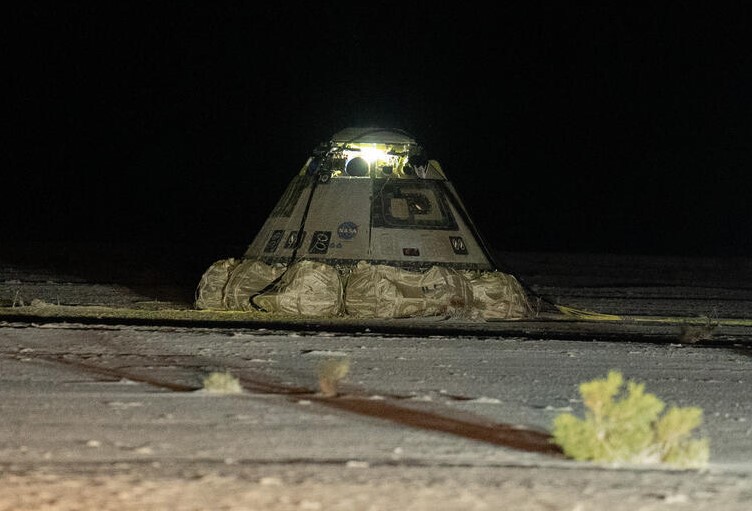
Boeing's crew flight test(CFT-1) Starliner undocked from the International Space Station(ISS) on Sept. 6, at 2204 UTC, performed a series of burns through its 6-hour flight in space, and landed uncrewed, under guiding parachutes, in New Mexico's White Sands Space Harbor at 0401 UTC on Sept. 7. Due to Thruster and other issues, the capsule (named Calypso) did not return with its crew, NASA astronauts Butch Wilmore and Suni Williams.

"Great landing of Calypso!" Williams said from ISS, on the agency's webcast. "I don't think that could have gone better."

Williams and Wilmore have no need for their "Boeing Blue" spacesuits which are among the gear that Calypso brought home Saturday morning. "The suits are not compatible," manager of NASA's Commercial Crew Program, Steve Stich said during a press conference on Wednesday (Sept. 4). "So the Starliner suits would not work in [SpaceX Crew] Dragon, and vice versa." Both astronauts will come home in February aboard the Elon Musk spacecraft.

"I'm happy to report that Starliner did really well today in the undocking, reentry and landing sequence," Stich told reporters after the touchdown Saturday morning. "It was a bullseye landing, a great landing out at White Sands." He added that Wilmore and Williams would have been fine if they'd been aboard the capsule. "It would have been a safe, successful landing with the crew on board;"

Stich however added that NASA's decision to err on the side of safety with the data they had on hand before landing still stands: "I think we made the right decision."

Boeing representatives did not participate in the post-landing briefing, but did release a statement shortly after Starliner's return.

"I want to recognize the work the Starliner teams did to ensure a successful and safe undocking, deorbit, reentry and landing," Mark Nappi, Boeing's vice president and program manager of Boeing's Commercial Crew Program, said in the statement. "We will review the data and determine the next steps for the program."

This was the third touchdown overall for Starliner. The spacecraft also flew two uncrewed test flights to the ISS, one in December 2019 and one in May 2022. Starliner failed to meet up with the orbiting lab on the first flight after suffering several glitches. The second uncrewed mission was a success, though Starliner experienced some thruster issues on that flight as well.

Boeing and NASA had hoped that CFT-1 would pave the way for Starliner's certification, allowing the capsule to join Crew Dragon and Russia's Soyuz in flying six-month-long astronaut missions to the ISS.

NASA in 2014, gave SpaceX and Boeing multibillion-dollar contracts to finish work on their astronaut spacecraft -- Crew Dragon and Starliner, respectively. The agency wanted one or both of those vehicles to start flying astronauts to and from the ISS by 2017, reestablishing a homegrown orbital human spaceflight capability -- something the U.S. had lacked since the retirement of the space shuttle in 2011.

Musk's SpaceX won the race with first astronaut mission, a test flight to the ISS called Demo-2, which lifted off in May 2020, and the company has since launched about nine crewed and 30 cargo missions to the orbiting lab.

Starliner's crewed debut, CFT-1 launched atop a United Launch Alliance Atlas V rocket on June 5 this year, sending Williams and Wilmore to the orbiting lab for a planned eight-day stay which will now turn into an 8-month stay, to be rescued by Musk's Dragon.

community logo
Join the keneci Network Community
To read more articles like this, sign up and join my community today
0
What else you may like…
Videos
Posts
Articles
SpaceX Starlink Internet Satellites

With Starlink internet, data is continuously being sent between a ground dish and a Starlink satellite orbiting 550km above. Furthermore, the Starlink satellite zooms across the sky at 27,000 km/hr! MORE VIDEOS ON KENECI NETWORK RUMBLE CHANNEL: https://rumble.com/c/Keneci

00:28:08
Elon Musk, DOGE Speak On Waste And Fraud

US Department of Government Efficiency Services (USDS) led by Elon Musk speak on the "mind-boggling" fraud and waste in UInited States federal government

00:00:45
January 17, 2025
SpaceX Launches Starship 7th Test Flight

SpaceX successfully executed its second-ever “chopsticks” catch of a Super Heavy booster (or Booster 14) using the “Mechazilla” launch tower on Thursday(Jan. 16), during the seventh uncrewed test flight of the company's 123-meter Starship rocket. However, the megarocket's upper stage(or Ship 33) was lost approximately 8.5 minutes into the flight in a “rapid unscheduled disassembly(RUD)” or explosion

00:10:30
Welcome to Keneci Network!

Join the conversations!

December 09, 2025
Bitcoin White Paper By Satoshi Nakamoto

Bitcoin white paper

Bitcoin_White_Paper.pdf
September 17, 2024
Charges Against Sean 'Diddy' Combs In Grand Jury Indictment

The rapper was charged with racketeering conspiracy, sex trafficking by force, fraud or coercion, and transportation to engage in prostitution in the indictment unsealed Tuesday(Sept. 17)

Combs-Indictment-24-Cr.-542.pdf
post photo preview
Tit-for-tat: Iran Strikes US Navy Ships After American Attack On 3 Iranian Civilian Oil Tankers

The Islamic Revolutionary Guard Corps (IRGC) attacked six vessels Saturday, after U.S. Central Command (CENTCOM) struck three Iranian oil tankers. The IRGC claimed it targeted three oil tankers transiting the Strait of Hormuz on "unauthorized" routes and three U.S.-affiliated ships in other areas, using anti-ship missiles.

CENTCOM announced earlier that U.S. forces had "permanently disabled" two Iranian crude carriers and "completely destroyed" a third after the IRGC launched ballistic missiles at a U.S. aircraft carrier and a guided-missile destroyer, which successfully evaded the attacks with no American personnel harmed, CENTCOM claimed.

This exchange marks a significant escalation in the U.S.-Iran conflict that began in late February 2026. The strikes on Saturday, were part of a new U.S. "tanker for tanker" policy, first implemented earlier in the week week when the U.S. hit two Iranian government tankers in response to IRGC attacks on commercial shipping in the Strait of Hormuz.

Trump administration executed a targeted operational shift from striking military sites (such as radars or launchers) toward hitting Iran's commercial oil assets. Using a combination of Navy and Air Force fighters and drones, CENTCOM struck three Iranian crude oil tankers

M/T Downy was struck at the stern off Kharg Island (Iran’s primary crude export hub) and "permanently disabled." M/T Stark 1 struck at the stern near the coastal city of Jask and also "permanently disabled." And M/T Kylo (Noxen), an unladen tanker struck in multiple critical areas in the Gulf of Oman, rendering it inoperable; it subsequently sank.

CENTCOM claimed the targeted tankers was part of a "multibillion-dollar shadow network" funding the IRGC and its regional proxies.

"Let the message to the IRGC be clear: If you shoot at two of our ships, we will impose an even higher economic cost—taking out three of yours," CENTCOM's Admiral Brad Cooper said in a statement. "We will not hesitate to defend American forces, and if necessary, destroy Iran’s limited and exposed oil fleet."

The IRGC Navy warned other vessels not to transit the strait via "unauthorized" waterways, threatening to target them. Iran’s Foreign Ministry condemned the U.S. strikes as "illegal and aggressive" violations of the UN Charter, while Iranian state media confirmed the crew evacuations from the hit tankers.

Defense Secretary Pete Hegseth posted on social media, "If Iran shoots at U.S. ships, we will destroy (and sink) their oil tankers." President Donald Trump had earlier described the conflict as "small potatoes" and declared the Strait of Hormuz "open."

The Strait of Hormuz is the world's most critical oil transit chokepoint, normally handling ~20% of global petroleum. Tensions escalated sharply after a naval blockade and military actions effectively closed off unapproved shipping routes.

US shift to "Tanker-for-Tanker" warfare, transitioning from neutralizing offensive threats (like mine-laying capabilities and coastal radar installations) to targeting the "shadow network" fleet that generates revenue for the IRGC, observers say, is likely to exacerbate the global energy crisis.

Read full Article
September 03, 2026
post photo preview
China, US Developing Military 'Hunter' Satellites: Leaked Report

The United States and China are rapidly developing military space capabilities, including "hunter" satellites and orbital weapons, signaling a shift toward potential space warfare.

Recently leaked documents and space-tracking data from early September 2026, reportedly show both nations are creating spacecraft capable of maneuvering near, inspecting, or potentially disabling other satellites.

Unlike traditional satellites that follow fixed, predictable orbital paths, hunter satellites—also called co-orbital threat systems or inspector satellites—possess high maneuverability. They are equipped with advanced propulsion, autonomous navigation, and physical or directional payloads designed to interact with other spacecraft.

China and the US are aggressively pursuing on-orbit refueling technologies. Because maneuvering in space consumes significant fuel, refueling capabilities allow hunter satellites to remain operational indefinitely rather than becoming dead weight after a few maneuvers.

China’s advancements include orbital "dogfighting" and refueling technologies. Chinese military-linked researchers are pursuing satellites designed to pursue and capture other spacecraft, with patents covering autonomous fuel-efficient maneuvers and net-based capture systems.

Officially referred to as "space debris removal," "in-orbit servicing," or "repair craft," the exact same robotic mechanisms (grappling arms, nets, lasers) used in systems can be weaponized to disable enemy satellites.

In June 2026, a Chinese spaceplane released a mini-satellite that circled another spacecraft, an act US officials described as a dress rehearsal for combat. Additionally, China likely conducted an on-orbit refueling attempt last year, a breakthrough that would allow satellites to extend their operational lives indefinitely.

Chinese military-linked patent filings reveal developments in autonomous, fuel-efficient pursuit calculations and multi-satellite netting systems designed to capture non-cooperative target spacecraft.

The US is countering with joint allied operations and electromagnetic weapons. The US Space Force has introduced ground-based electromagnetic weapons to disrupt satellite communications and operates a secret, crewless spaceplane similar to China’s.

Ground- and space-based lasers can blind satellite optics or permanently damage solar arrays. High-powered electromagnetic weapons are designed to sever satellite data links to ground stations.

In a significant strategic signal, US Space Command, alongside Five Eyes allies recently conducted their first joint military space operation in the path of a suspected Chinese spy satellite, demonstrating allied coordination. In one instance, a US military satellite executed a close-approach intercept vector near a Chinese Shiyan 12-01 satellite, signaling operational readiness to inspect and counter adversary craft.

Autonomous craft like the US X-37B and China's secretive Shenlong serve as mobile deployment platforms for covert payloads, anti-satellite surveillance, and maneuver warfare.

US Space Force leadership describes the Chinese threat as "substantial," noting rapid expansion in both the number and complexity of Beijing’s space missions.

Read full Article
September 02, 2026
post photo preview
Owl Around The World: Rocket Lab Electron Launches Japanese StriX Satellite

Rocket Lab successfully launched its 94th Electron mission, deploying the latest StriX synthetic aperture radar satellite for Japanese company Synspective. The "Owl Around The World," mission lifted off from Launch Complex 1 in New Zealand at 1201 UTC on Wed (Sept. 2).

The Electron's upper 'kick stage' deployed the Strix satellite 56 minutes after liftoff, into a 575 kilometer low Earth orbit to expand Synspective’s imaging constellation.

Synspective is building a constellation of approximately 30 StriX satellites to provide high-resolution Earth observation data for urban planning, infrastructure monitoring, and disaster response.

Named after the owl genus Strix, these satellites use radar to image Earth’s surface day and night, penetrating cloud cover and darkness.

The Strix constellation will "make it possible to quickly monitor and confirm on-the-ground changes during disasters such as earthquakes and floods at night, as well as in areas that are difficult to access," Synspective's website reads.

"In addition to disaster response, we will leverage our SAR satellite capabilities to promote efficient resource utilization," it adds. "For example, we can use our satellite data to monitor natural resources and urban development, ensuring sustainable and optimal use of land and water."

Rocket Lab has been the exclusive launch partner for Synspective since 2020, maintaining a 100% mission success record for all Synspective launches.

The company has 16 additional Electron missions booked to deploy the remainder of the constellation before 2030.

The StriX program began with StriX-α launched on December 15, 2020, followed by StriX-β in February 2022 and the first commercial satellite, StriX-1, in September 2022.

As of Wednesday's launch, 10 StriX satellites have reached orbit, including recent missions like "Viva La StriX" (May 2026) and "Ten Owl of Ten" (June 2026).

The Electron rocket is a two-stage, small-lift vehicle standing 18 meters tall, recognized as the world’s most frequently launched small-lift orbital rocket. Rocket Lab has also launched nine missions to date with HASTE, a suborbital version of Electron that allows customers to test sensors and instruments in a hypersonic flight environment. While Electron debuted in 2017, HASTE lifted off for the first time in June 2023.

Read full Article
See More
Available on mobile and TV devices
google store google store app store app store
google store google store app tv store app tv store amazon store amazon store roku store roku store
Powered by Locals