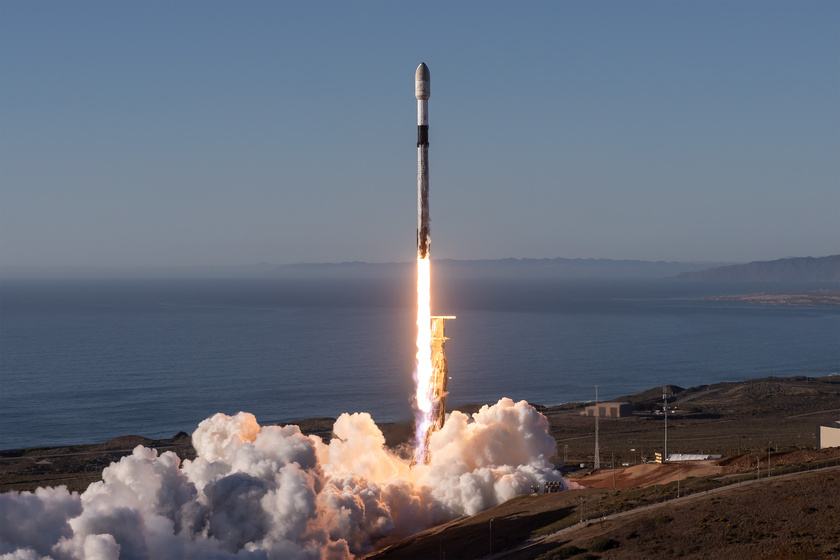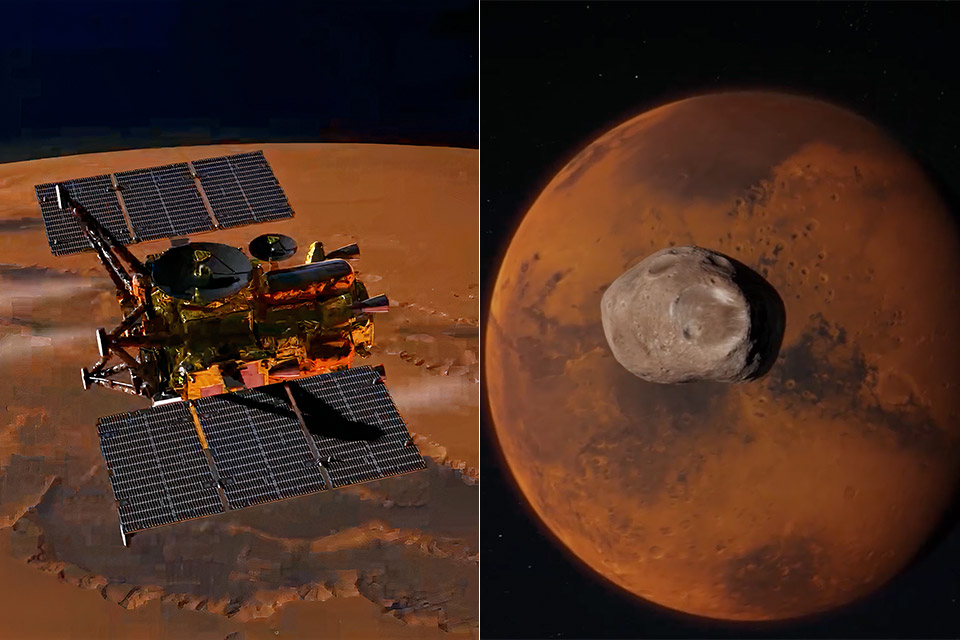
Japan Aerospace Exploration Agency, JAXA's H3-24L rocket launched the Martian Moons eXploration (MMX) mission on Monday (Oct. 19), at 1941 UTC, from Pad-2 at the Yoshinobu Launch Complex within the Tanegashima Space Center. The mission aims to become the first to return samples from Phobos, Mars’s larger moon, with a targeted Earth return in 2031.
This was the 10th liftoff of Japan's expendable, two-stage H3 rocket (flight H3 F10), which was jointly developed by JAXA and Mitsubishi Heavy Industries. After clearing its launch pad today, the 63-meter rocket flew a nominal trajectory through its ascent corridor over the Pacific Ocean, jettisoning its four solid boosters in pairs just before the flight clock reached two minutes. The launch vehicle shed its payload fairings about one minute and 20 seconds later, exposing MMX to the vacuum of space for the first time.
H3's first stage, powered by two LE-9 rocket engines, channels a mixture of liquid hydrogen and liquid oxygen to produce a combined thrust of 331,000 pounds (1,471 kN), according to Mitsubishi Heavy Industries. As the mission clock approached T+5 minutes, H3 executed its main engine cutoff procedure and separated from the second stage, which ignited its engines for a 5.5-minute burn about 10 seconds later.
All continued to go to plan after that. The H3's upper stage ignited its engine for a second time for a trans-Mars injection burn about one hour and four minutes after liftoff, a maneuver that lasted roughly six minutes and 25 seconds and took MMX to a maximum velocity of about 38,858 kilometers per hour(kph).
MMX was released from the rocket's upper stage right on schedule, about one minute after the completion of that burn and roughly 71 minutes after liftoff. The success elicited loud cheers in mission control, which viewers saw and heard on JAXA's launch webcast.
The spacecraft is now under its own power, and on course for Mars. The interplanetary transit will last about 10 months, with the spacecraft scheduled to arrive at the Red Planet in August 2027. When it does, MMX's propulsion module will execute an orbital insertion burn to place itself in a quasi-satellite orbit (QSO) around Phobos, which places MMX within the space around the moon as both circle Mars.
The primary goal of MMX is to collect at least 10 grams of Phobos regolith to determine if the Martian moons are captured asteroids or formed from debris ejected by an ancient impact on Mars. The mission will also conduct flybys of the smaller moon, Deimos, and study Mars itself to understand the early solar system's evolution. The spacecraft carries 13 scientific instruments, including MEGANE (developed with NASA) to measure elemental composition via gamma rays and neutrons, and MIRS for infrared mineral analysis.
Led by JAXA with contributions from NASA, ESA, CNES (France), and DLR (Germany), the ~4,480 kilogram spacecraft consists of propulsion, exploration, and return modules. Key components include the Idefix rover (developed by France and Germany) for surface reconnaissance and a lander equipped with both a coring sampler and a pneumatic surface sampler.
NASA has also invested about $87 million through the end of the mission, which includes funding for United States scientists and astromaterials experts on the MMX team. At least 15% of the planned 10-gram (0.35 ounces) returned Phobos sample will be reserved for NASA's study. Those materials will be transferred and maintained at the agency's Johnson Space Center in Houston for analysis and long-term preservation.
MMX is not the first Phobos sample-return project to take flight. That distinction goes to Russia's Phobos-Grunt ("Phobos-Soil") mission, which launched in November 2011 but failed to get out of Earth orbit due to a rocket glitch. The 14.5-ton spacecraft eventually crashed back to Earth over the Pacific Ocean in January 2012.