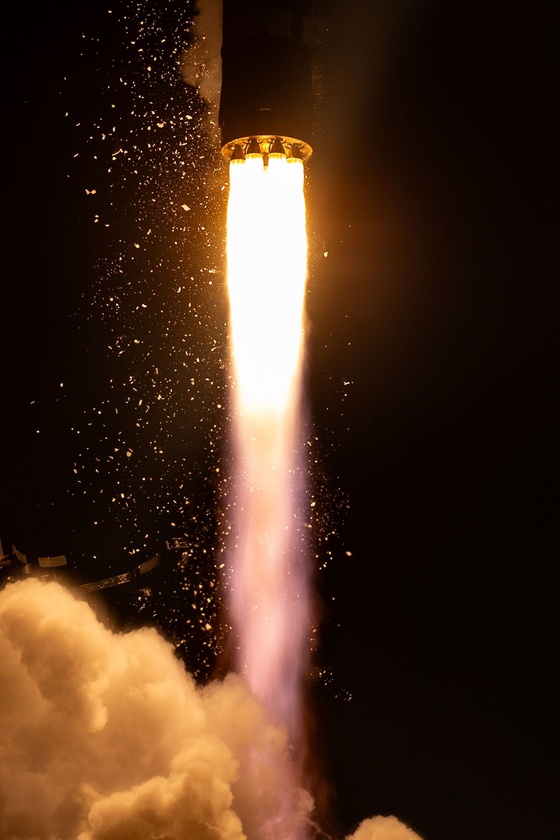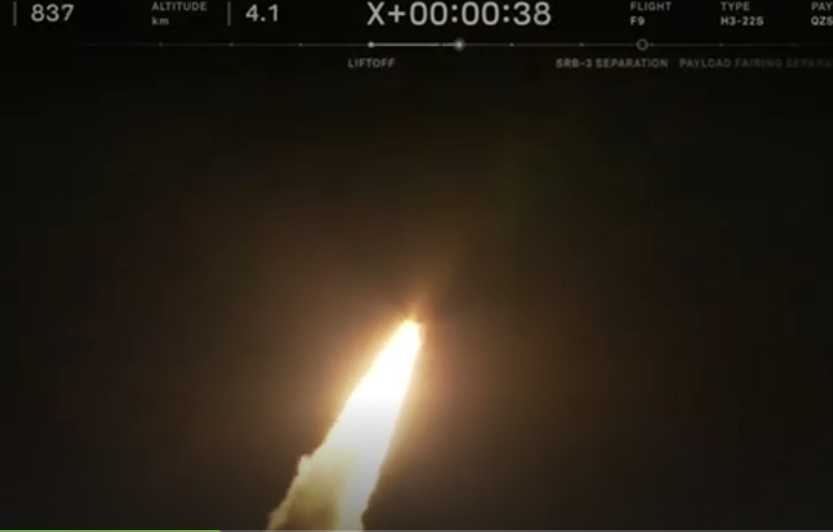
Japan space agency, JAXA successfully launched the H3 rocket (Flight 9) from the Tanegashima Space Center at 1923 UTC, on Monday (Aug. 11), carrying the 4,898-kilogram Michibiki 7 (QZS-7) navigation satellite.
The rocket launch which occurred after delays caused by Typhoon 13, utilized the standard H3-22 configuration (two LE-9 engines and two SRB-3 solid rocket boosters) and the upper stage successfully deployed the satellite into its target orbit about 29 minutes after liftoff.
This mission marks a critical milestone for Japan’s space program, as Michibiki 7 adds to the Quasi-Zenith Satellite System (QZSS) constellation.
"This system is compatible with GPS satellites and can be utilized with them in an integrated fashion," Japanese officials wrote in a description of the QZSS project. "QZSS can be used even in the Asia-Oceania regions with longitudes close to Japan, so its usage will be expanded to other countries in these regions as well."
The QZSS network will eventually consist of 11 satellites, if all goes according to plan. With seven satellites about to be in orbit following Monday's launch, QZSS transitions from a GPS augmentation service to a fully independent regional navigation system, ensuring at least four satellites are simultaneously visible over Japan at all times for high-precision positioning.
Michibiki 7 is carrying a payload for the United States as well — the Situational Awareness Camera Hosted Instrument (SÃCHI), which was developed for the U.S. Space Force by the MIT Lincoln Laboratory. This is the second of two SACHIs to go up on a QZSS satellite; Michibiki 6, which launched atop an H3 in February 2025, hosts the other one. (Yes, Michibiki 6 launched before Michibiki 5.)
"This program will allow the United States to monitor satellite behavior within the GEO belt over a very interesting part of the world," Mark Huber, a technical staff member in the Lincoln Laboratory's Space Systems and Technology Division, said in a statement in December 2020.
"It is also a pathfinder in several ways," he added. "The U.S. team is blueprinting methods to allow sensitive data sharing between the United States and Japan."
The H3 — which stands 57 or 63 meters tall, depending on what type of payload fairing it employs — debuted in March 2023 and had eight liftoffs under its belt before today's launch which serves as the second consecutive success for the H3 rocket following a major setback in December 2025.
That December 2025 failure, which involved the launch of Michibiki 5 mission, was caused by an anomaly in the second-stage engine that prevented the satellite from reaching orbit. The June 2026 return-to-flight mission--which successfully delivered 6 satellites--tested a new low-cost H3-30S variant, while Monday's flight confirmed the reliability of the standard configuration, restoring Japan’s primary launch capability after last year's retirement of the workhorse H-2A rocket.