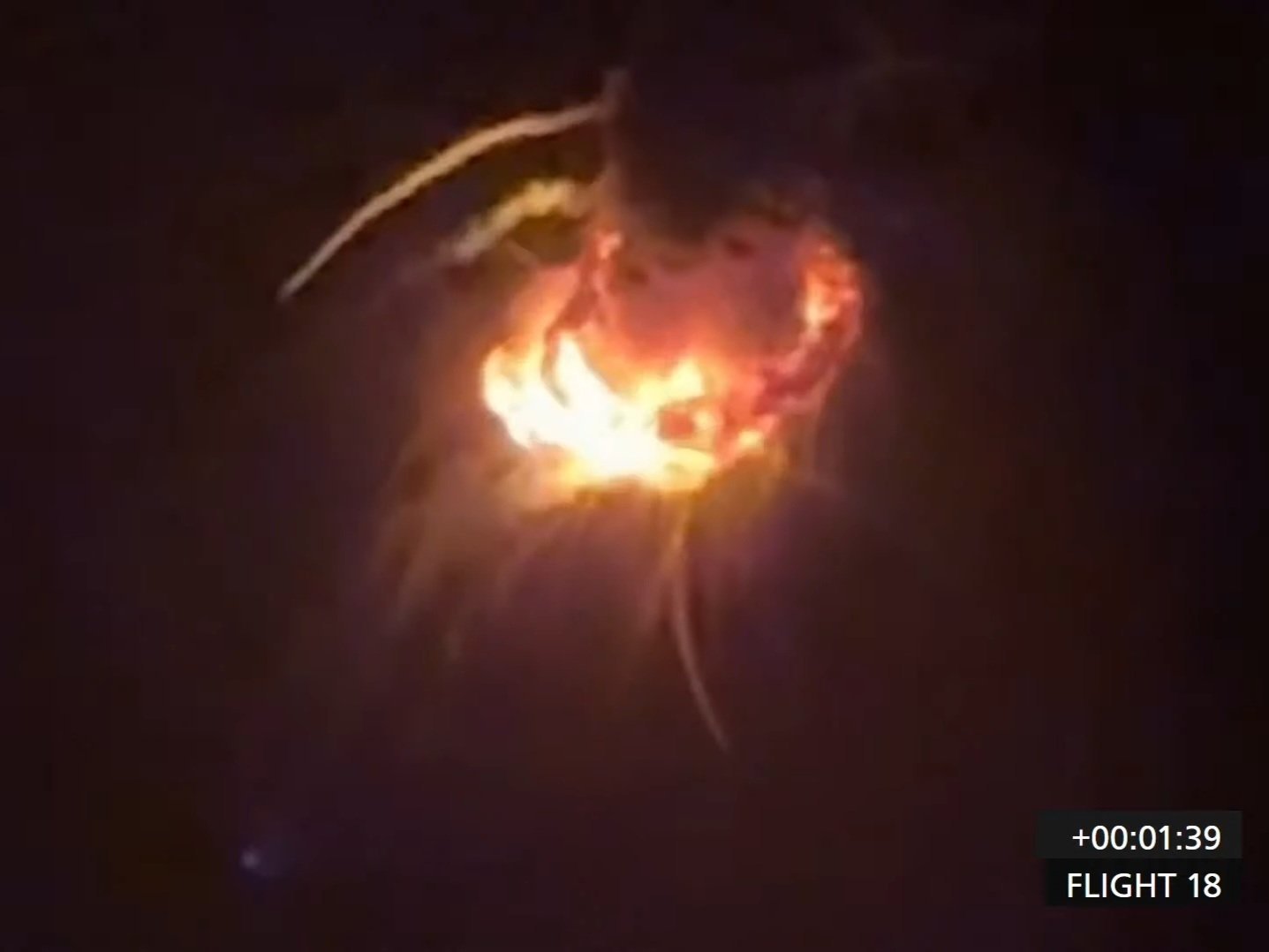
The Long March 7A rocket launched at 1200 UTC, Monday, (Aug. 10), by China Aerospace Science and Technology Corporation (CASC) from the Wenchang Space Launch Site in Hainan, China, suffered a catastrophic failure about 85 seconds after liftoff. Video reposted to social media captured the shock of onlookers the moment that the rocket burst into flames.
The failure occurred during the joint burn phase of the first stage and boosters, specifically involving the YF-100 engines, which has triggered a fleet-wide investigation potentially impacting other missions like Chang'e 7.
The explosion generated a massive fireball and debris cloud over the South China Sea, resulting in the total loss of the vehicle and its payload, the China's Zhongxing-4B communications satellite, presumably bound for geostationary transfer orbit(GTO). China's Zhongxing satellites provide telecommunications and broadband internet services and are also thought to provide services for China's military.
The Long March 7A's four side boosters and core stage detach as a full cluster during first stage separation, which typically occurs just under three minutes after liftoff. As today's incident occurred just 85 seconds into flight, the rocket was still engaged in the main stage's initial engine burn to escape Earth's atmosphere.
Monday's incident marks the second in-flight failure for the Long March 7A since its debut in 2020, ending a streak of 16 consecutive successful missions. The debut launch also ended with the vehicle's explosion. China traced that mishap to an engine malfunction that occurred shortly after first-stage separation. This morning's launch, however, didn't get that far.
A Chinese Zhuque-3 rocket is scheduled for liftoff Monday evening to fly from China's Jiuquan Satellite Launch Center, 2,415 kilometers from Wenchang, at 2345 UTC, and is expected to feature a first-stage landing attempt. It is unclear what repercussions Monday's explosion may have on the mission.
CASC uses the standard Long March 7 rocket, which shares its core stage with the 7A, as its launch vehicle for delivering cargo to the Tiangong space station in low Earth orbit about every eight months. The most recent of those missions launched in May, putting the next resupply launch sometime around January 2027 which may face delays due to Monday's explosion.