keneci Network
News • Comedy • Science & Tech
Trump's Jabs At 'War Hawk' Graham, Netanyahu Over Pickaxe Mountain Reports
July 28, 2026
post photo preview

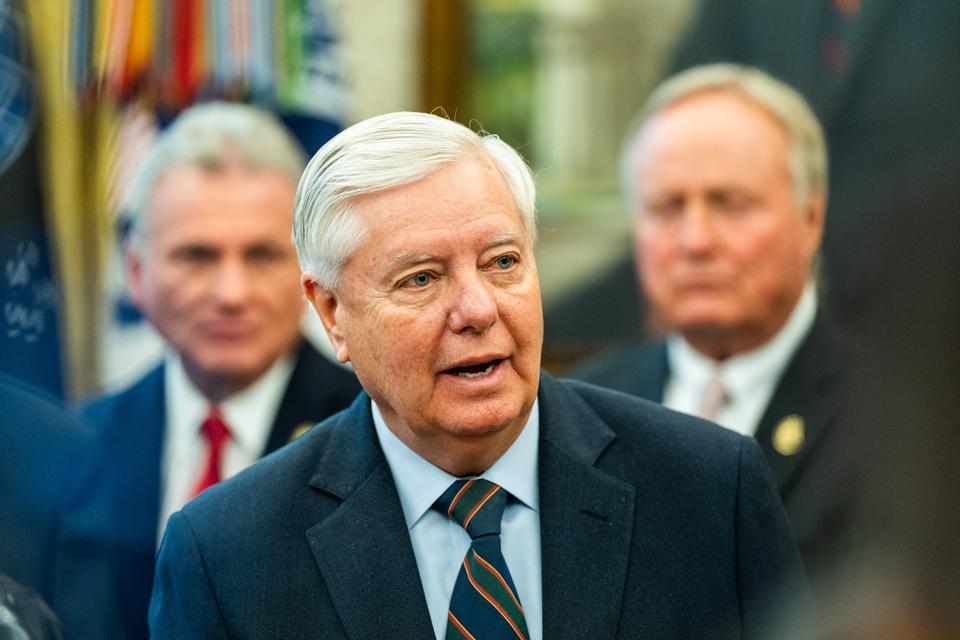
In separate remarks Tuesday, at the memoraila service, for Senator Lindsey Graham at the Washington National Cathedral, and during a Fox News interview, President Donald Trump addressed foreign policy, the ongoing conflict with Iran, and his personal and political relationships with both the late senator and Israeli Prime Minister Benjamin Netanyahu who was also present at the ceremony along with Ukrainian President Volodymyr Zelenskyy and other top U.S. officials.

Trump affectionately characterized Graham as a man who "liked war" and was "extremely hawkish," saying during the Fox News interview and his eulogy that the senator "never saw a war he didn't like." While the president acknowledged Graham's recent shift toward support for negotiating a deal with Iran, he maintained that the late senator's primary instinct was military action, particularly regarding the conflicts in Iran and Ukraine.

The U.S. president described Graham as a "force of nature" and a "great politician" whose friendship evolved from their 2016 rivalry during the presidential election campaigns. He remembered Graham as a "true American original," a "beloved friend," and a "giant of the United States Senate" who died at age 71.

In the Fox News interview hours before hosting Netanyahu at the White House, Trump aired frustration regarding discussions over Iran.

Trump dismissed reports originating from Israeli sources regarding Iran’s heavily fortified subterranean nuclear facility at Pickaxe Mountain, located near the Natanz complex.

Asked about the reports, Trump said, "I don't need Bibi to tell me [that]... Bibi is telling me that because he wants me to stay involved. We know exactly what's going on." He continued, "I heard Bibi announce that. I said, 'Why didn't you just tell it to me? Why did you have to announce it to the world?' I know exactly what's going on at Pickaxe. It's not a big problem."

Trump also added that while the site remains an issue, "If we don't make a deal, we'll take it out very easily."

The public friction between the two leaders came during a pause in U.S. aerial bombardment against Iranian installations to explore diplomatic options. Netanyahu sought to ensure the U.S. maintained military pressure on the Iran's deeply buried nuclear infrastructure.

Graham's funeral served as an impromptu summit in Washington D.C., bringing together world leaders including Netanyahu and Zelenskyy, both of whom held separate closed-door meetings with Trump at the White House.


community logo
Join the keneci Network Community
To read more articles like this, sign up and join my community today
0
What else you may like…
Videos
Posts
Articles
SpaceX Starlink Internet Satellites

With Starlink internet, data is continuously being sent between a ground dish and a Starlink satellite orbiting 550km above. Furthermore, the Starlink satellite zooms across the sky at 27,000 km/hr! MORE VIDEOS ON KENECI NETWORK RUMBLE CHANNEL: https://rumble.com/c/Keneci

00:28:08
Elon Musk, DOGE Speak On Waste And Fraud

US Department of Government Efficiency Services (USDS) led by Elon Musk speak on the "mind-boggling" fraud and waste in UInited States federal government

00:00:45
January 17, 2025
SpaceX Launches Starship 7th Test Flight

SpaceX successfully executed its second-ever “chopsticks” catch of a Super Heavy booster (or Booster 14) using the “Mechazilla” launch tower on Thursday(Jan. 16), during the seventh uncrewed test flight of the company's 123-meter Starship rocket. However, the megarocket's upper stage(or Ship 33) was lost approximately 8.5 minutes into the flight in a “rapid unscheduled disassembly(RUD)” or explosion

00:10:30
Welcome to Keneci Network!

Join the conversations!

December 09, 2025
Bitcoin White Paper By Satoshi Nakamoto

Bitcoin white paper

Bitcoin_White_Paper.pdf
September 17, 2024
Charges Against Sean 'Diddy' Combs In Grand Jury Indictment

The rapper was charged with racketeering conspiracy, sex trafficking by force, fraud or coercion, and transportation to engage in prostitution in the indictment unsealed Tuesday(Sept. 17)

Combs-Indictment-24-Cr.-542.pdf
post photo preview
Origin: SpaceX's Cursor Launches Code Hosting Platform, Github Rival Built For AI Coding Agents

Cursor, now owned by SpaceX, launched Origin, a code hosting platform built for AI coding agents, on Monday. The platform is currently in beta for paid users and allows developers to sync existing repositories from GitHub, with real-time two-way synchronization available--mirrors commit history, branches, and PR activity, keeping GitHub as the canonical source of truth until a team chooses to detach.

Built by the Graphite team acquired in late 2025, Origin is designed to handle high-frequency commits and parallel agent workloads, featuring AI-powered automated merge conflict resolution and sub-400-millisecond global sync latency.

Unlike GitHub, which was built for human-first developers, Origin is architected to manage fleets of AI agents committing simultaneously, addressing the bottleneck of manual code review. Early previews highlighted capabilities such as 296,000 clones per hour and the ability to handle 22 commits per second per repository.

The platform integrates directly into the Cursor IDE, featuring a Codebase tab for repository management and a Review tab for automated pull request processing. Instead of forcing developers to jump between a local editor and an external browser tab to check pull requests or review builds, Origin integrates repository management straight into Cursor.

Initial integrations include Vercel, Buildkite, and Depot, with support for existing GitHub Actions workflows to facilitate CI/CD pipelines.

"You can now host your repos in Cursor Origin and deploy to Vercel via Cursor Origin which is itself hosted on Vercel," Vercel chief executive Guillermo Rauch posted on X. "And unlike GitHub, it's online 😁" Asked why he was smiling, Rauch replied: "trying to make light of the situation. We ourselves are stuck because of github rn!"

Origin was first unveiled at Cursor’s Compile conference on June 16, 2026, alongside a new iOS app and a 1.5-trillion-parameter model. The launch follows SpaceX’s $60 billion all-stock acquisition of Cursor, which aims to consolidate control over the entire software development pipeline from editor to infrastructure.

By launching Origin, SpaceXAI and Cursor are shifting AI development from the editor level down to the infrastructure layer. Rather than relying on Microsoft-owned GitHub to store code while using Cursor to write it, Origin creates a vertically integrated ecosystem.

GitHub has been unreliable, in recent years and was down for several hours Monday, as Cursor launched Origin. An analysis by LeadDev counted 257 incidents between May 2025 and April 2026, 48 of them major — roughly one significant disruption per week. February was the worst month on record with 37.

GitHub Actions alone accounted for 57 outages in twelve months. Chief technology officer Vlad Fedorov has said the platform "wasn't built for the scale it's now being asked to handle" and must design for 30 times today's load. In an April engineering post covered by InfoQ, the company acknowledged it "failed to meet its own reliability standards," citing rapid growth, tight architectural coupling and inadequate load shedding. Monday's outage was the seventh incident on GitHub's status page in fifteen days.

The fatigue is audible. "GitHub really doesn't feel built for the agent era," one developer wrote on X as Origin went live. "It goes down way too often, but until now there haven't been many real alternatives."

Read full Article
post photo preview
USS Abraham Lincoln Condition Deteriorates As Gulf Leaders' Frustrations With Trump Admin Over Iran War, Grow

Sailors aboard the USS Abraham Lincoln (CVN-72) have reported severely deteriorating conditions to family members, including food shortages, broken plumbing, and mental health crises, following a record-breaking deployment of over 250 consecutive days at sea amid the Iran war.

There are unconfirmed reports of "low marale," sailors writing "anti-Israel and anti-war messages," using words like "goyims" and mocking President Donald Trump's repeated claims about iminent peace deals with Iran. Text messages published online and reported by military observers showed extreme frustration with the indefinite deployment. Some sailors reportedly wrote home that they felt trapped in an unclear mission, with messages such as "the Navy does not care" and questioning U.S. involvement in the wider Middle Eastern conflict.

Supply chain disruptions reportedly stemming from Iranian attacks on the Naval Support Activity in Bahrain forced the U.S. Navy to relocate its primary logistics hub to Diego Garcia, located roughly 3,540 kilometers from operational areas. This distance, combined with the "highly contested environment," have severely lengthened the carrier’s replenishment timelines.

Supplies that previously moved seamlessly via supply ships out of Bahrain began taking weeks to arrive, stalling shipments of mails, spare parts, fresh food, hygiene items (soap, toothpaste), and mails, while causing care packages to be lost or delayed for months. 

Sailors reportedly described eating dry cereal due to a lack of milk, consuming rotten meat, and dealing with moldy showers and non-functional toilets, which family members argue has created unbearable living conditions for the 5,000 personnel on board.

Although the Navy acknowledged logistical challenges like clogged toilets and ventilation issues causing mildew, officials maintain that sailors have access to clean water and healthy meals, attributing the hardships to the necessities of combat operations against Iran.

While families and lawmakers cite reports of suicide attempts and overboard incidents linked to exhaustion and supply failures, the Navy and Defense Secretary Pete Hegseth have disputed these accounts as "completely misrepresented," saying there is no confirmed increase in suicidal ideation on the career. Acting Navy Secretary Hung Cao acknowledged that crew members were "pushed to their limits" and confirmed temporary meal adjustments, but maintained that no core operational capabilities or meals were dropped.

While opposition Democrat lawmakers demand investigations into the "unbearable" conditions and the mental health toll on the crew, Trump downplayed the concerns, remarking that the deployment was "not nearly long enough," even as the Navy announced plans to replace the USS Abraham Lincoln with the USS George Washington.


Gulf Leaders' Frustrations With Trump Admin Over Prolonged Iran War, Grow

Meanwhile, frustration with the Trump administration has reached a critical point among U.S. allies in the Persian Gulf, driven by concerns that he lacks the diplomatic capability to end the prolonged war with Iran. Saudi Arabia, the United Arab Emirates, Qatar, Kuwait, and Bahrain are now reportedly united in their aggravation with Washington.

The Gulf nations reportedly feel "unnecessarily entangled" in a conflict they did not start but are forced to endure; with one Gulf official saying bluntly, "Trump started this war, and we are paying the price," and noting that anger toward the U.S. is at its highest level since joint U.S.-Israeli attacks on Iran in February 2026.

Gulf leaders complain that Trump’s policy is "erratic" and "unpredictable," characterized by repeated threats against Iran followed by sudden withdrawals citing diplomatic progress that never materializes.

The breakdown in trust is exacerbated by the failure of recent diplomatic initiatives, specifically the June Memorandum of Understanding (MOU) between the U.S. and Iran. Gulf leaders dismissed the agreement as a "joke" because it failed to address their top security concerns: Iran’s ballistic missile arsenal and its support for proxy forces. Furthermore, the continued closure of the Strait of Hormuz has inflicted severe economic damage on Gulf economies, yet the U.S. has been unable to force its reopening despite months of conflict.

For the first time, this diplomatic friction has led to concrete strategic debates regarding the presence of U.S. military installations. While Qatar and Bahrain currently host large U.S. bases essential to American regional power projection, officials in multiple Gulf states have begun questioning the utility of continuing to host these facilities. The concern is that these bases make them less safe, not more safe, by painting them as primary targets for Iranian missile and drone strikes without guaranteeing a decisive U.S. victory or security guarantee.

For now, a complete expulsion of U.S. forces is not imminent. Gulf states remain heavily dependent on Washington for security support, intelligence, and arms supplies. As one official reportedly admitted, "Whatever we do, we cannot say no to the United States." However, the mere discussion of closing bases signals a significant erosion of the trust that has underpinned Gulf security architecture for decades.

Gulf nations are actively diversifying their security and defense partnerships. A pivotal development occurred last week with the signing of the Makkah Defense Agreement, a mutual defense agreement between Saudi Arabia, Turkey, and Pakistan. Senior European officials reportedly describe this pact as a direct "signal to the U.S." that regional powers are preparing for a future where American guarantees are insufficient.

This shift indicates that while the U.S. remains a primary partner, Gulf leaders no longer view it as the sole guarantor of regional security. The strategy involves building a network of Sunni Muslim alliances to manage local threats independently, reducing vulnerability to the whims of U.S. domestic politics and presidential decision-making.

While the White House reportedly maintains that Trump has "extraordinary relationships" with Gulf partners and that Iran is "more isolated than ever," the reality on the ground suggests a deepening rift. Analysts warn that unless a clear strategy emerges, the security lockdown and economic strain could destabilize the region further, pushing Gulf states to seek accommodations with Tehran independent of Washington.

Read full Article
post photo preview
Globalstar 2-R Launch 1, USSF-366: SpaceX Doubleheader Missions 38 minutes Apart

SpaceX set a new operational record by launching two Falcon 9 rockets just 38 minutes 31 seconds apart on early morning, UTC, Sunday, (Aug. 16), besting its old record—set on Aug. 31, 2024 with two Starlink missions — by 27 minutes. The Elon Musk's company already launches far more frequently than any other oufit, and operates the largest satellite constellation—about 11,000 satellites and counting.

The first mission, Globalstar 2-R Launch 1, lifted off at 0112 UTC from Space Launch Complex 40 (SLC-40), at Cape Canaveral Space Force Station in Florida, carrying eight satellites for the Louisiana-based telecom company Globalstar to replenish its low Earth orbit (LEO) constellation.

The Falcon 9 first stage booster B1090, marking its 14th mission, landed as planned at Landing Zone 40 (LZ-40), Cape Canaveral, about eight minutes after liftoff. The second stage deployed all eight satellites to orbit successfully over a six-minute window beginning 56.5 minutes after launch.

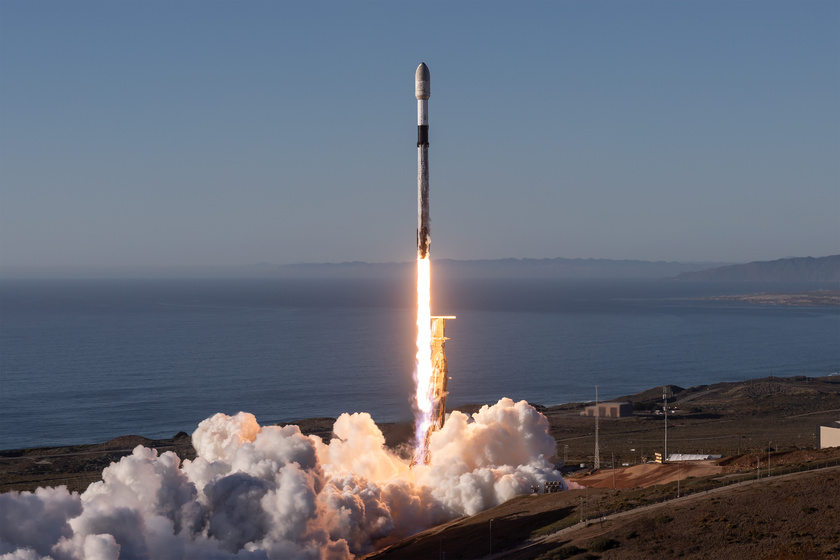
While the second stage was powering its way to LEO to deploy Globalstar 2-R Launch 1, another Falcon 9 launched at 0150 UTC from Space Launch Complex 4 East (SLC-4E) at Vandenberg Space Force Base in California, on a national security USSF-366 mission carrying a classified payload for the U.S. Space Force.

The national security flight's Falcon 9 first stage booster B1088, which completed its 18th flight, landed on the autonomous droneship "Of Course I Still Love You" in the Pacific Ocean about 8.5 minutes after liftoff.

The USSF-366 payload is believed to be a batch of classified LEO satellites using SpaceX's Starshield satellite bus for national security purposes. SpaceX's mission description doesn't reveal when and where the Falcon 9's upper stage will deploy the payloads.

Sunday's launches were part of a busy period for SpaceX, which continues to expand its launch cadence and the Starlink broadband network. The doubleheader brought the tally to 96 Falcon 9 launches in 2026— about 75% of which are Starlink missions—and marked the 650th successful Falcon booster landing in SpaceX history.

Read full Article
See More
Available on mobile and TV devices
google store google store app store app store
google store google store app tv store app tv store amazon store amazon store roku store roku store
Powered by Locals