keneci Network
News • Science & Tech • Comedy
Astronauts Return To Earth Aboard Soyuz MS-28 After 241 Days On Space Station
post photo preview

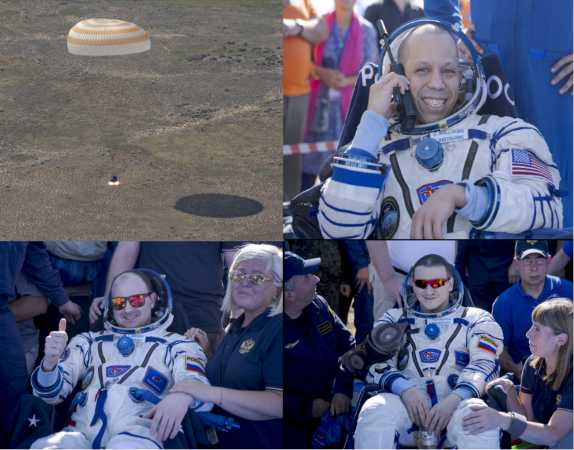
Soyuz MS-28 spacecraft, carrying NASA astronaut Chris Williams and Roscosmos cosmonauts Sergey Kud-Sverchkov and Sergei Mikaev, returned to Earth at 1027 UTC, July 26, 2026, after a 241-day mission aboard the International Space Station (ISS), concluding the Expedition 74 crew rotation. The capsule undocked from the station’s Rassvet module at 0703 UTC and executed a parachute-assisted landing on the Kazakh steppe southeast of Dzhezkaz.

The crew's departure activities began on Saturday morning with a change-of-command ceremony aboard the International Space Station (ISS). Kud‑Sverchkov handed over the reins of the orbiting lab to NASA astronaut Jessica Meir, part of the transition from ISS Expedition 74 to Expedition 75 (which officially began when Soyuz MS‑28 undocked). The crew then gave their farewells and closed the hatches between the ISS and Soyuz MS-28 on Saturday night.

Following a fiery re-entry and a 10-minute descent under parachutes, the crew was recovered by Russian teams who provided medical checks and traditional matryoshka dolls bearing their likenesses. Williams was flown to Karaganda and then to NASA’s Johnson Space Center in Houston, while the cosmonauts returned to Star City near Moscow.

The crew completed 3,856 orbits covering 164 million kilometers, marking the first spaceflight for Williams and Mikaev, and the second for Kud-Sverchkov, who previously served on Expedition 64-65 (2020–2021) and now has logged 426 days and 9 minutes in space.

William, a former medical physicist and astrophysicist, conducted two spacewalks to replace a joint on the station’s robotic arm and prepare for new solar blanket installations, while also participating in research on cancer treatments and in-space manufacturing. Kud-Sverchkov and Mikaev also performed maintenance spacewalks outside the Russian segment of the station.

The departure marked the beginning of Expedition 75, commanded by Meir. The new crew, consisting of Anil Menon, Pyotr Dubrov, and Anna Kikina, arrived at the ISS on July 14 via Soyuz MS-29. Soyuz MS-28 launched to the ISS on Nov. 27, which was Thanksgiving Day.

community logo
Join the keneci Network Community
To read more articles like this, sign up and join my community today
0
What else you may like…
Videos
Posts
Articles
SpaceX Starlink Internet Satellites

With Starlink internet, data is continuously being sent between a ground dish and a Starlink satellite orbiting 550km above. Furthermore, the Starlink satellite zooms across the sky at 27,000 km/hr! MORE VIDEOS ON KENECI NETWORK RUMBLE CHANNEL: https://rumble.com/c/Keneci

00:28:08
Elon Musk, DOGE Speak On Waste And Fraud

US Department of Government Efficiency Services (USDS) led by Elon Musk speak on the "mind-boggling" fraud and waste in UInited States federal government

00:00:45
January 17, 2025
SpaceX Launches Starship 7th Test Flight

SpaceX successfully executed its second-ever “chopsticks” catch of a Super Heavy booster (or Booster 14) using the “Mechazilla” launch tower on Thursday(Jan. 16), during the seventh uncrewed test flight of the company's 123-meter Starship rocket. However, the megarocket's upper stage(or Ship 33) was lost approximately 8.5 minutes into the flight in a “rapid unscheduled disassembly(RUD)” or explosion

00:10:30
Welcome to Keneci Network!

Join the conversations!

December 09, 2025
Bitcoin White Paper By Satoshi Nakamoto

Bitcoin white paper

Bitcoin_White_Paper.pdf
September 17, 2024
Charges Against Sean 'Diddy' Combs In Grand Jury Indictment

The rapper was charged with racketeering conspiracy, sex trafficking by force, fraud or coercion, and transportation to engage in prostitution in the indictment unsealed Tuesday(Sept. 17)

Combs-Indictment-24-Cr.-542.pdf
post photo preview
Berlin Pride Event Attack Suspect Killed By Police

Abdul Ballout, a 21-year-old German citizen of Lebanese descent, was killed by police on Sunday, following a nearly 24-hour manhunt for the deadly attack at Berlin's Christopher Street Day (Pride) celebration.

Authorities classified the incident as an Islamist terrorist attack, stating Ballout drove a white van into a crowd in Berlin’s Tiergarten park around 10 p.m. on Saturday (July 25) before allegedly stabbing several people with a machete.

The attack left one woman dead and 29 others injured, including three with life-threatening conditions, prompting the immediate cancellation of the festival’s closing rally.

Police spokesman Florian Nath earlier said the suspect was known to investigators because of his alleged ties to Islamic groups in Berlin.

"The suspect is known to police. He is known to us as a member of Islamic circles here in Berlin, and our search for this person is proceeding at full speed," Nath said. "We still have no information whatsoever regarding his specific motives, the exact sequence of events, or his role in the crime itself."

Ballout had a documented history of attempting to join the Islamic State (IS) group, according to the authorities. In May 2025, he traveled to Lebanon and attempted to enter Syria to join IS militants but was arrested by Lebanese authorities and later extradited to Germany.

Although he had previously received a suspended sentence for planning attacks and disseminating IS propaganda, he was released from detention in May 2026. During the final confrontation in Berlin’s Spandau district, Ballout allegedly charged at SEK tactical police units with a weapon, leading officers to fatally shoot him.

"Everything we see here points to us dealing with an Islamic terror attack," German Interior Minister Alexander Dobrindt said. 

Dobrindt and German Chancellor Friedrich Merz condemned the act as a heinous assault on German society and freedom.

The Christopher Street Day (Pride) event, which typically draws over one million participants, was shut down immediately after the violence, and police deployed more than 2,000 officers to secure the area. While Ballout was the primary suspect identified by prosecutors, another man was also arrested on the night of the attack and charged with multiple crimes in connection with the van incident.

Read full Article
post photo preview
Trump Halts US Strikes On Iran, As Clashes Between The Houthis and Saudi Arabian Forces Escalate With Aramco Attack

President Donald Trump ordered a halt to U.S. military strikes on Iran on Friday, ending a 13-day streak of consecutive nightly attacks to create space for diplomatic negotiations. He reportedly met with advisers to discuss potential escalation and weighed whether to launch a "massive attack;" as military officials raised worries about U.S. readiness for wider conflicts with adversaries like China.

The decision came shortly after an Omani delegation arrived in Tehran to discuss reopening the Strait of Hormuz, with Trump telling reporters at the White House he preferred to "make a deal" while keeping the military "locked and loaded."

"We're talking to [the Iranians] right now. I think they're getting more and more serious as the days go by. We're locked and loaded and ready to go, but we're talking to them," Trump said.

Later on Friday, during his remarks at the White House Correspondents Association dinner, Trump said he didn't think Iran is ready to make a deal at the moment, "but I'm willing to listen."

The Israeli security cabinet and Israel Defense Force reportedly expected another round of U.S. strikes on Friday and prepared for a massive U.S. attack that could trigger a retaliatory attack on Israel, Israeli officials say.

Trump's decision comes at a critical juncture as regional conflict spreads, maritime blockades persist, and U.S. ammunition stockpile depletes. Iran has closed the Strait of Hormuz, while U.S. Central Command (CENTCOM) has maintained an active maritime blockade to prevent tankers from entering or exiting Iranian oil terminals (such as Kharg Island).

As part of the blockade operations, U.S. forces targeted non-compliant oil tankers—including firing a Hellfire missile directly into the engine room of a vessel attempting to run the blockade—disabling its propulsion system without sinking the ship. Dozens of vessels have been turned back or redirected, according to CENTCOM.

Meanwhile the conflict is escalating on another front, as Iran-aligned Houthi forces launched coordinated ballistic missile and drone strikes overnight on Saturday, targeting major Saudi Aramco refining facilities in Jizan and Yanbu along the Red Sea. Satellite thermal imaging and geolocated footage confirmed active fires and smoke plumes at the Jizan refinery complex.

With transit through the Strait of Hormuz severely disrupted, attacks on Saudi Arabia's Red Sea oil infrastructure directly threaten alternative export routes, compounding global energy market volatility.

Regional mediators are currently pressing for an extended cease-fire or de-escalation off-ramp, as threat of all out war remains high across CENTCOM's area of responsibility.

The ceasefire broke down in early July 2026 after Iranian forces attacked non-compliant commercial vessels near the Strait of Hormuz, after Tehran accused the US of breaking the memorandum of understanding.

The US responded with renewed strikes on Iranian military targets (air defenses, command sites, small boats, radars, etc.) to protect navigation. This led to multiple nights of US action, Iranian retaliation (including on US bases), and blockade enforcement. CENTCOM conducted strikes on Iran for roughly 13 consecutive nights until Friday, targeting capabilities threatening shipping in the Strait of Hormuz.

Read full Article
post photo preview
Starship Flight 13: SpaceX Megarocket Makes Softest Splashdown, Deploys Starlink V3 Satellites

SpaceX successfully conducted Starship Flight 13 mission, its 13th suborbital test flight launching from Pad 2 at Starbase in Boca Chica, Texas, at 2251 UTC on Friday (July 24). The mission marked the second flight of the upgraded Starship V3 vehicle and achieved several critical milestones, including the first deployment of functional Starlink V3 satellites and a significantly improved re-entry for the upper stage.

The 124-meter Ship-Booster megarocket combo lifted off successfully, with all 33 Raptor engines on the Super Heavy booster 20 (B20) igniting at launch. After main engine cutoff (MECO), the vehicles separated via hot-staging. B20 flipped and initiated its boostback burn using 13 engines, to steer back toward the Texas Gulf Coast.

As B20 dropped toward the Gulf, the landing burn system suffered incomplete engine ignition--only eight of the 13 required landing engines fired--causing the booster to enter the water faster than intended with a harder splashdown at about 8 minutes after liftoff, rather than executing a soft splashdown.

"It didn't look like we lit all 13 engines that we were planning for that initial landing burn," SpaceX spokesperson Dan Huot said in live commentary. "We were targeting a softer splashdown and, as you saw, it came in with quite a bit of velocity."

Ship 40 (S40) continued into a suborbital trajectory, successfully deploying all 20 Starlink V3 satellites over a 10-minute period starting at about 17 minutes after liftoff.

The V3 satellites extended their solar arrays and antennas, attempting laser communications with the existing constellation. Six satellites carried cameras to photograph the Starship heat shield. Because the trajectory was intentionally suborbital, the satellites reentered the atmosphere 20 minutes after deployment as planned.

Starship is designed to launch 60 Starlink V3 satellites at a time, spitting them out through a slit-like payload bay door like a giant PEZ candy dispenser. All 20 Starlink V3 satellites deployed smoothly, with the last two switching on flashlights and looking back at their Ship carrier before floating off into orbital darkness.

S40 tested its heat shield—including experimental white-painted tiles simulating missing thermal protection. About 39 minutes after liftoff, S40 reignited one of its six Raptor engines to test a critical engine relight capability that will allow future Starships to enter and leave orbit. The burn went off without a hitch.

Then it was time for reentry, with cameras beaming back stunning views of Starship wrapped in super-hot plasma as it fell back to Earth. Reentry telemetry held steady via Starlink internet. The spacecraft executed a three-engine burn, leading into a belly-flop descent, landing flip, and engine reignition for a soft touchdown in the Indian Ocean about 65.5 minutes after liftoff, as it shifted down to two engines, then one engine before it toppled over to rest on the waves.

The sight of a floating Starship triggered a cacophony of cheers from SpaceX teams at Starbase and its Hawthorne, California rocket factory in the company's livestream.

"Starship is intact, floating in the ocean and transmitting telemetry!" SpaceX CEO Elon Musk wrote on X.

"That is a first," Huot added as a drone beamed stunning views of Starship bobbing in the waves. "That is the softest splashdown we have ever had with Starship in the Indian Ocean."

"I'm a little over the moon right now," Huot later added. "Wow. Lucky number 13. Hell of a great day for Starship."

Summarizing the mission on their website, SpaceX writes, "On Friday, July 24, 2026, at 5:51 p.m. CT, Starship lifted off from Starbase, Texas on its thirteenth flight test. This was the second flight of the Starship and Super Heavy V3 vehicles and the first Starship flight to deploy the next generation Starlink V3 satellites.

"The flight test began with Super Heavy igniting all 33 Raptor 3 engines and ascending over the Gulf of America. The successful first-stage ascent was followed by a hot-staging maneuver, with Starship’s upper stage igniting its six Raptor engines to continue its flight to space.

"Following stage separation, the Super Heavy booster performed a directional flip maneuver. The startup sequence was modified for this flight to be more robust to timing variability in engine startup and flip in the desired direction, which is done to increase overall performance. The booster successfully completed the high thrust portion of the boostback burn with all 33 engines, the first time with a Super Heavy V3, before ending the burn early. It attempted to relight its engines for the landing burn, with a subset successfully igniting before experiencing a hard splashdown in the Gulf.

"After completing a full-duration ascent burn on all six Raptor engines, Starship achieved its planned velocity and trajectory. Starship then successfully deployed all 20 Starlink V3 satellites. SpaceX engineers were able to successfully communicate with every satellite using radio frequency and laser links and downloaded key telemetry from the satellites. The Starlink satellites were deployed on the pre-planned trajectory and are expected to have demised upon reentry approximately 20 minutes after deployment.

"The vehicle also reignited a single Raptor engine in an in-space demonstration of a core capability for future orbital missions.

"Starship re-entered the Earth’s atmosphere and was able to gather critical data on the performance of its heatshield before executing a dynamic banking move to mimic the trajectory that future missions returning to Starbase will fly. Starship then guided itself using its four flaps to the pre-planned splashdown zone in the Indian Ocean. After relighting all three Raptor engines, Starship executed a landing flip, landing burn, and soft splashdown, coming to rest intact in the Indian Ocean and providing critical views of an intact heatshield for the first time."

Flight 13 mission advanced SpaceX’s goals for Starlink expansion, as future flights will carry up to 60 Starlink V3 satellites. It also supports NASA’s Artemis III mission, where a modified Starship is scheduled to dock with the Orion spacecraft in Earth orbit in 2027. NASA has also tapped Starship to land its Artemis IV astronauts on the moon in 2028.

"Congrats on getting Flight 13 underway," NASA Administrator Jared Isaacman wrote on X after the launch. "Excited for what will be learned from this mission. When Starship comes online, its capabilities will be game-changing, not least of which will be ensuring we never give up the Moon again!" In a lunar coincidence, Friday's launch coincided with the 57th anniversary of the Apollo 11 astronauts' return to Earth after their historic moon landing flight.

The successful heat shield data and satellite deployment provide crucial insights for making Starship reusable and ready for operational missions, potentially including the first launch from Florida later in 2026.

Friday's launch followed a one-day delay caused by Tropical Storm Bertha and a previous abort on July 16, where six engines on the Super Heavy booster failed to ignite due to turbopump issues. SpaceX replaced the affected engines and implemented hardware and software modifications to address failures seen in Flight 12, specifically targeting improved engine relight reliability and boostback burn stability.

Read full Article
See More
Available on mobile and TV devices
google store google store app store app store
google store google store app tv store app tv store amazon store amazon store roku store roku store
Powered by Locals