keneci Network
News • Comedy • Science & Tech
Starship Flight 13: SpaceX Megarocket Makes Softest Splashdown, Deploys Starlink V3 Satellites
July 25, 2026
post photo preview

SpaceX successfully conducted Starship Flight 13 mission, its 13th suborbital test flight launching from Pad 2 at Starbase in Boca Chica, Texas, at 2251 UTC on Friday (July 24). The mission marked the second flight of the upgraded Starship V3 vehicle and achieved several critical milestones, including the first deployment of functional Starlink V3 satellites and a significantly improved re-entry for the upper stage.

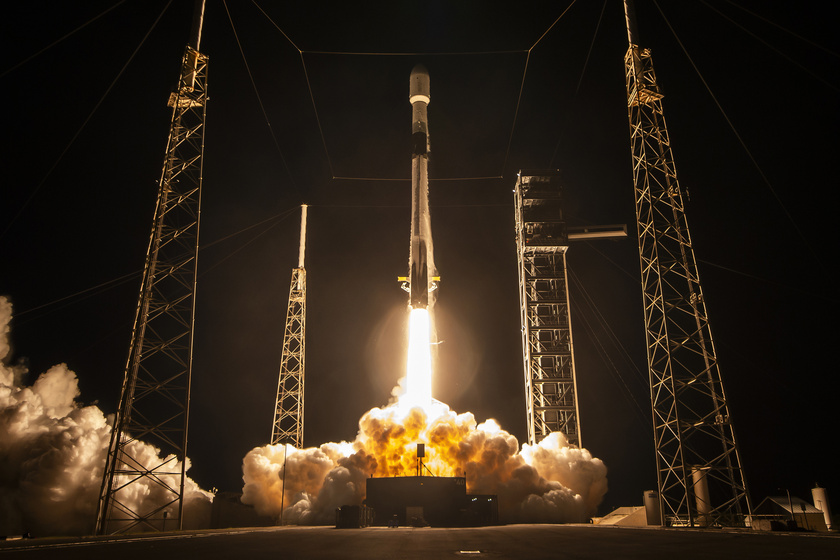
The 124-meter Ship-Booster megarocket combo lifted off successfully, with all 33 Raptor engines on the Super Heavy booster 20 (B20) igniting at launch. After main engine cutoff (MECO), the vehicles separated via hot-staging. B20 flipped and initiated its boostback burn using 13 engines, to steer back toward the Texas Gulf Coast.

As B20 dropped toward the Gulf, the landing burn system suffered incomplete engine ignition--only eight of the 13 required landing engines fired--causing the booster to enter the water faster than intended with a harder splashdown at about 8 minutes after liftoff, rather than executing a soft splashdown.

"It didn't look like we lit all 13 engines that we were planning for that initial landing burn," SpaceX spokesperson Dan Huot said in live commentary. "We were targeting a softer splashdown and, as you saw, it came in with quite a bit of velocity."

Ship 40 (S40) continued into a suborbital trajectory, successfully deploying all 20 Starlink V3 satellites over a 10-minute period starting at about 17 minutes after liftoff.

The V3 satellites extended their solar arrays and antennas, attempting laser communications with the existing constellation. Six satellites carried cameras to photograph the Starship heat shield. Because the trajectory was intentionally suborbital, the satellites reentered the atmosphere 20 minutes after deployment as planned.

Starship is designed to launch 60 Starlink V3 satellites at a time, spitting them out through a slit-like payload bay door like a giant PEZ candy dispenser. All 20 Starlink V3 satellites deployed smoothly, with the last two switching on flashlights and looking back at their Ship carrier before floating off into orbital darkness.

S40 tested its heat shield—including experimental white-painted tiles simulating missing thermal protection. About 39 minutes after liftoff, S40 reignited one of its six Raptor engines to test a critical engine relight capability that will allow future Starships to enter and leave orbit. The burn went off without a hitch.

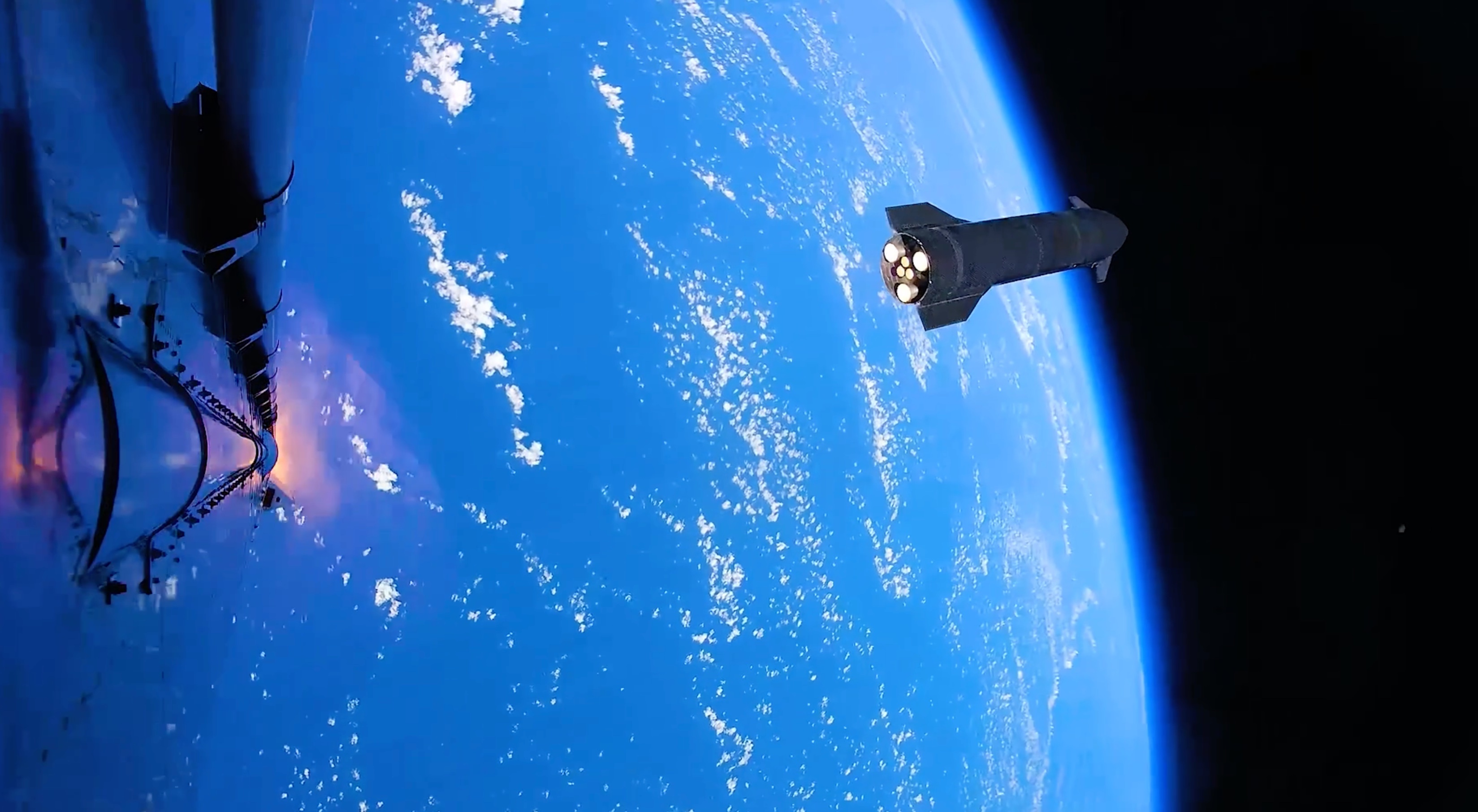
Then it was time for reentry, with cameras beaming back stunning views of Starship wrapped in super-hot plasma as it fell back to Earth. Reentry telemetry held steady via Starlink internet. The spacecraft executed a three-engine burn, leading into a belly-flop descent, landing flip, and engine reignition for a soft touchdown in the Indian Ocean about 65.5 minutes after liftoff, as it shifted down to two engines, then one engine before it toppled over to rest on the waves.

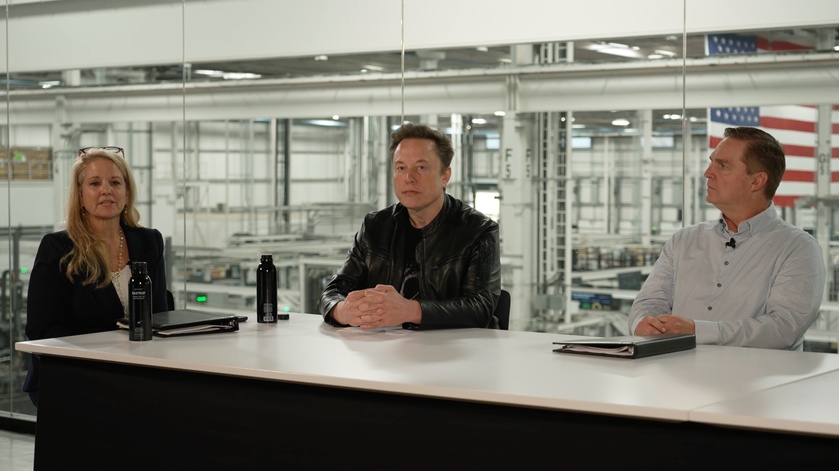
The sight of a floating Starship triggered a cacophony of cheers from SpaceX teams at Starbase and its Hawthorne, California rocket factory in the company's livestream.

"Starship is intact, floating in the ocean and transmitting telemetry!" SpaceX CEO Elon Musk wrote on X.

"That is a first," Huot added as a drone beamed stunning views of Starship bobbing in the waves. "That is the softest splashdown we have ever had with Starship in the Indian Ocean."

"I'm a little over the moon right now," Huot later added. "Wow. Lucky number 13. Hell of a great day for Starship."

Summarizing the mission on their website, SpaceX writes, "On Friday, July 24, 2026, at 5:51 p.m. CT, Starship lifted off from Starbase, Texas on its thirteenth flight test. This was the second flight of the Starship and Super Heavy V3 vehicles and the first Starship flight to deploy the next generation Starlink V3 satellites.

"The flight test began with Super Heavy igniting all 33 Raptor 3 engines and ascending over the Gulf of America. The successful first-stage ascent was followed by a hot-staging maneuver, with Starship’s upper stage igniting its six Raptor engines to continue its flight to space.

"Following stage separation, the Super Heavy booster performed a directional flip maneuver. The startup sequence was modified for this flight to be more robust to timing variability in engine startup and flip in the desired direction, which is done to increase overall performance. The booster successfully completed the high thrust portion of the boostback burn with all 33 engines, the first time with a Super Heavy V3, before ending the burn early. It attempted to relight its engines for the landing burn, with a subset successfully igniting before experiencing a hard splashdown in the Gulf.

"After completing a full-duration ascent burn on all six Raptor engines, Starship achieved its planned velocity and trajectory. Starship then successfully deployed all 20 Starlink V3 satellites. SpaceX engineers were able to successfully communicate with every satellite using radio frequency and laser links and downloaded key telemetry from the satellites. The Starlink satellites were deployed on the pre-planned trajectory and are expected to have demised upon reentry approximately 20 minutes after deployment.

"The vehicle also reignited a single Raptor engine in an in-space demonstration of a core capability for future orbital missions.

"Starship re-entered the Earth’s atmosphere and was able to gather critical data on the performance of its heatshield before executing a dynamic banking move to mimic the trajectory that future missions returning to Starbase will fly. Starship then guided itself using its four flaps to the pre-planned splashdown zone in the Indian Ocean. After relighting all three Raptor engines, Starship executed a landing flip, landing burn, and soft splashdown, coming to rest intact in the Indian Ocean and providing critical views of an intact heatshield for the first time."

Flight 13 mission advanced SpaceX’s goals for Starlink expansion, as future flights will carry up to 60 Starlink V3 satellites. It also supports NASA’s Artemis III mission, where a modified Starship is scheduled to dock with the Orion spacecraft in Earth orbit in 2027. NASA has also tapped Starship to land its Artemis IV astronauts on the moon in 2028.

"Congrats on getting Flight 13 underway," NASA Administrator Jared Isaacman wrote on X after the launch. "Excited for what will be learned from this mission. When Starship comes online, its capabilities will be game-changing, not least of which will be ensuring we never give up the Moon again!" In a lunar coincidence, Friday's launch coincided with the 57th anniversary of the Apollo 11 astronauts' return to Earth after their historic moon landing flight.

The successful heat shield data and satellite deployment provide crucial insights for making Starship reusable and ready for operational missions, potentially including the first launch from Florida later in 2026.

Friday's launch followed a one-day delay caused by Tropical Storm Bertha and a previous abort on July 16, where six engines on the Super Heavy booster failed to ignite due to turbopump issues. SpaceX replaced the affected engines and implemented hardware and software modifications to address failures seen in Flight 12, specifically targeting improved engine relight reliability and boostback burn stability.


community logo
Join the keneci Network Community
To read more articles like this, sign up and join my community today
0
What else you may like…
Videos
Posts
Articles
SpaceX Starlink Internet Satellites

With Starlink internet, data is continuously being sent between a ground dish and a Starlink satellite orbiting 550km above. Furthermore, the Starlink satellite zooms across the sky at 27,000 km/hr! MORE VIDEOS ON KENECI NETWORK RUMBLE CHANNEL: https://rumble.com/c/Keneci

00:28:08
Elon Musk, DOGE Speak On Waste And Fraud

US Department of Government Efficiency Services (USDS) led by Elon Musk speak on the "mind-boggling" fraud and waste in UInited States federal government

00:00:45
January 17, 2025
SpaceX Launches Starship 7th Test Flight

SpaceX successfully executed its second-ever “chopsticks” catch of a Super Heavy booster (or Booster 14) using the “Mechazilla” launch tower on Thursday(Jan. 16), during the seventh uncrewed test flight of the company's 123-meter Starship rocket. However, the megarocket's upper stage(or Ship 33) was lost approximately 8.5 minutes into the flight in a “rapid unscheduled disassembly(RUD)” or explosion

00:10:30
Welcome to Keneci Network!

Join the conversations!

December 09, 2025
Bitcoin White Paper By Satoshi Nakamoto

Bitcoin white paper

Bitcoin_White_Paper.pdf
September 17, 2024
Charges Against Sean 'Diddy' Combs In Grand Jury Indictment

The rapper was charged with racketeering conspiracy, sex trafficking by force, fraud or coercion, and transportation to engage in prostitution in the indictment unsealed Tuesday(Sept. 17)

Combs-Indictment-24-Cr.-542.pdf
post photo preview
Origin: SpaceX's Cursor Launches Code Hosting Platform, Github Rival Built For AI Coding Agents

Cursor, now owned by SpaceX, launched Origin, a code hosting platform built for AI coding agents, on Monday. The platform is currently in beta for paid users and allows developers to sync existing repositories from GitHub, with real-time two-way synchronization available--mirrors commit history, branches, and PR activity, keeping GitHub as the canonical source of truth until a team chooses to detach.

Built by the Graphite team acquired in late 2025, Origin is designed to handle high-frequency commits and parallel agent workloads, featuring AI-powered automated merge conflict resolution and sub-400-millisecond global sync latency.

Unlike GitHub, which was built for human-first developers, Origin is architected to manage fleets of AI agents committing simultaneously, addressing the bottleneck of manual code review. Early previews highlighted capabilities such as 296,000 clones per hour and the ability to handle 22 commits per second per repository.

The platform integrates directly into the Cursor IDE, featuring a Codebase tab for repository management and a Review tab for automated pull request processing. Instead of forcing developers to jump between a local editor and an external browser tab to check pull requests or review builds, Origin integrates repository management straight into Cursor.

Initial integrations include Vercel, Buildkite, and Depot, with support for existing GitHub Actions workflows to facilitate CI/CD pipelines.

"You can now host your repos in Cursor Origin and deploy to Vercel via Cursor Origin which is itself hosted on Vercel," Vercel chief executive Guillermo Rauch posted on X. "And unlike GitHub, it's online 😁" Asked why he was smiling, Rauch replied: "trying to make light of the situation. We ourselves are stuck because of github rn!"

Origin was first unveiled at Cursor’s Compile conference on June 16, 2026, alongside a new iOS app and a 1.5-trillion-parameter model. The launch follows SpaceX’s $60 billion all-stock acquisition of Cursor, which aims to consolidate control over the entire software development pipeline from editor to infrastructure.

By launching Origin, SpaceXAI and Cursor are shifting AI development from the editor level down to the infrastructure layer. Rather than relying on Microsoft-owned GitHub to store code while using Cursor to write it, Origin creates a vertically integrated ecosystem.

GitHub has been unreliable, in recent years and was down for several hours Monday, as Cursor launched Origin. An analysis by LeadDev counted 257 incidents between May 2025 and April 2026, 48 of them major — roughly one significant disruption per week. February was the worst month on record with 37.

GitHub Actions alone accounted for 57 outages in twelve months. Chief technology officer Vlad Fedorov has said the platform "wasn't built for the scale it's now being asked to handle" and must design for 30 times today's load. In an April engineering post covered by InfoQ, the company acknowledged it "failed to meet its own reliability standards," citing rapid growth, tight architectural coupling and inadequate load shedding. Monday's outage was the seventh incident on GitHub's status page in fifteen days.

The fatigue is audible. "GitHub really doesn't feel built for the agent era," one developer wrote on X as Origin went live. "It goes down way too often, but until now there haven't been many real alternatives."

Read full Article
post photo preview
USS Abraham Lincoln Condition Deteriorates As Gulf Leaders' Frustrations With Trump Admin Over Iran War, Grow

Sailors aboard the USS Abraham Lincoln (CVN-72) have reported severely deteriorating conditions to family members, including food shortages, broken plumbing, and mental health crises, following a record-breaking deployment of over 250 consecutive days at sea amid the Iran war.

There are unconfirmed reports of "low marale," sailors writing "anti-Israel and anti-war messages," using words like "goyims" and mocking President Donald Trump's repeated claims about iminent peace deals with Iran. Text messages published online and reported by military observers showed extreme frustration with the indefinite deployment. Some sailors reportedly wrote home that they felt trapped in an unclear mission, with messages such as "the Navy does not care" and questioning U.S. involvement in the wider Middle Eastern conflict.

Supply chain disruptions reportedly stemming from Iranian attacks on the Naval Support Activity in Bahrain forced the U.S. Navy to relocate its primary logistics hub to Diego Garcia, located roughly 3,540 kilometers from operational areas. This distance, combined with the "highly contested environment," have severely lengthened the carrier’s replenishment timelines.

Supplies that previously moved seamlessly via supply ships out of Bahrain began taking weeks to arrive, stalling shipments of mails, spare parts, fresh food, hygiene items (soap, toothpaste), and mails, while causing care packages to be lost or delayed for months. 

Sailors reportedly described eating dry cereal due to a lack of milk, consuming rotten meat, and dealing with moldy showers and non-functional toilets, which family members argue has created unbearable living conditions for the 5,000 personnel on board.

Although the Navy acknowledged logistical challenges like clogged toilets and ventilation issues causing mildew, officials maintain that sailors have access to clean water and healthy meals, attributing the hardships to the necessities of combat operations against Iran.

While families and lawmakers cite reports of suicide attempts and overboard incidents linked to exhaustion and supply failures, the Navy and Defense Secretary Pete Hegseth have disputed these accounts as "completely misrepresented," saying there is no confirmed increase in suicidal ideation on the career. Acting Navy Secretary Hung Cao acknowledged that crew members were "pushed to their limits" and confirmed temporary meal adjustments, but maintained that no core operational capabilities or meals were dropped.

While opposition Democrat lawmakers demand investigations into the "unbearable" conditions and the mental health toll on the crew, Trump downplayed the concerns, remarking that the deployment was "not nearly long enough," even as the Navy announced plans to replace the USS Abraham Lincoln with the USS George Washington.


Gulf Leaders' Frustrations With Trump Admin Over Prolonged Iran War, Grow

Meanwhile, frustration with the Trump administration has reached a critical point among U.S. allies in the Persian Gulf, driven by concerns that he lacks the diplomatic capability to end the prolonged war with Iran. Saudi Arabia, the United Arab Emirates, Qatar, Kuwait, and Bahrain are now reportedly united in their aggravation with Washington.

The Gulf nations reportedly feel "unnecessarily entangled" in a conflict they did not start but are forced to endure; with one Gulf official saying bluntly, "Trump started this war, and we are paying the price," and noting that anger toward the U.S. is at its highest level since joint U.S.-Israeli attacks on Iran in February 2026.

Gulf leaders complain that Trump’s policy is "erratic" and "unpredictable," characterized by repeated threats against Iran followed by sudden withdrawals citing diplomatic progress that never materializes.

The breakdown in trust is exacerbated by the failure of recent diplomatic initiatives, specifically the June Memorandum of Understanding (MOU) between the U.S. and Iran. Gulf leaders dismissed the agreement as a "joke" because it failed to address their top security concerns: Iran’s ballistic missile arsenal and its support for proxy forces. Furthermore, the continued closure of the Strait of Hormuz has inflicted severe economic damage on Gulf economies, yet the U.S. has been unable to force its reopening despite months of conflict.

For the first time, this diplomatic friction has led to concrete strategic debates regarding the presence of U.S. military installations. While Qatar and Bahrain currently host large U.S. bases essential to American regional power projection, officials in multiple Gulf states have begun questioning the utility of continuing to host these facilities. The concern is that these bases make them less safe, not more safe, by painting them as primary targets for Iranian missile and drone strikes without guaranteeing a decisive U.S. victory or security guarantee.

For now, a complete expulsion of U.S. forces is not imminent. Gulf states remain heavily dependent on Washington for security support, intelligence, and arms supplies. As one official reportedly admitted, "Whatever we do, we cannot say no to the United States." However, the mere discussion of closing bases signals a significant erosion of the trust that has underpinned Gulf security architecture for decades.

Gulf nations are actively diversifying their security and defense partnerships. A pivotal development occurred last week with the signing of the Makkah Defense Agreement, a mutual defense agreement between Saudi Arabia, Turkey, and Pakistan. Senior European officials reportedly describe this pact as a direct "signal to the U.S." that regional powers are preparing for a future where American guarantees are insufficient.

This shift indicates that while the U.S. remains a primary partner, Gulf leaders no longer view it as the sole guarantor of regional security. The strategy involves building a network of Sunni Muslim alliances to manage local threats independently, reducing vulnerability to the whims of U.S. domestic politics and presidential decision-making.

While the White House reportedly maintains that Trump has "extraordinary relationships" with Gulf partners and that Iran is "more isolated than ever," the reality on the ground suggests a deepening rift. Analysts warn that unless a clear strategy emerges, the security lockdown and economic strain could destabilize the region further, pushing Gulf states to seek accommodations with Tehran independent of Washington.

Read full Article
post photo preview
Globalstar 2-R Launch 1, USSF-366: SpaceX Doubleheader Missions 38 minutes Apart

SpaceX set a new operational record by launching two Falcon 9 rockets just 38 minutes 31 seconds apart on early morning, UTC, Sunday, (Aug. 16), besting its old record—set on Aug. 31, 2024 with two Starlink missions — by 27 minutes. The Elon Musk's company already launches far more frequently than any other oufit, and operates the largest satellite constellation—about 11,000 satellites and counting.

The first mission, Globalstar 2-R Launch 1, lifted off at 0112 UTC from Space Launch Complex 40 (SLC-40), at Cape Canaveral Space Force Station in Florida, carrying eight satellites for the Louisiana-based telecom company Globalstar to replenish its low Earth orbit (LEO) constellation.

The Falcon 9 first stage booster B1090, marking its 14th mission, landed as planned at Landing Zone 40 (LZ-40), Cape Canaveral, about eight minutes after liftoff. The second stage deployed all eight satellites to orbit successfully over a six-minute window beginning 56.5 minutes after launch.

While the second stage was powering its way to LEO to deploy Globalstar 2-R Launch 1, another Falcon 9 launched at 0150 UTC from Space Launch Complex 4 East (SLC-4E) at Vandenberg Space Force Base in California, on a national security USSF-366 mission carrying a classified payload for the U.S. Space Force.

The national security flight's Falcon 9 first stage booster B1088, which completed its 18th flight, landed on the autonomous droneship "Of Course I Still Love You" in the Pacific Ocean about 8.5 minutes after liftoff.

The USSF-366 payload is believed to be a batch of classified LEO satellites using SpaceX's Starshield satellite bus for national security purposes. SpaceX's mission description doesn't reveal when and where the Falcon 9's upper stage will deploy the payloads.

Sunday's launches were part of a busy period for SpaceX, which continues to expand its launch cadence and the Starlink broadband network. The doubleheader brought the tally to 96 Falcon 9 launches in 2026— about 75% of which are Starlink missions—and marked the 650th successful Falcon booster landing in SpaceX history.

Read full Article
See More
Available on mobile and TV devices
google store google store app store app store
google store google store app tv store app tv store amazon store amazon store roku store roku store
Powered by Locals