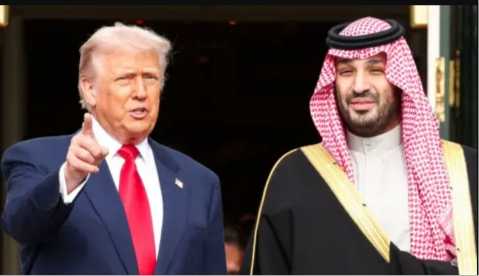
President Donald Trump in a Truth Social post Thursday, claimed that a newly signed U.S.-Saudi nuclear cooperation deal is contingent on Saudi Arabia joining the Abraham Accords to normalize relations with Israel, and he asserted the agreement prohibits uranium enrichment.
While Energy Secretary Chris Wright and Saudi Minister of Energy Prince Abdulaziz bin Salman signed the 30-year "123 agreement" on Wednesday to allow U.S. firms to develop Saudi Arabia's civilian nuclear program, Trump added the normalization condition via the Truth Social post Thursday, stating the deal "pertains only to non-military use" and involves "no enrichment of material." Saudi officials reportedly reject any changes to what has been signed by both countries
Conflicting reports exist regarding the deal's specific terms on enrichment and safeguards. Although Trump insists enrichment is banned, multiple sources indicate the agreement includes a provision for a joint U.S.-Saudi study to determine the feasibility of building a uranium enrichment facility in the kingdom in the future.
The deal notably excludes the International Atomic Energy Agency's (IAEA) "additional protocol" for snap inspections, relying instead on a bilateral safeguards agreement between the two nations, a departure from the "gold standard" set by the 2009 U.S.-UAE nuclear accord.
The agreement faces significant scrutiny over nuclear proliferation risks and the leverage lost for Israeli-Saudi normalization. Critics, including non-proliferation advocates and some lawmakers, warn that allowing Saudi Arabia to develop enrichment capabilities could enable a nuclear weapons program, especially given Crown Prince Mohammed bin Salman's past statements about matching Iran's capabilities.
Furthermore, experts argue that by signing the nuclear deal without first securing Saudi-Israeli normalization, the U.S. has surrendered a major diplomatic lever, as Saudi Arabia has historically demanded a clear path to Palestinian statehood before recognizing Israel. And critics note that the deal undermines U.S. demands of Iran to give up Uranium enrichment.
The deal must now undergo a mandatory 90-day review period by the U.S. Congress under a 1954 law, before it can enter into force.
Prime Minister Benjamin Netanyahu's office welcomed the potential for Saudi Arabia to join the Abraham Accords as a "historic leap forward," though officials in Jerusalem are reportedly furious over the deal.
The Jewish nation has a stockpile of ~90 assembled warheads (mostly plutonium-based); enough plutonium for potentially 100–200 weapons total, though the actual deployed/assembled number is limited by delivery systems and other factors. Delivery systemss are believed to include: gravity bombs for aircraft (like F-15/F-16), Jericho ballistic missiles (land-based) and possibly sea-launched cruise missiles (nuclear triad suspected but not fully confirmed).