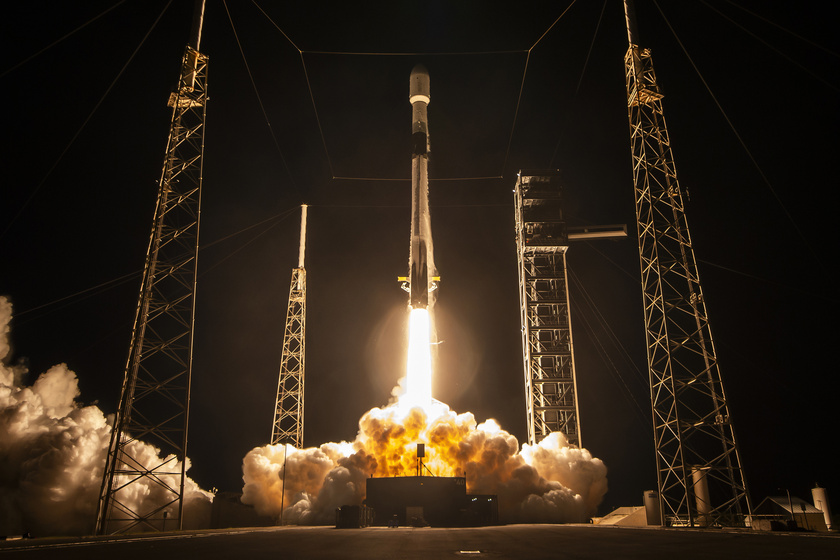
A Russian Soyuz MS-29 spacecraft, carrying NASA astronaut Anil Menon, Roscosmos cosmonaut Pyotr Dubrov, and Anna Kikina, launched from the Baikonur Cosmodrome in Kazakhstan at 1447 UTC Tuesday (July 14) and autonomously docked with the International Space Station (ISS) at 1752 UTC, just three hours after liftoff.
The Soyuz executed nominal side booster separation about two minutes after liftoff, followed by second stage separation about 2.5 minutes later, as the rocket flew at 169 kilometers(km) in altitude. Third stage orbital insertion and separation was completed at about 8 minutes and 46 seconds, putting Soyuz MS-29 spacecraft and crew on course to chase down the ISS.
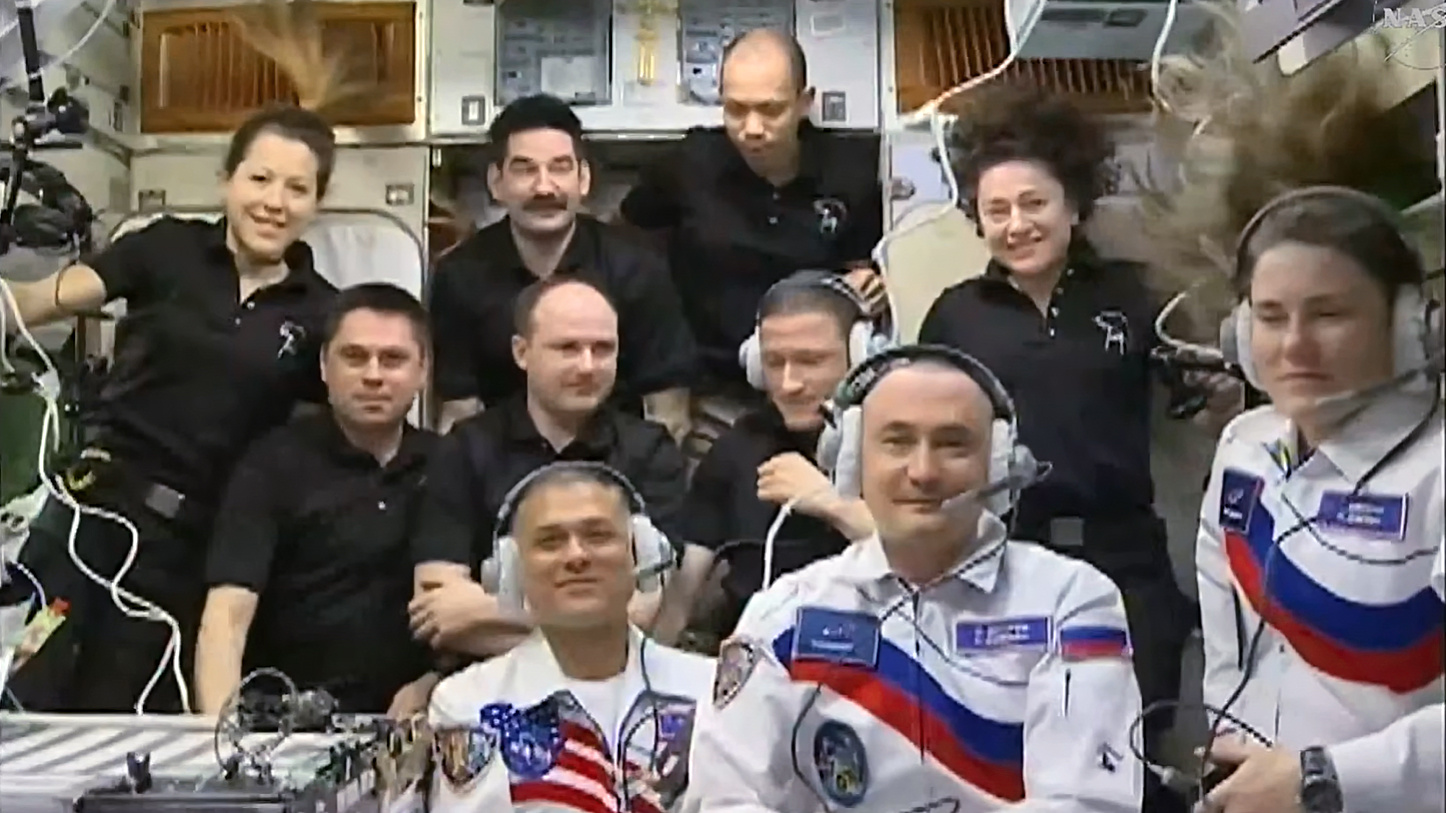
The Soyuz MS-29 capsule autonomously docked with the Prichal module of the ISS while both were flying about 418 km above the Mediterranean Sea. Following hatch opening at 2030 UTC, the trio floated into the ISS, welcomed by the seven astronauts already living aboard the ISS — NASA's Jessica Meir, Jack Hathaway, and Chris Williams, the European Space Agency's Sophie Adenot, and Sergey Kud-Sverchkov, Sergei Mikaev, and Andrey Fedyaev of the Russian space agency Roscosmos.
The MS-29 trio will spend about eight months living and working on the orbiting lab. Menon will help conduct a wide variety of scientific experiments during that stretch.
"He will continue research to refine in-space production of semiconductor crystals to enable the large-scale manufacturing of components needed for high-performance computers, artificial intelligence, and improved medical devices," NASA officials wrote in a July 9 media advisory. "Menon also will perform ultrasound using augmented reality and artificial intelligence methods that could eliminate the need for medical support from Earth on future space missions."
This is Menon’s first spaceflight and the second for Dubrov and Kikina, who will remain on the station for an eight-month mission through April 2027. The new trio will transition to Expedition 75 after the current crew commander Kud-Sverchkov, flight engineers Williams and Mikaev depart on Soyuz MS-28 later in the month.
Menon has already been to space, though not with NASA. In September 2024, while an employee of SpaceX, she flew on the company's Polaris Dawn mission to Earth orbit becoming the company's first flight surgeon. That five-day flight, which was funded and commanded by current NASA Administrator Jared Isaacman, featured the first-ever commercial spacewalk and reached a maximum altitude of 1,400.7 km — higher than any previous crewed Earth-orbiting mission had gotten.
Kikina, the only female member of Russia's active astronaut corps, flew to and from the ISS back then on SpaceX's Crew-5 mission. That was a big deal: She was the first Russian ever to fly on a private U.S. spacecraft, and the first cosmonaut to fly on any American space vehicle since December 2002, when cosmonauts Valery Korzun and Sergey Treshchov came back to Earth from the ISS aboard the space shuttle Endeavour.