keneci Network
News • Comedy • Science & Tech
Vance Backs Debate About US-Israel Alliance, Defends Tucker Carlson: TPUSA AmFest 2025
December 22, 2025
post photo preview

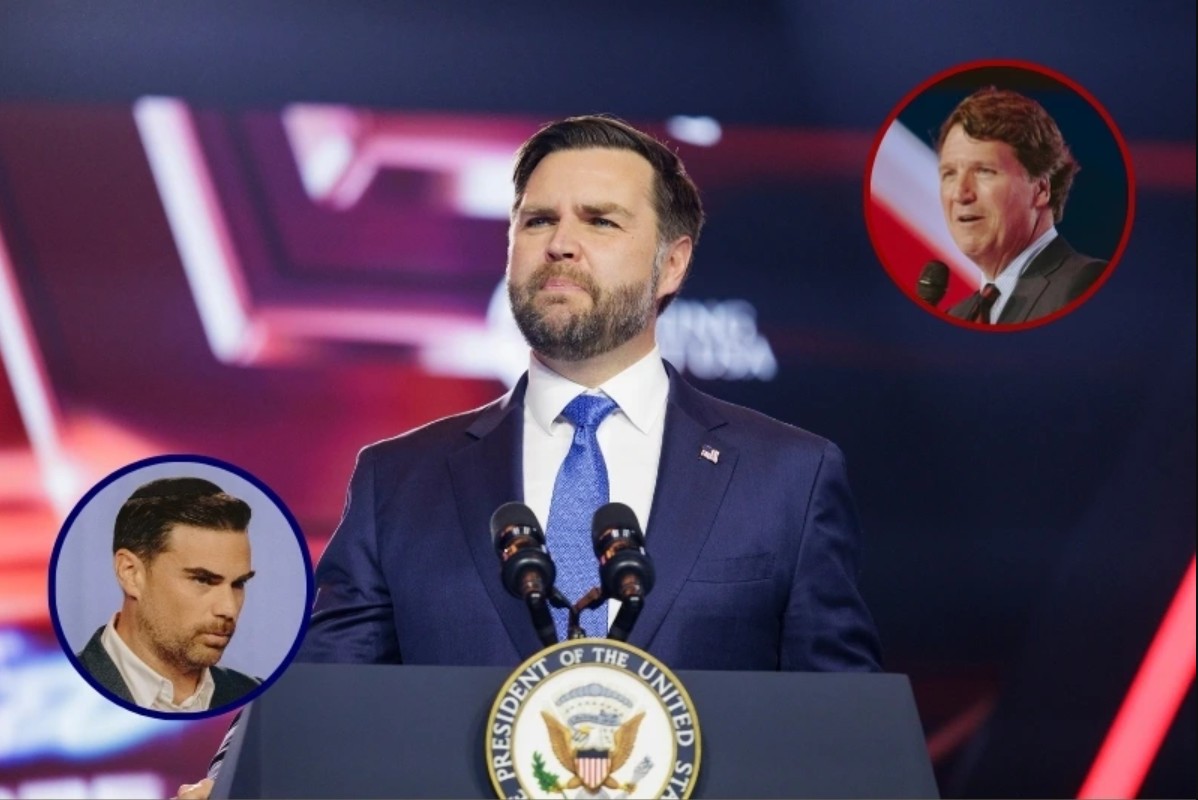
Vice President JD Vance rejects the effort by Jewish pro-Israel activists like Ben Shapiro to get conservatives to "denounce and deplatform" each other, and argued that those who smear people as antisemites are trying to shut down debate about the U.S. relationship with Israel. He made the comments over the weekend, in separate remarks in a speech at Turning Point USA's AmericaFest (AmFest) 2025 event and an earlier interview with Unherd's Sohrab Ahmari.

Vance delivered the closing address at the AmFest event in Phoenix Sunday, where he urged conservatives to avoid internal conflict and refrain from denouncing one another, directly responding to Ben Shapiro’s earlier call for condemnation of certain conservative figures.

The vice president emphasized unity, saying he did not bring a list of conservatives to denounce or deplatform, and framed the refusal to engage in internal purges as a tribute to the late Charlie Kirk, who had invited all voices to the movement.

Vance opened his speech by expressing gratitude to Erika Kirk, the new leader of Turning Point USA following her husband Charlie Kirk’s assassination in September, and praised her leadership.

The vice president rejected the idea of "purity tests" within the conservative movement, asserting that President Trump built a coalition by inviting all Americans, regardless of race, class, or background.

In a direct rebuttal to Shapiro’s Friday speech, which criticized figures like Tucker Carlson, Megyn Kelly, and Candace Owens for promoting antisemitism and conspiracy theories, Vance declared, “I didn’t bring a list of conservatives to denounce or to deplatform,” and stated that the best way to honor Charlie Kirk was to continue welcoming all voices.

Vance reaffirmed his belief that the United States is a “Christian nation,” stating, “We have been, and by the grace of God, we always will be a Christian nation,” a line that drew a long standing ovation.

He highlighted the administration’s achievements, including ending the southern border crisis with seven months of zero releases, negative net migration, declining rents, rising employment, and reduced inflation.

Vance also announced the end of diversity, equity, and inclusion (DEI) initiatives, declaring they had been relegated to the “dustbin of history,” and affirmed that Americans no longer need to apologize for their race or gender.

The speech was preceded by a surprise appearance from rapper Nicki Minaj, who spoke about changing one’s mind and her personal journey with faith, and followed by a video message from President Donald Trump, who praised Charlie Kirk and Erika Kirk.

The event was marked by significant internal tensions, particularly after Shapiro’s speech, which led to a public clash with Carlson and Megyn Kelly, who accused Shapiro of being used in a “proxy war” intended to thwart Vance's chances to become the Republican nominee in the 2028 presidential election.

Vance’s speech was widely interpreted as a strategic move to unify the movement amid these fractures.


Vance Defends Tucker Carlson, Encourages More Debate About U.S-Israel Relationship

Vance also delivered a wide-ranging interview earlier with UnHerd's Sohrab, published late Sunday, addressing the ongoing debate within the conservative movement over the influence of Israel on American foreign policy, the influence of controversial figure Nick Fuentes, and the vice president's vision for American identity.

In the interview, Vance condemned all forms of ethnic hatred including antisemitism as having no place in conservatism, while downplaying Fuentes’s influence and framing concerns about him as a distraction from a more substantive debate about US foreign policy toward Israel.

“Antisemitism, and all forms of ethnic hatred,” he said, “have no place in the conservative movement. Whether you’re attacking somebody because they’re white or because they’re black or because they’re Jewish, I think it’s disgusting.”

Fuentes, an ardent critic of Israeli influence in the U.S. government, has called Second Lady Usha Vance a “jeet” and labeled the vice president a race-traitor for marrying her.

“Let me be clear,” Vance said. “Anyone who attacks my wife, whether their name is Jen Psaki [the former Biden press secretary] or Nick Fuentes, can eat shit. That’s my official policy as vice president of the United States.”

Vance argues that Fuentes and his Groyper fans function as a useful foil for pro-Israel hard-liners in the Right’s debate over America’s alliance with the Jewish state.

The vice president said: “I think that Nick Fuentes, his influence within Donald Trump’s administration, and within a whole host of institutions on the Right, is vastly overstated, and frankly, it’s overstated by people who want to avoid having a foreign-policy conversation about America’s relationship with Israel.”

Vance told Unherd that he thinks 99% of Republicans and 97% of Democrats do not hate Jewish people, arguing that the real issue is a backlash against the consensus view on Israel, not widespread antisemitism.

“99% of Republicans, and I think probably 97% of Democrats, do not hate Jewish people for being Jewish," he told Sohrab. "What is actually happening is that there is a real backlash to a consensus view in American foreign policy. I think we ought to have that conversation and not try to shut it down. Most Americans are not antisemitic, they’re never going to be antisemitic, and I think we should focus on the real debate.”

Vance defended Carlson against criticism for hosting Fuentes, rejected "purity tests" within the movement, and emphasized that the "America First" coalition should be a broad tent welcoming all who love America.

“Tucker’s a friend of mine,” he told Sohrab. “And do I have disagreements with Tucker Carlson? Sure. I have disagreements with most of my friends, especially those who work in politics. You know this. Most people who know me know this. I’m [also] a very loyal person, and I am not going to get into the business of throwing friends under the bus.”

Vance continued: “The idea that Tucker Carlson — who has one of the largest podcasts in the world, who has millions of listeners, who supported Donald Trump in the 2024 election, who supported me in the 2024 election — the idea that his views are somehow completely anathema to conservatism, that he has no place in the conservative movement, is frankly absurd. And I don’t think anybody actually believes it.”

He argued that the political feud within the American Right is really about “gatekeeping,” and people “trying to settle their own ideological scores” — especially with respect to Washington’s policies in the Middle East.

“I happen to believe that Israel is an important ally, and that there are certain things that we’re certainly going to work together on,” Vance said. “But we’re also going to have very substantive disagreements with Israel, and that’s OK. And we should be able to say, ‘We agree with Israel on that issue, and we disagree with Israel on this other issue.’ Having that conversation is, I think, much less comfortable for a lot of people, because they want to focus on Nick Fuentes.”

Regarding racial politics on the fringe Right in recent years, Vance believes there have been far worse offenders who got away with it, because their version was aligned with elite prerogatives and left-wing moral hierarchies.

“Let’s say you believe, as I do, that racism is bad, that we should judge people according to their deeds and not their ethnicity,” Vance said. “Is Nick Fuentes really the problem in this country? He’s a podcaster. He has a dedicated group of young fans, and some of them have been shitty to my friends and family. Does that annoy me? Of course. But let’s keep some perspective. For the past five to 10 years, I’ve watched one-half of our political leadership go all in on the idea that discriminating against whites in college admissions and jobs is not just OK, but affirmatively good.”

He continued: “If you believe racism is bad, Fuentes should occupy one second of your focus, and the people with actual political power who worked so hard to discriminate against white men should occupy many hours of it.”

Right-wing racialism is, in large part, a reaction against bipartisan elites who for decades maintained a porous border, with the flow of newcomers surging to a flood under the Biden administration. “That necessarily leads to the destruction of social cohesion in the country that I love,” Vance told Unherd. “Ethnic rivalry and balkanization is the inevitable consequence of these things. You don’t have to think it’s a good thing. I certainly don’t, but it’s a predictable consequence.”

Responding to question about racist Groypers who troll him online over his mixed race children Ewan, Vivek, and Mirabel, Vance said: “If you look at my kids — half white, half-South Asian — they were among the most discriminated against in the entire elite-college and jobs hierarchy under Joe Biden. And the Left explicitly promises to bring that hierarchy back if they ever again get power.”

Vance pointed out that elected left-wing politicians have far worse impactful racist policy preferences. “It pisses me off that Fuentes calls my kids ‘jeet,’ and I appreciate that Ro Khanna would never do that. You know what pisses me off a million times more? That Ro Khanna, AOC, and Chris Murphy would deny them jobs and opportunities because they have the wrong skin color.”

The vice president further discussed his views on national identity, advocating for a blend of credal nationalism and cultural assimilation, and asserted that Christianity provides a crucial moral foundation for American unity.

"Do I think that somebody who came to the United States 15 minutes ago has the same understanding of American culture and American identity as somebody whose family has been here for 10 generations? No. Of course, I don’t believe that, because human beings are complex, and part of knowing a culture isn’t just believing certain things, but actually living in a culture, absorbing it,” Vance argued.

The vice president argues that Christianity is the common culture binding Americans together through turbulent times of the Republic's history

“When I talk about America having some common culture,” Vance said, “I think Christianity is very much at the heart of that. With the exception of Jefferson and a couple of others, most of our Founding Fathers were devout Christians. . . . There’s a lot about Christianity that is very useful, even if you’re not a Christian. I think Christianity gives us a common moral language. You saw that in the Civil Rights Era, you saw that during the Civil War. It was one of the ways that we were able to actually come together as a nation, post-Civil War: that shared Christian identity.”

However Vance rejects the prescriptions to governance given by some liberal Religious leaders. The vice president’s own spiritual leader as a Roman Catholic, Pope Leo XIV, takes a much more universalist approach to questions of immigration and assimilation, and has reportedly deputized the US bishops to counter the Trump administration’s strict border policies.

While he welcomes the Vatican’s voice in international affairs, Vance argued that the Bishop of Rome “is not going to be looking at an immigration policy with the same prudential lens that I have on.” The “dignity” of would-be migrants is part of it. So are “the wages of workers” and “the social cohesion of the United States of America.”

“Balkanization and ethnic hatred,” reflected in the rise of anti-immigration sentiment across the West., are mostly symptoms, to Vance’s mind, of the reckless open-borders policies of western left-wing leaders.


community logo
Join the keneci Network Community
To read more articles like this, sign up and join my community today
0
What else you may like…
Videos
Posts
Articles
SpaceX Starlink Internet Satellites

With Starlink internet, data is continuously being sent between a ground dish and a Starlink satellite orbiting 550km above. Furthermore, the Starlink satellite zooms across the sky at 27,000 km/hr! MORE VIDEOS ON KENECI NETWORK RUMBLE CHANNEL: https://rumble.com/c/Keneci

00:28:08
Elon Musk, DOGE Speak On Waste And Fraud

US Department of Government Efficiency Services (USDS) led by Elon Musk speak on the "mind-boggling" fraud and waste in UInited States federal government

00:00:45
January 17, 2025
SpaceX Launches Starship 7th Test Flight

SpaceX successfully executed its second-ever “chopsticks” catch of a Super Heavy booster (or Booster 14) using the “Mechazilla” launch tower on Thursday(Jan. 16), during the seventh uncrewed test flight of the company's 123-meter Starship rocket. However, the megarocket's upper stage(or Ship 33) was lost approximately 8.5 minutes into the flight in a “rapid unscheduled disassembly(RUD)” or explosion

00:10:30
Welcome to Keneci Network!

Join the conversations!

December 09, 2025
Bitcoin White Paper By Satoshi Nakamoto

Bitcoin white paper

Bitcoin_White_Paper.pdf
September 17, 2024
Charges Against Sean 'Diddy' Combs In Grand Jury Indictment

The rapper was charged with racketeering conspiracy, sex trafficking by force, fraud or coercion, and transportation to engage in prostitution in the indictment unsealed Tuesday(Sept. 17)

Combs-Indictment-24-Cr.-542.pdf
post photo preview
Iran Proposes 7-day Plan To End War With US, Reopen Strait of Hormuz

Iranian Foreign Minister Abbas Araghchi confirmed this week, that Tehran has submitted a seven-day plan to the United States via Qatari mediators to end the war, reopen the Strait of Hormuz, and restart nuclear talks. The proposal, presented on the sidelines of the 81st U.N. General Assembly in New York, is a compressed version of the June Islamabad Memorandum that previously collapsed, designed to move from a 60-day negotiation window to a seven-day implementation timeline.

The proposal outlines a plan that includes an immediate end to all hostilities, including in Lebanon and Gaza; lifting U.S. naval blockade of Iranian ports; sanctions waiver on Iranian oil exports; and the release of at least $12 billion in frozen Iranian assets.

If Washington accepts the terms, the seven-day clock starts the following day, with the Strait of Hormuz reopening on the final day to allow comprehensive nuclear negotiations to begin immediately, including frameworks to re-admit UN nuclear inspectors (IAEA) to inspect nuclear stockpiles and damaged facilities.

Araghchi said that a deal before the U.S. midterm elections would be preferable, noting that the economic impact of the strait's closure on global energy prices is a critical pressure point. He detailed the proposal to reporters and in private briefings on the sidelines of the 81st United Nations General Assembly in New York.

While U.S. officials described discussions as "positive and constructive," they emphasized they are not rushing into an agreement, and UAE and Saudi Arabia have reportedly expressed skepticism about the latest push.

The closure of the Strait of Hormuz—through which roughly 20% of global oil flows—triggered record-high energy and gasoline prices globally.


Pezeshkian Vows Iran Will Resist US-Israeli Aggression 'Until The Very End'

Meanwhile, Iranian President Masoud Pezeshkian appeared on Fox News on Thursday, following a defiant address to the UN General Assembly the day prior. He slammed the U.S. and Israel for imposing war on Iran, insisting Tehran does not seek conflict but will resist "until the very end."

The president said that "it is America that must choose whether it wants to end this or not," placing the responsibility for peace squarely on the Donald Trump administration. Despite seeking a deal, he vowed Iran would "keep resisting" U.S. sanctions and military strikes, stating, "We will find ways, and the life of our country will continue."

Pezeshkian categorically rejected any intent to build nuclear weapons, citing a religious decree by the late Supreme Leader Ali Khamenei that deems it "unholy and illegal." He said Iran is ready to dilute its 60% enriched uranium reserves and accepted verification under the NPT framework.

The president noted the war was "imposed" on Iran by U.S. and Israeli "instigations." He expressed willingness to revive the June memorandum for peace, which collapsed over disputes regarding the Strait of Hormuz. He denied that U.S. midterm elections influence Iran's timeline for a deal.

On the cinflict in Yemen, Pezeshkian said that the Houthis are "responsible for their own actions" and that Iran has "no systematic relationship" with them, contradicting U.S. claims of direct Iranian command.

The interview followed Pezeshkian's historic UN speech on Wednesday, where he became the first world leader to address the UNGA while his country is at active war with the host nation. He held up photos of Ali Khamenei, who was assassinated in a US-Israeli strike on February 28, 2026, and in which over 150 schoolchildren were killed. The U.S. and Israeli delegations boycotted or walked out of his address. The conflict, now in its seventh month, has seen repeated breakdowns in diplomacy.

Read full Article
September 23, 2026
post photo preview
Pezeshkian Slams Israel, US In Defiant UN Speech: Iran Will Never Bend The Knee

Iranian President Masoud Pezeshkian delivered a historic and defiant address to the United Nations General Assembly on Wednesday, becoming the first world leader to speak in person while his country is at active war with the host nation, the United States. Speaking a day after President Donald Trump threatened to "annihilate" Iran if a peace deal was not reached, Pezeshkian accused the U.S. and Israel of committing terrorism, war crimes, and violating international law.

Pezeshkian held up photographs of Ali Khamenei, the late Iranian Supreme Leader who was assassinated in the first hours of the U.S.-Israeli offensive in February 2026, as well as images of over 150 schoolchildren killed in a U.S. airstrike on a primary school in Minab.

The Iranian president said that a UN fact-finding mission found "reasonable grounds" to believe the U.S. committed a war crime in that attack. He further condemned the targeting of Iranian universities, hospitals, and infrastructure, asserting that Iran has "only defended itself" and will fight "until our last breath."

Addressing Trump by name, Pezeshkian rejected the U.S. president's characterization of Iran as a "bully" or "terrorist," declaring, "We have been the victims of terrorism." He vowed Iran would never "bend the knee" to sanctions or bullying but emphasized that Tehran remains "ready for dialogue and diplomacy and negotiations without accepting the language of force."

"The United States president described us as terrorists. We have been the victims of terrorism... We will never bow our head or bend at the knee in the face of sanctions, increased pressure, and increased bullying," Pezeshkian said.

Pezeshkian specified that any deal must include the end of the U.S. naval blockade in the Strait of Hormuz and the release of frozen Iranian assets. He heavily criticized Israel's "double standard," noting that Israel possesses nuclear weapons and kills civilians in Gaza yet faces no sanctions, while Iran is punished for seeking equal rights.

"Atomic and nuclear bombs are in the hands of the Israeli regime, but the inspectors are requested to come to Iran. Israel kills, but Iran is subject to sanctions," the Iranian president said.

Despite the fierce rhetoric, Pezeshkian closed his speech by stating that Iran remains willing to return to the negotiating table, provided force and coercion are dropped. "We are ready for dialogue, diplomacy, and negotiations without accepting the language of force," he said.

The U.S. delegation walked out during Pezeshkian's speech, and Secretary of State Marco Rubio subsequently dismissed the speech, questioning Iran's standing to lecture on human rights.

Pezeshkian, elected in July 2024 as a reform-minded candidate initially seeking to ease Western sanctions, has seen his presidency defined by intense military conflict. Following the military strikes in early 2026 and the assassination of Supreme Leader in February 2026, Pezeshkian has had to balance pressure from hardline factions at home while attempting to keep diplomatic channels open abroad.

Read full Article
September 23, 2026
post photo preview
Trump Threatens To Annihilate Iran In UN Speech, As China Rejects US Sanctions On Iranian Airlines

President Donald Trump delivered a 37-minute address to the United Nations General Assembly in New York City on Tuesday, in which he threatened to “annihilate the Islamic Republic” of Iran if a deal to end the ongoing war is not reached. Framing his decision as a binary choice, he said he would either allow Iran to “rebuild and create a far greater country” or “drive them into hell with no chance of survival.”

"Will a deal be made with Iran that lets them rebuild and create a far greater country than it ever was before? Or do I annihilate the Islamic Republic, and do it quickly... drive them into hell with no chance of survival...?" Trump said.

Trump called on all nations to enforce the “complete economic isolation of Iran” and maintain sanctions to bring down global energy prices. Iranian delegation reportedly walked out of the General Assembly hall during his address.

Trump defended the war, which began in February 2026 alongside Israel, as a necessary action to prevent Iran from acquiring nuclear weapons, dismissing reports of U.S. munitions shortages despite Pentagon inspector general reports of “strategic inventory shortfalls.”

The U.S. president later expressed confidence that a deal would ultimately be struck shortly after the upcoming U.S. midterm elections, asserting that Iranian officials are “waiting to see how I do” in that vote.

Iran’s armed forces condemned the speech as an “exploitation of the U.N.’s podium to legitimize aggression.” President Masoud Pezeshkian is scheduled to address the assembly on Wednesday.

Shortly after his speech, Trump announced that U.S. officials, including envoys Jared Kushner and Steve Witkoff, held a “very good” three-hour meeting with Iranian representatives at the U.N.

Beyond Iran, Trump touted U.S. operations in Venezuela, issued warnings to Cuba and Mexico regarding national security, announced plans to build two new military bases in Greenland via agreements with Denmark, and criticized international bodies like the UN Human Rights Council and the ICC.

 
US Envoy, Iranian Officials Hold Talks In New York

On the sidelines of the 2026 UN General Assembly, U.S. Special Envoy Steve Witkoff confirmed that American and Iranian delegations held a three-hour meeting mediated by Qatar and Pakistan, marking the first high-level contact between the sides in months.

Witkoff described the talks as "constructive and promising," stating in an X post, that mediators "shuttled between the two sides" throughout the day. President Donald Trump characterized the outcome as "very good" and "very productive."

The U.S. delegation included Witkoff and Trump's son-in-law Jared Kushner, while the Iranian side was led by Foreign Minister Abbas Araghchi. Iranian President Masoud Pezeshkian was also present in New York.

Although Trump initially suggested direct talks, Witkoff clarified via X that the negotiations were indirect, with mediators facilitating communication between the two delegations.

Iranian state media confirmed that Foreign Minister Araghchi presented Tehran’s non-negotiable conditions to reopen the strategic Strait of Hormuz. These terms include: an immediate lifting of the U.S. naval blockade, unfreezing seized Iranian financial assets abroad and an immediate halt to military operations across all regional fronts.

The meeting occurred against the backdrop of an ongoing conflict, with Iran's Foreign Minister Abbas Araghchi noting that discussions took place under the "constant threat of attack" as the U.S. conducted consecutive nights of strikes on Iranian military targets.

This indirect session marks the first high-level diplomatic exchange between Washington and Tehran since mid-June.

 
China Rejects US Sanctions On Iranian Airlines

As part of the U.S. campaign to enforce maximum economic pressure and isolate Tehran, Washington has imposed secondary sanctions on foreign entities doing business with Iranian transport and aviation infrastructure, notably Mahan Air and Iran Air.

Beijing has consistently rejected unilateral U.S. sanctions against Iranian transport and aviation, maintaining that economic relations and trade with Iran comply with international law. China continues to reject Washington's efforts to enforce unilateral extra-territorial jurisdiction over non-U.S. entities, officials say.

Read full Article
See More
Available on mobile and TV devices
google store google store app store app store
google store google store app tv store app tv store amazon store amazon store roku store roku store
Powered by Locals