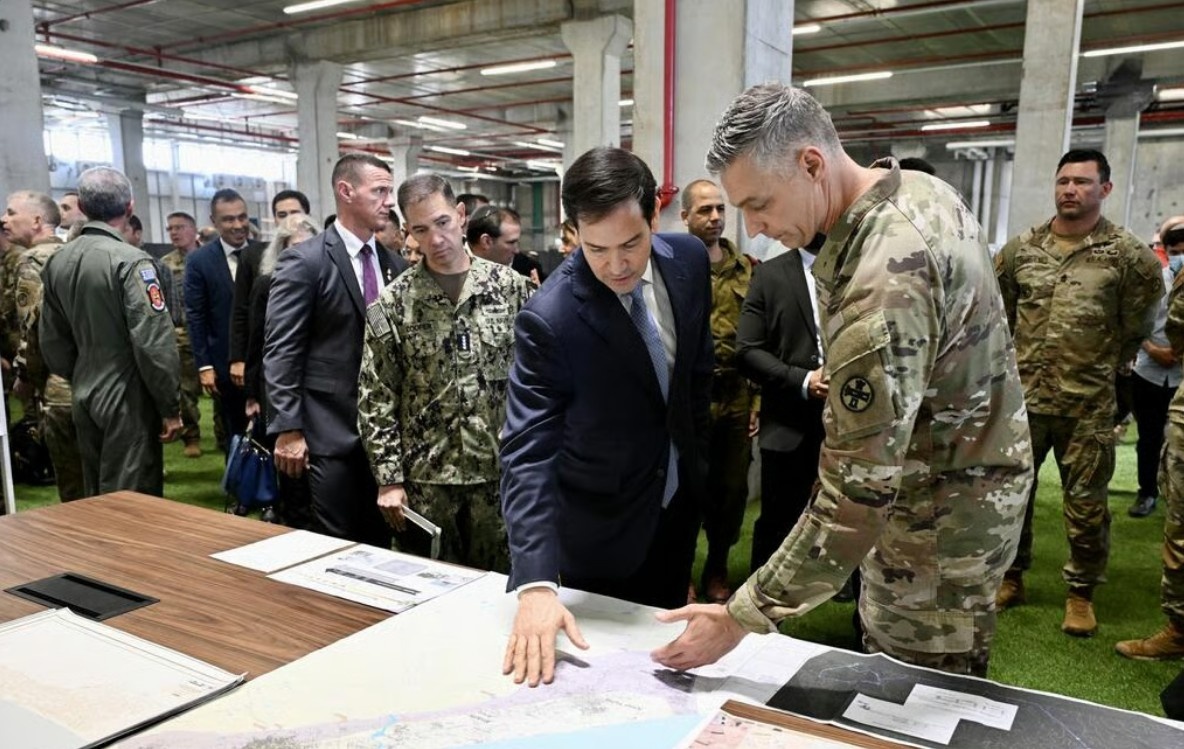
Israeli operatives are reportedly conducting widespread surveillance, including both open and covert recording, of U.S. forces and allied officials at the Civil-Military Coordination Center (CMCC) in Kiryat Gat, southern Israel, a joint facility established in October 2025 to monitor the Gaza ceasefire and coordinate aid under Donald Trump’s 20-point plan for Gaza’s future.
The scale of the surveillance prompted Lt Gen Patrick Frank, the U.S. commander at the base, to demand that recording cease, according to sources briefed on internal disputes. The Israeli military has denied gathering intelligence on its partners, stating that meeting documentation is standard protocol and that discussions are unclassified.
The CMCC, located in a former Gaza Humanitarian Foundation building, serves as a hub for military planners from the U.S., Israel, the UK, and the UAE, and has hosted diplomats and humanitarian workers.
Despite its stated purpose of coordinating humanitarian aid and planning for Gaza’s future, Palestinian representatives and organizations are entirely excluded from the center. Attempts to include Palestinian voices via video calls have been repeatedly interrupted by Israeli officials.
U.S. personnel, including logistics experts trained for disaster response, were deployed to boost aid flows into Gaza but found Israeli restrictions on goods—such as tent poles, water purification chemicals, pencils, and paper—far more significant than logistical challenges, leading to the departure of several dozen personnel within weeks.
While the U.S. has leverage, Israel retains control over Gaza’s perimeter and final approval for what enters the territory.
The CMCC’s interior has been described as resembling a "dystopian startup," with informal meeting spaces, artificial grass, and corporate-style terminology like "Wellness Wednesdays" and "Thirsty Thursdays" to frame humanitarian tasks.
This environment has fostered concern among diplomats and aid workers about the mixing of military and humanitarian efforts, the lack of an international mandate, and the potential for the center to violate international law.
The U.S. military declined to comment on the surveillance allegations, while the Israeli military dismissed claims of espionage, asserting that its documentation of meetings is transparent and professional.
The controversy underscores growing diplomatic tensions over the CMCC’s role and the exclusion of Palestinians from planning their own future, even as the center operates under the framework of a U.S.-backed ceasefire plan.