keneci Network
News • Science & Tech • Comedy
HTV-X1 Cargo Spacecraft Arrives At The ISS
October 29, 2025
post photo preview

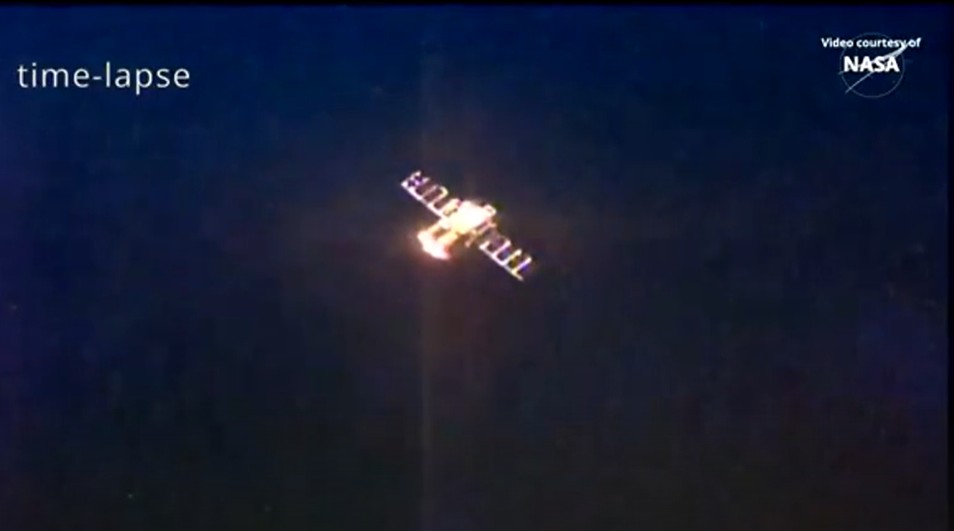
Japan's new HTV-X cargo spacecraft arrived at the International Space Station for the first time on Tuesday, delivering thousands of pounds of supplies and payloads to the crew aboard. The robotic HTV-X was captured by the station's Canadarm2 robotic arm at 1558 UTC, as the ISS flew approximately 418 kilometers over the south Atlantic Ocean. The capture was performed by NASA astronaut Zena Cardman and JAXA astronaut Kimiya Yui, who is a crew member of Expedition 73.

The HTV-X is the successor to Japan's H-II Transfer Vehicle (HTV), also known as Kounotori, which completed nine successful missions to the ISS between September 2009 and May 2020.

Like its predecessor, the HTV-X can carry about 6,000 kilograms) of payload to low Earth orbit. On this maiden mission, HTV-X1 was carrying about 4,080 kg of food, supplies, and scientific experiments. The spacecraft launched on October 25, 2025, atop an H3 rocket from the Tanegashima Space Center in Japan.

The HTV-X is designed to remain berthed to the ISS for up to six months, although the exact duration of this mission has not been finalized.

After departing the station, it has the capability to conduct extended missions in low Earth orbit for up to 1.5 years, enabling on-orbit technology demonstrations such as releasing a cubesat, testing a laser retroreflector, and deploying a structure with a flat-panel antenna and solar cells to evaluate future space-based solar power systems. The spacecraft will eventually reenter Earth's atmosphere and burn up over the South Pacific Ocean after completing its mission.

==================

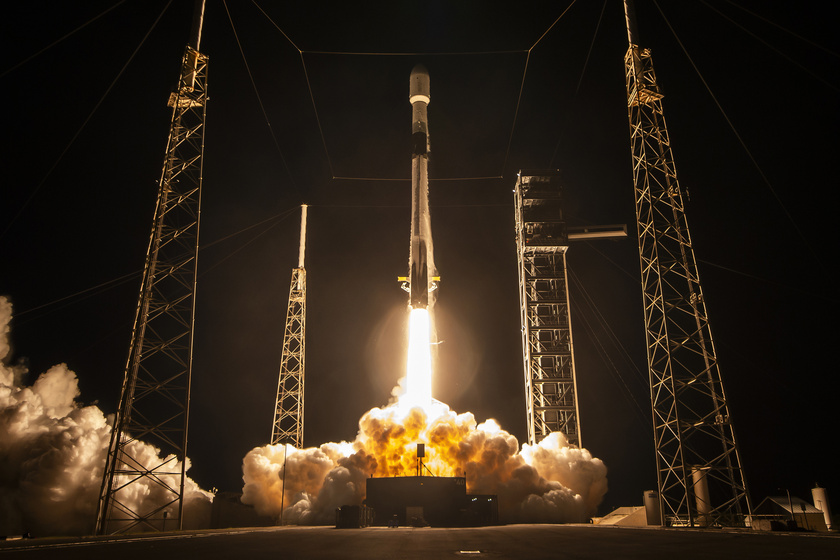
Japan Aerospace Exploration Agency (JAXA) successfully launched the first HTV-X1 cargo spacecraft, atop an H3 rocket from the Tanegashima Space Center at 0000 UTC, on Sunday (Oct. 26). It is expected to arrive at the International Space Station (ISS) for docking on Wednesday (Oct. 29) at about 1550 UTC.

The launch marked the maiden flight of the new generation of Japanese cargo ships and the debut of the H3 rocket’s configuration with four solid rocket boosters (SRBs). This H3 Flight 7 (H3 F7) mission represents a significant milestone in JAXA’s efforts to modernize its ISS resupply capabilities.

The HTV-X is the successor to the H-II Transfer Vehicle (HTV), also known as Kounotori ("White Stork"), which completed its nine missions to the ISS between 2009 and 2020. The new spacecraft was conceived in 2015 to develop a cost-reduced, improved version of the HTV, with a focus on enhanced efficiency and flexibility. It features a modular design, reusing the Pressurized Logistics Carrier (PLC) from the HTV but incorporating a new Service Module that replaces the Unpressurized Logistics Carrier, Avionics Module, and Propulsion Module.

A key design change was the removal of the side hatch for late access cargo, which was initially planned but later abandoned. Instead, unpressurized cargo is now carried on top of the Service Module, allowing for greater payload capacity and improved mission flexibility.

The HTV-X1 spacecraft is 8 meters(m) long (1.2 m shorter than its predecessor) and has a launch mass of 16,000 kg. It can carry a total of 5,820 kg of cargo, consisting of 4,069 kg of pressurized cargo and 1,750 kg of unpressurized cargo, representing a significant increase over the previous HTV's capabilities.

The spacecraft is powered by deployable solar cells, generating up to 1 kW of power, and is designed to remain berthed to the ISS for up to six months. After departure, it can conduct extended free-flight missions for up to 1.5 years, serving as a testbed for autonomous navigation and long-duration system reliability.

The primary mission of HTV-X1 includes delivering a mix of consumables, maintenance gear, and experimental equipment to the ISS. A key payload is the i-SEEP-3B, the latest version of Japan’s exposed experiment platform, which will be robotically installed on the Kibo laboratory module to host small scientific and commercial payloads.

This first flight is not only a resupply mission but also a full-scale demonstration of JAXA’s upgraded power, avionics, and modular service systems under real ISS conditions 

The H3 rocket, developed by Mitsubishi Heavy Industries (MHI), is designed to be a cost-effective and reliable launch vehicle, incorporating 3D-printed components and simplified structures. Its maiden flight in March 2023 ended in failure due to a second-stage engine issue, but subsequent missions have been successful, including a February 2025 launch that deployed the QZS-6 navigation satellite. The H3’s ability to deliver precise orbital insertion into the ISS’s narrow orbital plane makes it an ideal partner for the HTV-X.

"HTV-X enhances transportation capabilities and adds the capability to provide various users with on-orbit demonstration opportunities for up to 1.5 years after leaving ISS until reentry," Mitsubishi Heavy Industries, which builds the HTV-X for JAXA, wrote in a description of the vehicle.

Looking ahead, JAXA plans to extend the HTV-X design for future missions beyond low Earth orbit, including potential logistics support for the Lunar Gateway the space station NASA may build in lunar orbit as part of its Artemis program, and future lunar surface operations. The agency envisions it aiding "post-ISS human space activities in low Earth orbit."

HTV-X joins the stable of ISS cargo vehicles which currently include Russia's Progress vehicle and Northrop Grumman's Cygnus and SpaceX's Dragon, the only reusable craft of the four. The others are designed to burn up in Earth's atmosphere when their missions are over.

The successful launch of HTV-X1 signifies a new era in Japanese space logistics, enhancing international cooperation on the ISS and paving the way for Japan’s continued role in future space exploration


community logo
Join the keneci Network Community
To read more articles like this, sign up and join my community today
0
What else you may like…
Videos
Posts
Articles
SpaceX Starlink Internet Satellites

With Starlink internet, data is continuously being sent between a ground dish and a Starlink satellite orbiting 550km above. Furthermore, the Starlink satellite zooms across the sky at 27,000 km/hr! MORE VIDEOS ON KENECI NETWORK RUMBLE CHANNEL: https://rumble.com/c/Keneci

00:28:08
Elon Musk, DOGE Speak On Waste And Fraud

US Department of Government Efficiency Services (USDS) led by Elon Musk speak on the "mind-boggling" fraud and waste in UInited States federal government

00:00:45
January 17, 2025
SpaceX Launches Starship 7th Test Flight

SpaceX successfully executed its second-ever “chopsticks” catch of a Super Heavy booster (or Booster 14) using the “Mechazilla” launch tower on Thursday(Jan. 16), during the seventh uncrewed test flight of the company's 123-meter Starship rocket. However, the megarocket's upper stage(or Ship 33) was lost approximately 8.5 minutes into the flight in a “rapid unscheduled disassembly(RUD)” or explosion

00:10:30
Welcome to Keneci Network!

Join the conversations!

December 09, 2025
Bitcoin White Paper By Satoshi Nakamoto

Bitcoin white paper

Bitcoin_White_Paper.pdf
September 17, 2024
Charges Against Sean 'Diddy' Combs In Grand Jury Indictment

The rapper was charged with racketeering conspiracy, sex trafficking by force, fraud or coercion, and transportation to engage in prostitution in the indictment unsealed Tuesday(Sept. 17)

Combs-Indictment-24-Cr.-542.pdf
post photo preview
UN Inquiry: Israel Commtting Genocide By Deliberately Targeting Children

Srinivasan Muralidhar, chair of the UN Independent International Commission of Inquiry on the Occupied Palestinian Territory, including East Jerusalem, and Israel, released a report on Tuesday, concluding that Israel is committing genocide, crimes against humanity, and war crimes by deliberately targeting Palestinian children.

The inquiry found that between October 7, 2023, and October 7, 2025, at least 20,179 children were killed and 44,143 injured in Gaza, representing approximately 30% of the total death toll.

The commission determined that this deliberate targeting, which continued even after the October 2025 ceasefire, establishes genocidal intent to destroy the Palestinian group in Gaza.

The report cites evidence of Israeli security forces using precision weapons, including snipers and quadcopters, to shoot children in the head and upper body, as well as the destruction of critical infrastructure like schools, hospitals, and neonatal care units. Additionally, the commission documented war crimes in the West Bank, including the torture, sexual violence, and starvation of detained Palestinian children.

Beyond direct killings, the inquiry highlighted irreversible harm to Palestinian children’s health, education, and psychological development, describing the destruction of childhood as a systematic campaign eroding the foundations of Palestinian society.

The commission stated that targeting children is a key element establishing Israel’s intent to destroy the Palestinian group, noting that the proportion of child fatalities is higher than in previous Gaza conflicts (where it was ~24%).

The report identified specific Israeli military units responsible for these killings, including the Kfir Brigade, 162nd Division, 98th and 99th Divisions, and the Refa’im (Ghost) Unit.

Israel dismissed the report as a "libelous sham" and "defamatory advocacy report," asserting that it ignored Hamas tactics and that every child deserves protection.

This report builds on a September 2025 conclusion by the same commission that Israel had committed genocide in Gaza, which also implicated senior Israeli officials, including Prime Minister Benjamin Netanyahu.

Read full Article
post photo preview
Starfall: SpaceX Launches New Reentry Cargo Capsule

SpaceX successfully launched its first **Starfall reentry capsule aboard a Falcon 9 rocket from Space Launch Complex-40 (SLC-40) at Cape Canaveral Space Force Station on Tuesday (June 23), at 1053 UTC, initiating a demonstration mission to test a new uncrewed cargo return vehicle designed to bring sicentific payloads and goods manufactured in low Earth orbit (LEO) back to Earth.

Following stage separation about 2.5 minutes after liftoff, the Falcon 9 first stage booster B1078  touched down on the SpaceX autonomous droneship "A Shortfall of Gravitas" downrange in the Atlantic, about 9 minutes after launch. B1078's previous missions include NASA's Crew-6 launch to the International Space Station, a Space Force mission and 23 Starlink launches, among others.

Starfall is a disk-shaped, cylindrical capsule measuring 3.1 meters (10.2 feet) in diameter and 0.75 meters (2.5 feet) tall, with a dry mass of 2,100 kilograms and a payload capacity of 1,000 kilograms.

AA5AbUAuBQvZ4Z0qae23l8QBT67PHIAJfAroopu5-tUwdRmkQJpgSCd0nISLo4XOGLCDYAKbvglSKdx-1BxDaicgc6bL2njoL_WbaHi3p4DvXxvfZsObl8ZuaX-lFmSKxcCg4ZiuitGHvfJXVwwG2DC0WLoIGXDhzXuVg7uB7pMv861B8F3J-ylfedWwRg=w1280

Unlike traditional conical spacecraft, Starfall features an aluminum top plate for payload storage and a carbon-fiber heat shield that uses compressed nitrogen gas for attitude control during reentry. The vehicle lacks a dedicated propulsion system for independent deorbiting, relying instead on the Falcon 9’s second stage or an external kick-stage to initiate the return trajectory.

Starfall is designed to support commercial in-space manufacturing and rapid point-to-point cargo delivery, offering a scalable solution for returning materials from microgravity environments after their exposure to space conditions.

In the event that Starfall experiences some sort of issue in space or during reentry, SpaceX has designed the spacecraft for safe expendability. "Capsules use nonhazardous inert cold gas (nitrogen) for attitude control and contain no liquid propellants or hazardous substances. All pressurized systems would be vented prior to splashdown, therefore, no propellants would be released into the ocean," the company says in the Federal Aviation Administration (FAA)'s document.

This debut mission targets a splashdown in the Pacific Ocean, approximately 1,300 kilometers off the U.S. West Coast, following recent approval from the FAA for two reentry tests.

SpaceX plans to launch Starfall on suborbital missions, in addition to the longer-term stretches it will be able to spend in LEO. The company has not yet specified how long it plans to keep the test Starfall vehicle in orbit on this debut mission, and did not broadcast views of the Falcon 9 second stage after separation from the rocket's booster.

Varda Space has landed five of the company's own 0.9 m-wide, roughly 300 kg conical "W-series" capsules to date, one of which returned a payload for the U.S. Air Force after more than eight weeks on orbit. Starfall is more than three times as large.

Read full Article
post photo preview
'El Tigre' Abelardo de la Espriella Ahead In Colombia's Presidential Runoff Election Results, As Outgoing President Petro Alleges Israeli Interference

Right-leaning millionaire lawyer and political outsider Abelardo de la Espriella holds a slim lead over leftist senator Iván Cepeda in Colombia's preliminary presidential runoff results, with 49.66% of the vote to Cepeda's 48.7%—a margin of approximately 250,000 votes.

The preliminary count, covering 99.99% of ballots, shows de la Espriella ahead, but the result is not yet official pending a slower, manual scrutiny process expected to take several days.

Outgoing President Gustavo Petro, who endorsed Cepeda, has alleged electoral irregularities and claimed that Israel rigged the election by compromising voting software, asserting that only the "State of Israel" could have altered server IP addresses to favor de la Espriella who is pro-Israel.

Petro has called for a full recount of the ballots and an audit of the electoral software, urging calm while refusing to recognize the outcome until the official count is certified. Cepeda's campaign is challenging results from 33,000 polling stations, though no recount has ever overturned a Colombian presidential election.

De la Espriella, nicknamed "El Tigre," has denied any wrongdoing and called for national unity, while Israeli Foreign Minister Gideon Sa'ar, U.S. Secretary of State Marco Rubio and President Donald Trump have congratulated him on his victory.

De la Espriella, 47, is a criminal defense attorney known for representing paramilitary leaders and high-profile clients, including figures linked to drug trafficking. He campaigns on a hardline security platform, promising to end peace talks with armed groups, build 10 mega-prisons, and boost oil and gas production.

In contrast, Cepeda, 63, is a close ally of Petro and vows to continue the outgoing president's "Total Peace" policy, which focuses on negotiations with armed groups, social reforms, and a moratorium on new fossil fuel projects.

The election marks a potential sharp rightward shift in Colombia, aligning with a broader regional trend of right-wing victories in Latin America.

Read full Article
See More
Available on mobile and TV devices
google store google store app store app store
google store google store app tv store app tv store amazon store amazon store roku store roku store
Powered by Locals