keneci Network
News • Science & Tech • Comedy
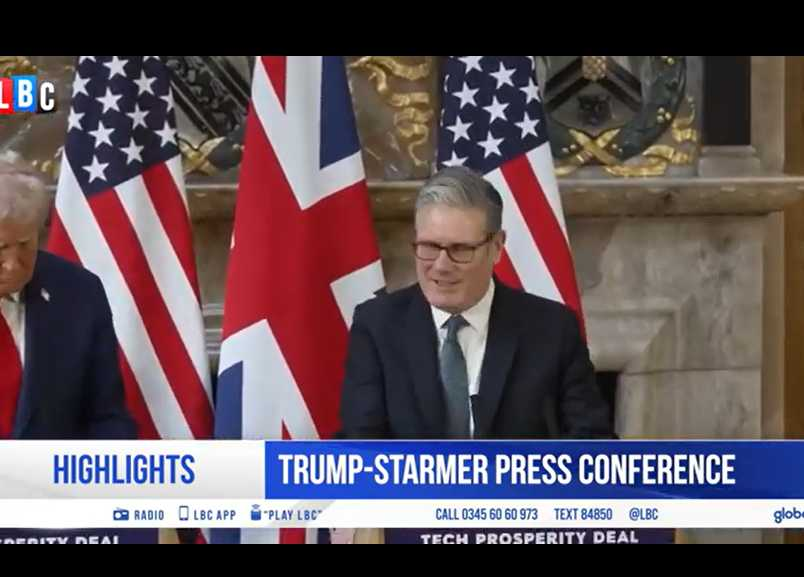
Trump, PM Starmer Talk Illegal Immigration, Free Speech At Presser, Following Glitzy State Visit
September 19, 2025
post photo preview

President Donald Trump and UK Prime Minister Keir Starmer held a joint press conference at Chequers following Trump's second state visit to the UK, where they addressed key international issues including the war in Ukraine, free speech, immigration, and trade, while navigating diplomatic sensitivities around Gaza and the UK's recognition of Palestinian statehood.

Trump notably shifted his stance on Russia, blaming President Vladimir Putin for the war in Ukraine and stating he felt "really let down" by him, and suggested that falling oil prices, driven by European and Indian imports of Russian oil, would force Putin to exit the war; while Starmer emphasized the need for increased pressure on Putin to achieve a lasting peace deal.

The conference also saw Trump advise Starmer to use military force to control irregular migration, a suggestion that drew attention given the UK's recent one-in-one-out migrant return deal.

On free speech, Starmer falsely claimed the UK's commitment to protecting it as a "founding value" but stressed the need to draw a line against online content that promotes paedophilia and suicide, particularly to children, a position that aligned with US concerns about tech regulation.

The leaders discussed the UK's planned recognition of Palestinian statehood, with Trump acknowledging it as "one of our few disagreements" but avoiding direct criticism, while Starmer emphasized the need for a peace plan and humanitarian aid to Gaza.

Trump praised the UK's commitment to increasing defense spending to 5% of GDP, a move that reportedly won favour in the White House, and lauded the "unbreakable bond" between the two nations, signing a new tech prosperity agreement with major US and UK companies.

Trump appeared to forget Peter Mandelson, the UK ambassador to the US who was recently fired over his ties to Jeffrey Epstein, claiming he "didn't know him" despite meeting him during the signing of the UK-US trade deal.

The press conference followed a lavish state visit at Windsor Castle, including a royal dinner and a military welcome, but was also marked by protests, with 70% of Britons reportedly disliking Trump and 44% believing his visit should be canceled.

=================

President Donald Trump was welcomed to Windsor Castle on Wednesday, for his unprecedented second state visit to the United Kingdom, greeted by King Charles III, Queen Camilla, Prince William, and Princess Catherine. The visit is the first time a U.S. president has been invited for a second state visit by a British monarch, following his 2019 visit under the late Queen.

The visit featured a grand royal carriage procession, a state banquet for 160 guests in St. George’s Hall, and a full program of ceremonial events, including a joint U.S.-U.K. military flyover and a special musical performance.

Trump and First Lady Melania Trump arrived at Windsor Castle aboard Marine One, which landed inside the Walled Garden, a rare occurrence.

The couple was greeted by Prince William and Catherine, the Princess of Wales, before joining King Charles III for a carriage procession through the royal estate in the Irish State Coach, followed by Queen Camilla and Melania Trump in the Scottish State Coach.

The procession was escorted by 80 soldiers from the Household Cavalry Mounted Regiment and flanked by the Life Guards and the Blues and Royals, with 1,300 military personnel and 120 horses participating in the ceremony.

A 41-round gun salute and the playing of both nations' national anthems marked the arrival.

Trump and the King inspected the Guard of Honor before attending lunch in the State Dining Room.

Tiffany Trump  joined dad Trump to meet the British Royal during the historic state visit. The 31-year-old, who gave birth to son Alexander in May, was accompanied by husband Michael Boulos, 28, for the trip. The couple were spotted arriving to the state banquet hosted by King Charles III and Queen Camilla, where the President and First Lady are guests of honor.

Tiffany, who entered with Michael behind Kate Middleton and Prince William, opted for a royal blue off-the-shoulder gown which shimmered with sequins.

The state dinner was held in St. George’s Hall, where the Waterloo Table, capable of seating 160 guests, was set with over 4,000 pieces of silver and china. Guests included British politicians and Trump administration officials.

President Trump was also accompanied by several prominent tech executives at the state banquet. The guest list included the CEOs of Apple, OpenAI, Nvidia, Microsoft and Google DeepMin, Tim Cook, Sam Altman, Jensen Huang, Satya Nadella and Demis Hassabis respectively, and Ruth Porat, President and Chief Investment Officer for Alphabet (Google), and her husband. Rupert Murdoch, the News Corp and Fox Corporation owner was also present. Trump recently filed a lawusuit against him and and his media outlet Wall Street Journal.

Trump delivered a toast at the Windsor Castle banquet, praising the "special relationship" between the U.S. and U.K. He described the relationship as "priceless, eternal. It's irreplaceable and unbreakable," comparing the nations to "two notes in one chord or two verses of a poem" and praising King Charles as a "very, very special man" and Prince William as "remarkable."

"It’s a singular privilege to be the first American president welcomed here and, if you think about it, it’s a lot of presidents and this was the second state visit, and that’s the first, and maybe that’s going to be the last time," said Trump to bust of laughter in the room. "But this is truly one of the highest honors of my life, such respect for you and such respect for your country."

In his toast, King Charles paid tribute to the "special relationship," stating the U.S. and U.K. are now the "closest of kin," having fought, died, innovated, traded, and mourned together. He emphasized the enduring bond between the two nations and urged global cooperation on environmental stewardship.

The King urged Trump to consider the importance of protecting the environment, stating the legacy of both nations should ensure future generations experience "natural treasures" and have access to clean water, air, and food.

The musical program at the banquet included classical pieces, the Rolling Stones' "You Can't Always Get What You Want," and a James Bond Medley, reflecting Trump's personal playlist.

The wine list featured a 2016 Wiston Estate Cuvée, a 2018 Domaine Bonneau de Martray, Corton-Charlemagne, a 2000 Ridge Vineyards Monte Bello, and a 1998 Pol Roger, Extra Cuvée de Réserve.

After dinner, guests were served Warre’s 1945 Vintage Port, Hennessy 1912 Cognac, and Bowmore Queen’s Cask 1980, a gift to the late Queen Elizabeth II.

Trump visited St. George’s Chapel, where he laid a wreath at the tomb of the late Queen Elizabeth II and toured the historic chapel.

Despite the royal welcome, protests by far-leftists occurred in London, with over 1,500 police deployed and around 50 groups represented, including the Stop Trump Coalition, who opposed the visit due to Trump's policies

On Tuesday night, images of Trump and convicted sex offender Jeffrey Epstein were projected onto Windsor Castle, leading to four arrests.


community logo
Join the keneci Network Community
To read more articles like this, sign up and join my community today
0
What else you may like…
Videos
Posts
Articles
SpaceX Starlink Internet Satellites

With Starlink internet, data is continuously being sent between a ground dish and a Starlink satellite orbiting 550km above. Furthermore, the Starlink satellite zooms across the sky at 27,000 km/hr! MORE VIDEOS ON KENECI NETWORK RUMBLE CHANNEL: https://rumble.com/c/Keneci

00:28:08
Elon Musk, DOGE Speak On Waste And Fraud

US Department of Government Efficiency Services (USDS) led by Elon Musk speak on the "mind-boggling" fraud and waste in UInited States federal government

00:00:45
January 17, 2025
SpaceX Launches Starship 7th Test Flight

SpaceX successfully executed its second-ever “chopsticks” catch of a Super Heavy booster (or Booster 14) using the “Mechazilla” launch tower on Thursday(Jan. 16), during the seventh uncrewed test flight of the company's 123-meter Starship rocket. However, the megarocket's upper stage(or Ship 33) was lost approximately 8.5 minutes into the flight in a “rapid unscheduled disassembly(RUD)” or explosion

00:10:30
Welcome to Keneci Network!

Join the conversations!

December 09, 2025
Bitcoin White Paper By Satoshi Nakamoto

Bitcoin white paper

Bitcoin_White_Paper.pdf
September 17, 2024
Charges Against Sean 'Diddy' Combs In Grand Jury Indictment

The rapper was charged with racketeering conspiracy, sex trafficking by force, fraud or coercion, and transportation to engage in prostitution in the indictment unsealed Tuesday(Sept. 17)

Combs-Indictment-24-Cr.-542.pdf
post photo preview
Iran-US Ceasefire Falters , As Israel Pummels Lebanon, Killing 254+ Civilians

The U.S. and Iran agreed to a two-week ceasefire announced by President Donald Trump on Truth Social, contingent on Iran reopening the Strait of Hormuz. Trump wrote the ceasefire was a "double sided CEASEFIRE" because the U.S. had "already met and exceeded all Military objectives," and called Iran’s 10-point peace proposal a "workable basis on which to negotiate." The deal, mediated by Pakistan, was announced late Tuesday, just hours before Trump’s deadline for Iran to reopen the strait or face devastating strikes.

Iranian Foreign Minister Seyed Abbas Araghchi confirmed the agreement, stating: _"If attacks against Iran are halted, our Powerful Armed Forces will cease their defensive operations. For a period of two weeks, safe passage through the Strait of Hormuz will be possible via coordination with Iran's Armed Forces." The country is reportedly charging a toll before each vessel can sail through the strait, paid in bitcoin to bypass US-imposed sanctions.

Iran pointed out the ceasefire included Lebanon, but Israel and the U.S. rejected this, with Trump calling Lebanon a "separate skirmish." Israeli Prime Minister Benjamin Netanyahu claimed the ceasefire did not cover Lebanon, where as part of its 'Operation Eternal Darkness,' Israel launched over 160 strikes in 10 minutes, killing at least 254 people and injuring 1,165, according to Lebanon’s Civil Defense.

Iranian Parliament Speaker Mohammad Bagher Ghalibaf accused the U.S. and Israel of violating the ceasefire, citing three breaches: continued Israeli attacks on Lebanon, an alleged drone incursion into Iranian airspace (a Hermes-900 drone shot down in Fars province), and U.S. refusal to accept Iran’s right to uranium enrichment.

Iran temporarily closed the Strait of Hormuz again in response to the Lebanon strikes, threatening the deal’s stability. Pakistan’s Prime Minister Shehbaz Sharif initially claimed the ceasefire applied "everywhere including Lebanon," but the U.S. and Israel contradicted this, with Vice President JD Vance stating Iran had "misunderstood" the terms.

Peace talks are scheduled to begin in Islamabad on Saturday.

Meanwhile early Thurday, Trump wrote on Truth Social: "All U.S. Ships, Aircraft, and Military Personnel, with additional Ammunition, Weaponry, and anything else that is appropriate and necessary for the lethal prosecution and destruction of an already substantially degraded Enemy, will remain in place in, and around, Iran, until such time as the REAL AGREEMENT reached is fully complied with. If for any reason it is not, which is highly unlikely, then the "Shootin' Starts," bigger, and better, and stronger than anyone has ever seen before. It was agreed, a long time ago, and despite all of the fake rhetoric to the contrary - NO NUCLEAR WEAPONS and, the Strait of Hormuz WILL BE OPEN & SAFE. In the meantime our great Military is Loading Up and Resting, looking forward, actually, to its next Conquest. AMERICA IS BACK!"

Read full Article
post photo preview
Artemis II Earthset Photos: Astronauts Heading Home After Historic Loop Around Far Side Of The Moon

The Artemis II crew—NASA astronauts Reid Wiseman, Victor Glover, and Christina Koch, along with Canadian Space Agency astronaut Jeremy Hansen aboard Orion spacecraft, Integrity—are heading home after completing a historic loop around the far side of the Moon on April 6, 2026.

During this flyby, the crew set a new record by traveling 252,756 miles from Earth, surpassing the Apollo 13 distance, and captured the first-ever "Earthset" images from the lunar far side at 22:41 UTC, alongside a total solar eclipse viewed from space.


The astronauts described the experience as "overwhelming" and "extraordinary," with Wiseman noting that seeing the Moon fully eclipse the Sun created nearly 54 minutes of totality and revealed details of the Sun's corona typically hidden from Earth.

Glover remarked that "humans probably have not evolved to see what we're seeing," while Koch emphasized the emotional weight of the mission, stating, "We will explore, we will build ships... but ultimately, we will always choose Earth." The crew also shared a group hug and celebrated with maple cream cookies during the communication blackout, and Wiseman dedicated the mission to his late wife, Carroll.

NASA Administrator Jared Isaacman led a 20-minute Q&A with the crew, thanking them for their courage and representing the "best of us." He expressed gratitude to the two billion people on Earth eagerly awaiting the imagery, saying, "Thank you for taking us with you to the moon... Godspeed and go Artemis II."

Isaacman also acknowledged the crew's lessons for the upcoming Artemis III mission, specifically addressing the need to fix the onboard space toilet plumbing and improve packing strategies for food and hygiene.

For about seven hours, the crew observed the Moon's far side, capturing images of 30 lunar targets (including the Orientale basin) and testing Orion's manual piloting and radiation protection capabilities.

The mission featured the first moonship-to-spaceship radio linkup with the International Space Station, connecting Wiseman and Koch (who performed the first all-female spacewalk in 2019) despite being 230,000 miles apart.

President Donald Trump congratulated the Artemis II crew during a live phone call on April 6, hailing them as "modern-day pioneers" after their Orion spacecraft completed the record-breaking lunar flyby.

Trump praised the astronauts individually, calling out Wiseman, Glover, Koch, and Hansen, and emphasized that "America is back" in space exploration, saying, "At long last, America is back, and America is back in many ways stronger than ever before. We're the hottest country anywhere in the world." He credited his administration for reviving NASA, saying he had chosen to "revive" rather than close it down, and highlighted the creation of the U.S. Space Force as one of his most important decisions.

Trump asked about the crew’s experience during 40–45 minutes of lost communication while behind the moon; Glover replied,"I said a little prayer, but then I had to keep rolling," as he recorded scientific observations.

Hansen described the far side of the moon as visually distinct, with fewer dark "mares" due to Earth’s gravitational influence on the near side, and thanked Trump on behalf of Canada for U.S. leadership in space.

An awkward silence occurred mid-call, with no one speaking for about a minute, prompting Wiseman to request a "quick comm check;" Trump confirmed he was still on the line, calling the reception "great."

Trump invited the crew to the Oval Office, saying, "I look forward to having you in the Oval Office at the White House," and jokingly requested their autographs, adding, "I don’t really ask for autographs much, but you deserve that." The crew accepted immediately, with Glover calling the mission "the thrill and honor of a lifetime," and thanking the American and Canadian people.

The crew launched from Kennedy Space Center on Wednesday, spent ~25 hours circling Earth, and entered the lunar sphere of influence on Thursday evening before the April 6 flyby.

The 10-day mission is scheduled to conclude on Friday, April 10, 2026, with a splashdown in the Pacific Ocean off San Diego, recovered by the USS John P. Murtha.

The crew is currently on their way back to Earth, having exited the lunar sphere of influence on Tuesday afternoon, and will undergo medical checks and family conferences before re-entry.

=================

 
UPDATE | Artemis II Crew's Orion Capsule Completes Translunar Injection Burn On Path To The Moon

The translunar injection (TLI) burn for the Artemis II mission was successfully completed on Thursday, (April 2), at 2349 p.m. UTC, sending the crew and the Orion spacecraft, Integrity on a path toward the Moon for the first time since 1972. The engine fired for about five minutes and 50 seconds (some reports cite 5:49 to 5:55), adding 867 mph to Integrity's velocity and accelerating it to 24,500 mph to escape Earth's gravitational clasp

This critical maneuver placed Integrity into a free-return trajectory that will carry the four astronauts around the far side of the Moon and back toward Earth without requiring further major engine firings. The burn utilized the Orbital Maneuvering System engine on the European Service Module, generating up to 6,000 pounds of thrust, and was preceded by a "Go" poll from NASA's Mission Management Team after confirming the spacecraft's systems were healthy.

The engine fired at an altitude of just 115 miles above Earth. Mission controllers in Houston described the burn as "flawless," with the crew reporting they are "glued to the window" observing Earth. Integrity is now on track to reach a distance of 252,455 miles from Earth, surpassing the record set by Apollo 13, with a planned splashdown on Day 10 of the mission.

Following liftoff Wednesday, NASA astronauts Reid Wiseman, Victor Glover, Christina Koch, and Canadian Space Agency(CSA) astronaut Jeremy Hansen aboard Integrity stayed in Earth orbit for more than 24 hours, checking out the capsule's various systems ahead of its planned plunge into deep space.

"With that successful TLI, the crew is feeling pretty good up here on our way to the moon, and we just wanted to communicate to everyone around the planet who's worked to make Artemis possible that we firmly felt the power of your perseverance during every second of that burn," Hansen, said just after the maneuver.

"Humanity has once again shown what we are capable of, and it's your hopes for the future that carry us now on this journey around the moon," he added.

Artemis 2 launched Wednesday evening (April 1) from NASA's Kennedy Space Center in Florida, sending four astronauts aloft on the first-ever crewed flight of Orion and its Space Launch System (SLS) rocket. The duo had flown together just once before, on the uncrewed Artemis 1 mission to lunar orbit in 2022.

"Our TLI burn, the burn that gets us going to the moon, is also our deorbit burn," Koch said in a NASA interview before launch. "As soon as we take that burn, we have bought off on basically the rest of the mission."

The TLI burn used Orion's main orbital maneuvering engine, which was salvaged from NASA's space shuttle program and upgraded for an Artemis trip to the moon. The engine has flown in space 19 times before on three different space shuttles. If you strapped it to a car, it would accelerate you from zero to 60 mph (97 kph) in 2.7 seconds.

=================

NASA successfully launched the Artemis II mission on Wednesday, (April 1), at 2235 UTC from Kennedy Space Center's Launch Complex 39B, marking the first crewed flight beyond low Earth orbit since the Apollo 17 mission in 1972.

The Space Launch System (SLS) rocket, standing 32 stories tall, ignited its twin solid rocket boosters and four RS-25 engines to generate 8.8 million pounds of thrust, lifting the Orion spacecraft named "Integrity" into space.

The four-person crew consists of NASA astronauts Reid Wiseman (Commander), Victor Glover (Pilot), and Christina Koch (Mission Specialist), alongside Canadian Space Agency astronaut Jeremy Hansen (Mission Specialist), who became the first Canadian and non-U.S. citizen to travel to the Moon's vicinity.

Close to three and a half hours into the Artemis 2 mission, pilot Victor Glover took control of Orion after the capsule separated from the Space Launch System rocket's Interim Cryogenic Propulsion Stage, or ICPS. Glover will now manually pilot Orion around ICPS, carrying out a series of maneuvers designed to test the spacecraft's propulsion systems and ability to operate in close proximity to another object in space.

"I see it. Look at that, woohoo! I see the ICPS and the moon in the field of view," Glover said during NASA's live broadcast of the mission.

These tests, known as proximity operations or "prox ops," are a key part of this test flight and will evaluate Orion's ability to fly near and interface with future Artemis program hardware such as the lunar lander that will eventually be chosen for NASA's planned moon landings.

"It's quite nice and very responsive," Glover said, referencing the spacecraft's Digital Autopilot (DAP) system.

The 10-day mission is a lunar flyby that will not involve a landing but will travel approximately 250,000 miles from Earth, surpassing the previous record set by Apollo 13 in 1970 by reaching 4,600 miles beyond the Moon's far side.

Key mission objectives include testing Orion's life support and navigation systems, performing an in-space rendezvous with the spent Interim Cryogenic Propulsion Stage, and validating emergency procedures for future lunar landings.

The crew is expected to perform a translunar injection burn to commit to the Moon, fly around the lunar far side, and return to Earth for a planned **splashdown in the Pacific Ocean** around April 11, 2026. This flight serves as the critical second step in NASA's Artemis program, paving the way for **Artemis III (lunar landing in 2027)** and the eventual establishment of a sustainable human presence on the Moon.

Read full Article
post photo preview
Iran's 10-point Proposal Demands Permanent Ceasefire, Strait Of Hormuz Toll, As Israeli Airstrikes Target South Pars Natural Gas Field

Iran has reportedly rejected a proposed 45-day ceasefire, instead presenting its own 10-point plan demanding a permanent end to the war. The proposal, conveyed through Pakistani mediators, includes conditions such as reparations and guarantees against future attacks, which U.S. officials have deemed unacceptable.

Key elements of Iran’s 10-point response reportedly include:

- A permanent cessation of hostilities in Iran, Lebanon, Gaza, and Iraq.

- Recognition of Iran’s authority over the Strait of Hormuz, including the right to regulate traffic and collect tolls.

- Full removal of U.S. military bases from the Middle East.

- Compensation for war damages inflicted during the conflict.

- Lifting of all economic sanctions on Iran.

- Formal recognition of Iran’s right to enrich uranium under the Nuclear Non-Proliferation Treaty (NPT).

- A regional framework for security ensuring no resumption of aggression.

- Safe passage protocols** for international shipping through the Strait.

- Reconstruction support for war-affected areas.

- Guarantees that negotiations will not be used as cover for future attacks.

This comes amid escalating hostilities, as Israel launched strikes on Iran’s South Pars natural gas field, targeting its largest petrochemical plant—responsible for about 50% of Iran’s petrochemical output—and killing key Iranian military figures, including IRGC intelligence chief Majid Khademi.

The Israeli Defense Forces (IDF) and the United States also conducted large-scale strikes on Tehran's Mehrabad International Airport, targeting dozens of Iranian aircraft and helicopters to degrade the air force capabilities of both the Iranian Air Force and the Islamic Revolutionary Guard Corps (IRGC).

Satellite imagery and military reports confirm the destruction of at least 12 to 17 aircraft, including fighter jets, transport planes, and potentially the world's last in-service Boeing 747-100 converted as a KC-747 tanker, which were used by the IRGC Quds Force to supply proxies.

The operation, part of a broader assault on six military airfields across Iran, specifically targeted hangars, maintenance facilities, and runways in the western sector of the capital, effectively paralyzing the regime's ability to move high-level personnel and military equipment from the capital.

Over 80 Israeli fighter jets participated in the coordinated wave of attacks, which also included strikes on smaller airstrips like Azmayesh Airport and facilities linked to the Quds Force, such as a drone manufacturing factory.

Israeli officials said the strikes were designed to cripple the IRGC's logistics network, which has historically used commercial and military aircraft at Mehrabad to ferry weapons and advisors to proxies like Hezbollah across the Middle East.

The strikes on Mehrabad contributed to a broader campaign that also hit Shahid Beheshti University, the Pasteur Institute, and various military academies, leading to severe disruptions in regional air travel and raising international concerns over attacks on civilian and research infrastructure.

Airstrikes has also hit Sharif University of Technology in Tehran, a sanctioned institution tied to Iran’s military programs, drawing domestic and international condemnation.

Civilian infrastructure across Iran, including power plants and airports, has come under sustained attack, prompting fears of humanitarian crisis and warnings from the UN that targeting such sites may constitute war crimes under international law.

Iran fired missiles at Israel and neighboring countries, with strikes in Haifa killing four; Israel claims to have intercepted most incoming projectiles.

President Trump has intensified threats, vowing to "decimate every bridge and power plant in Iran" by Tuesday night if the Strait of Hormuz remains closed, calling for "free traffic of oil" as a non-negotiable condition. He dismissed Iran’s 10-point plan as “not good enough,” while still suggesting a deal is possible.

At a White House press conference Monday with Trump, Defense Secretary Pete Hegseth and Joint Chiefs Chair Gen. Dan Caine detailed the high-risk rescue of two U.S. airmen from an F-15E shot down by a shoulder-fired missile.

The operation, involving 155 aircraft, CIA "exquisite technologies," and extensive deception tactics, retrieved the pilot within hours and the weapons officer two days later from a mountainous cave. Hegseth likened the Easter-weekend rescue to the resurrection of Jesus Christ, underscoring the administration’s fusion of religious rhetoric with military messaging.

Despite Trump’s repeated deadlines, analysts note a pattern of postponements, raising doubts about the credibility of his ultimatums.

Read full Article
See More
Available on mobile and TV devices
google store google store app store app store
google store google store app tv store app tv store amazon store amazon store roku store roku store
Powered by Locals