keneci Network
News • Comedy • Science & Tech
SpaceX Private Ax-4 Astronauts Arrive At The Space Station
June 26, 2025
post photo preview

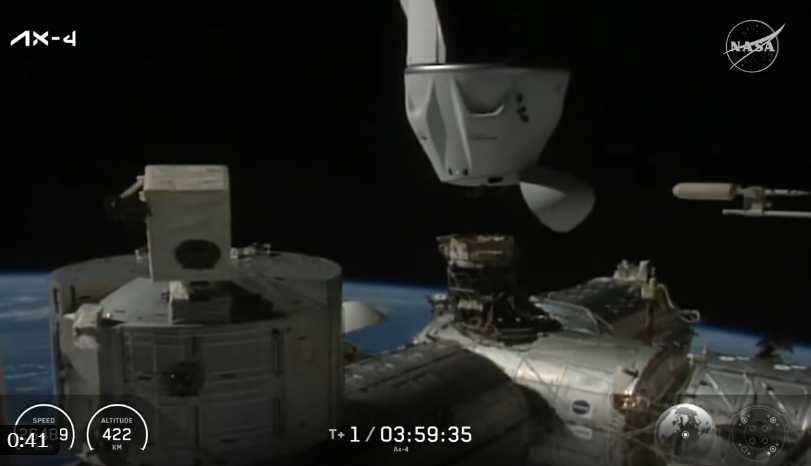
The SpaceX Ax-4 Crew Dragon "Grace" docked with the International Space Station (ISS) at 1031 UTC on June 26, and the hatches between the spacecraft and the station were opened at 1214 UTC. The station's current crew, including Exp. 73 commander JAXA astronaut Takuya Onishi, welcomed the Ax-4 astronauts abaord.

The spacecraft had launched from NASA’s Kennedy Space Center in Florida on a Falcon 9 rocket at 0631 UTC on June 25 for Houston-based Axiom Space, completing a 28-hour orbital journey to the space station.

Welcoming the Ax-4 crew mission commander Peggy Whitson, mission pilot Shubhanshu Shukla (India), mission specialists Sławosz Uznański (Poland) and Tibor Kapu (Hungary), Onishi noted the presence of 11 astronauts from six countries on the ISS. He welcomed the crew, stating, “With your arrival right now, there are 11 astronauts from six countries, and all of us are here in order to advance human space exploration and scientific research, symbolizing international cooperation.”

The Ax-4 crew received their astronaut wings during the ceremony, with Whitson expressing appreciation for the support provided by the ISS crew and Kapu describing the Expedition 73 team as “the best crew” to join.

The Ax-4 crew will work alongside the Expedition 73 members, including NASA astronauts Anne McClain, Nichole Ayers, and Jonny Kim, JAXA’s Onishi, and Roscosmos cosmonauts Sergey Ryzhikov, Kirill Peskov, and Alexey Zubritsky.

"We're looking forward to getting a lot of work done with you guys, and I really appreciate all the support you provided for to us in advance of actually even getting here," Whitson said in response to Onishi.

"I'm very, very confident that the next 14 days are going to be amazing, advancing science and research and working together," said Shukla, mentioning that the view so far had surpassed his expectations.

"This is an ultimate scientific laboratory where we come to do science, to test the technologies of our countries, to do technology demonstrations and science outreach that I can't wait to do for the for the next two weeks, and we will all try to do our best representing our countries," Uznański said as he was handed the microphone.

Finally, as his wings were clipped to his jumpsuit, "I really feel that this is the best crew that you could join. It really feels great to be part of Expedition 73," said Kapu. "I'm 100% sure that this is going to be awesome."

The Ax-4 mission, a private astronaut mission, will last approximately 14 days, during which the crew will conduct over 60 scientific experiments, including seven proposed by India, such as studying water bears (tardigrades) in microgravity and investigations in bio-manufacturing and bio-astronautics.

==================

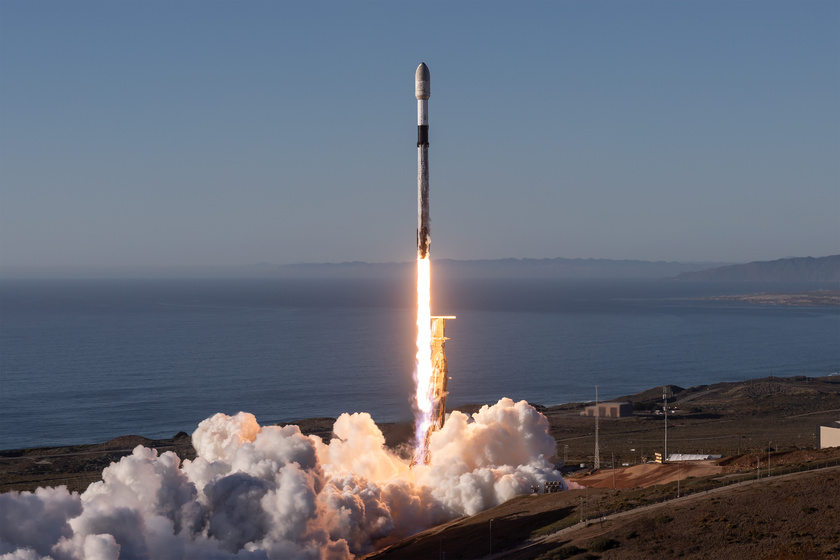
Falcon 9 rocket launched SpaceX's newest Dragon spacecraft, named "Grace," at 0631 UTC on June 25, 2025, from Launch Complex-39A at NASA's Kennedy Space Center. The Ax-4 mission for Houston-based Axiom Space, to the International Space Station (ISS) is carrying former NASA astronaut Peggy Whitson, who is also Axiom's director of human spaceflight. Alongside her are mission pilot Shubhanshu Shukla and specialists Sławosz Uznański-Wiśniewski and Tibor Kapu.

The Falcon 9 first stage booster (B1094) touched down safely as planned about ~8 minutes after liftoff at SpaceX's Landing Zone 1(LZ 1) at Cape Canaveral Space Force Station.

About a minute later, the Falcon 9's second stage completed its orbital insertion and deployed Dragon to begin the final leg of Ax-4's journey to the space station.

The Dragon spacecraft is scheduled to dock with the dorsal port of the space station's Harmony module at approximately 1100 UTC on June 26.

Grace is the fifth Crew Dragon in SpaceX's fleet, and was named by the Ax-4 crew, with its name symbolizing elegance and harmony in space exploration. Ax-4 is the Dragon's debut mission carrying the crew of four to the International Space Station (ISS). The spacecraft featured upgraded life-support systems, touchscreen controls, and autonomous docking capabilities.

The crew shared images of their mission's zero-g indicator, a plush baby swan toy named Joy, symbolized cultural values—wisdom (India), resilience (Poland), and grace (Hungary)—and signaled the crew’s arrival in microgravity.

The Ax-4 crew will spend about two weeks aboard the ISS, living and working alongside the seven long-term occupants of ISS Expedition 73. They will conduct more than 60 science experiments and STEM outreach events, the highest number on any Axiom mission to date, representing 31 countries, including the U.S., India, Poland, Hungary, and others.

The experiments focuses on:

  • Human Research: Studies on muscle regeneration and the impact of isolation on mental health.

  • Life and Biological Sciences: Investigations into how sprouts, edible microalgae, and tiny aquatic organisms grow and survive in microgravity.

  • Earth Observation: Research to support environmental monitoring.

  • Material Sciences: Technology demonstrations for future space applications.

The crew trained extensively for ISS operations, with access to the U.S. segment of the station, including the Columbus and Kibō modules. Educational outreach included interactive events with schools and communities in the crew’s home countries.

This mission marks the first time people from India, Poland, and Hungary have flown together to the ISS and represents the return of these countries to human spaceflight for the first time in 40 years  It is also the fourth private astronaut mission to the ISS.

Whitson is a former NASA astronaut and Axiom Space’s Director of Human Spaceflight. She is the most experienced American astronaut, with 675 days in space prior to this mission. This was her fifth spaceflight and second time commanding an Axiom mission. She holds records for the most spacewalks by a female astronaut (10) and the most cumulative time in space by a U.S. astronaut.

Shukla is a Group Captain in the Indian Air Force and an astronaut with the Indian Space Research Organisation (ISRO). Shukla became the second Indian to reach space and the first to serve in a critical operational role on an ISS mission. With over 2,000 hours of flight experience, he trained at the Yuri Gagarin Cosmonaut Training Center in Russia and is part of India’s Gaganyaan program, set for 2027.

Uznański-Wiśniewski is a European Space Agency (ESA) project astronaut from the 2022 Astronaut Reserve Class. Uznański-Wiśniewski was the second Polish astronaut to travel to space and the first since 1978. An engineer with experience at CERN’s Large Hadron Collider, he trained extensively in Europe, Japan, and the U.S. for the mission, carrying the Polish flag from the 1978 mission.

Kapu is representing the Hungarian to Orbit (HUNOR) program. Kapu was the second Hungarian astronaut to reach space and the first to visit the ISS. A mechanical engineer with expertise in space radiation protection, he was selected from 247 applicants and trained at NASA facilities.

"It has been more than 40 years since the first person from India, Poland and Hungary has been to space, and through this commercial space opportunity we are accelerating the national space programs in each of these three countries and creating new pathways for technological advancements," Whitson said at the crew's January press conferece. "I'm sure this crew is going to be inspiring a whole new generation of young people."

This is the second Axiom astronaut mission to the ISS that has been sponsored in part by another national government or the European Space Agency (ESA). Of the 60 experiments to be carried out by the Ax-4 crew, 17 are being supported by ESA and Poland, and 25 through Hungary's orbital astronaut program HUNOR.

"Each country who comes brings something different than what we have in the normal suite of what we see for our research," said NASA's ISS program manager Dana Weigel during a May 20 Ax-4 press call. "It really expands the breadth of what we can do with research and the number of countries, institutions, academic organizations, etc., who participate."

Thursday's launch was initially scheduled for June 11 but was delayed due to high altitude winds and a leak aboard the ISS.

The space station's aftmost module, Zvezda, has experienced an ongoing leak for more than five years now, but has remained stable during that time. Last week, a change in the pressure data that monitors the leak prompted NASA to delay Ax-4 while they monitored the issue.


community logo
Join the keneci Network Community
To read more articles like this, sign up and join my community today
0
What else you may like…
Videos
Posts
Articles
SpaceX Starlink Internet Satellites

With Starlink internet, data is continuously being sent between a ground dish and a Starlink satellite orbiting 550km above. Furthermore, the Starlink satellite zooms across the sky at 27,000 km/hr! MORE VIDEOS ON KENECI NETWORK RUMBLE CHANNEL: https://rumble.com/c/Keneci

00:28:08
Elon Musk, DOGE Speak On Waste And Fraud

US Department of Government Efficiency Services (USDS) led by Elon Musk speak on the "mind-boggling" fraud and waste in UInited States federal government

00:00:45
January 17, 2025
SpaceX Launches Starship 7th Test Flight

SpaceX successfully executed its second-ever “chopsticks” catch of a Super Heavy booster (or Booster 14) using the “Mechazilla” launch tower on Thursday(Jan. 16), during the seventh uncrewed test flight of the company's 123-meter Starship rocket. However, the megarocket's upper stage(or Ship 33) was lost approximately 8.5 minutes into the flight in a “rapid unscheduled disassembly(RUD)” or explosion

00:10:30
Welcome to Keneci Network!

Join the conversations!

December 09, 2025
Bitcoin White Paper By Satoshi Nakamoto

Bitcoin white paper

Bitcoin_White_Paper.pdf
September 17, 2024
Charges Against Sean 'Diddy' Combs In Grand Jury Indictment

The rapper was charged with racketeering conspiracy, sex trafficking by force, fraud or coercion, and transportation to engage in prostitution in the indictment unsealed Tuesday(Sept. 17)

Combs-Indictment-24-Cr.-542.pdf
post photo preview
Spectrum: German Company Launches Europe's Ist Privately-developed Rocket To Orbit

German startup Isar Aerospace successfully launched its Spectrum rocket into orbit from Andøya Spaceport in northern Norway at 2012 UTC on Saturday (Sept. 5), marking the first privately developed rocket to reach orbit from continental Europe.

After liftoff, the rockety's first stage burned for two-and-a-half minutes, separated, and the second stage ignited to reach orbital velocity. After a circularization burn, the payload fairing was discarded, and the payloads were deployed.

The "Onward and Upward" mision deployed five small satellites (CubeSats) and a non-separating technology experiment, completing the full flight sequence that failed during the small launch rocket’s inaugural launch 17 months earlier. Payloads included CyBEEsat, TriSat-S, Platform 6, FramSat-1, SpaceTeamSat1 and “Let It Go.”

"This is right now making history — making history for Spectrum, making history for Isar, making history for Europe,” Nikolaos Perakis, Spectrum chief engineer at Isar, said during Saturday's launch webcast. "I'm incredibly proud of this massive achievement."

The first test flight in March 2025, from Andøya, "Going Full Spectrum," lasted only about 30 seconds before crashing into the Norwegian Sea. An investigation revealed that a pressure relief valve malfunctioned, causing a loss of attitude control during the roll maneuver.

"A comprehensive investigation was completed within two months of the launch," Isar wrote in a September 2025 update. "The findings identified an unintended opening of the vent valve and a loss of attitude control at the start of the roll maneuver as the initiating events that led to the in-flight failure."

The return-to-flight mission faced multiple scrubs in 2026 due to weather, technical issues, and a boat straying into the launch range. Bad weather and an intruding boat scuttled multiple attempts in March, and an April 9 try was scrubbed due to a leak in a composite overwrapped pressure vessel.

Isar next tried to fly on June 15 but stood down after "detecting off-nominal behavior in the vehicle's fluid systems," according to a company update that day on X. But the company got that issue under control, rolling Spectrum back to the pad for today's launch.

"We had some delays, obviously," Petrakis said during the webcast. "We had some setbacks, but we came back stronger from them. And it validates this tremendous amount of engineering across all the teams, and that's what brings us into orbit."

So Saturday was a very big day for Isar, which is thinking big with Spectrum. “Flight 2 is a big, big milestone, big success," Petrakis said. "But this is just the beginning. So I'm really looking forward to the next steps."

Saturday's achievement positions Isar Aerospace as the first European commercial space company to deliver satellites into orbit from European soil, challenging the dominance of providers like Rocket Lab and SpaceX and complementing existing European heavy-lift systems like Ariane 6. The company has secured a $232 million (€200 million) contract with the European Space Agency (ESA) under the European Launcher Challenge and aims to manufacture 30+ rockets annually at its facility near Munich.

Spectrum is 28 meters tall with a 2-meter diameter; and utilizes automated-wound carbon fiber composite for primary structure to reduce mass and improve manufacturing throughput. The rocket's first stage is powered by nine Aquila sea-level engines and one vacuum-optimized Aquila engine powers the second stage. The small launch vehicle uses liquid oxygen (LOX) and liquid propane, a choice made for density and ease of sourcing compared to methane or kerosene.

AG8ngQU1GZNwb3E7BFGJQWxhHn6ZTiKiUhpwEGR7EVBqyd8eeXidmIee0NAd8j98MVS1pQYo0VfrhLi-SZu2Ckf7KFBSX1dE3TGXEZ9YCc5jkJRO5c6gA_8TeWvXaT6b-p-I4cvagYRCjg3X-TQjApAbmnKF4oOIMfrGV3vfdF4owERVycbTJJHRdRws7MKkpMxZVCXY_7kN7uiaa7vbgYdkvPZnzfkQg0GfkVQlzqpX=w1280
AG8ngQWh7iKKO5ystXfeMzHwtu_jfVwNDa0XGVYObsN0Vy62QGhfbA_60u95cj_bDfs6dH2DGgIEn69r-r--q4r3U3qQEVaqvrZnopdENA0YVsN_2PK-1gXgxLhfyAda4WmTK7eLccHYj2oD_BUMNXU284j-OcGxWpuzSxDMkHY-BYMcm-wr-68qad0g8DX8mSF0jdooTW6qxAZIoBti8uCa7dYGWO1Cte7GzdfO3qJRLwo=w1280
AG8ngQU-1pOpYj9SpMugdet_mF-3fQs6gMn9BUQ9z2P-v1BnyclMMxJoFvm4joN1Ut2C6MvAM5mKZSFptSVIAg2nA8ziOjYu25KShPZfYnEqP8rMDQYx0QNIcQFEPtWohMao2wmys4W7hVgj7Cehf0c3Tj0LoOYxDvuKk0Tg5si0c8ij1-5rJ7sniT_iEdCpS-qoDQkkI8x4goQ7E631ikLdJvOHEYuLROp7cD0grKNb6t0=w1280

Spectrum is designed to carry up to 1,000 kilogram(kg) to Low Earth Orbit (LEO) and about 700 kg to Sun-Synchronous Orbit (SSO). The company is aiming for a price point of about $11,600 (€10,000) per kg.

Read full Article
September 06, 2026
post photo preview
Tit-for-tat: Iran Strikes US Navy Ships After American Attack On 3 Iranian Civilian Oil Tankers

The Islamic Revolutionary Guard Corps (IRGC) attacked six vessels Saturday, after U.S. Central Command (CENTCOM) struck three Iranian oil tankers. The IRGC claimed it targeted three oil tankers transiting the Strait of Hormuz on "unauthorized" routes and three U.S.-affiliated ships in other areas, using anti-ship missiles.

CENTCOM announced earlier that U.S. forces had "permanently disabled" two Iranian crude carriers and "completely destroyed" a third after the IRGC launched ballistic missiles at a U.S. aircraft carrier and a guided-missile destroyer, which successfully evaded the attacks with no American personnel harmed, CENTCOM claimed.

This exchange marks a significant escalation in the U.S.-Iran conflict that began in late February 2026. The strikes on Saturday, were part of a new U.S. "tanker for tanker" policy, first implemented earlier in the week week when the U.S. hit two Iranian government tankers in response to IRGC attacks on commercial shipping in the Strait of Hormuz.

Trump administration executed a targeted operational shift from striking military sites (such as radars or launchers) toward hitting Iran's commercial oil assets. Using a combination of Navy and Air Force fighters and drones, CENTCOM struck three Iranian crude oil tankers

M/T Downy was struck at the stern off Kharg Island (Iran’s primary crude export hub) and "permanently disabled." M/T Stark 1 struck at the stern near the coastal city of Jask and also "permanently disabled." And M/T Kylo (Noxen), an unladen tanker struck in multiple critical areas in the Gulf of Oman, rendering it inoperable; it subsequently sank.

CENTCOM claimed the targeted tankers was part of a "multibillion-dollar shadow network" funding the IRGC and its regional proxies.

"Let the message to the IRGC be clear: If you shoot at two of our ships, we will impose an even higher economic cost—taking out three of yours," CENTCOM's Admiral Brad Cooper said in a statement. "We will not hesitate to defend American forces, and if necessary, destroy Iran’s limited and exposed oil fleet."

The IRGC Navy warned other vessels not to transit the strait via "unauthorized" waterways, threatening to target them. Iran’s Foreign Ministry condemned the U.S. strikes as "illegal and aggressive" violations of the UN Charter, while Iranian state media confirmed the crew evacuations from the hit tankers.

Defense Secretary Pete Hegseth posted on social media, "If Iran shoots at U.S. ships, we will destroy (and sink) their oil tankers." President Donald Trump had earlier described the conflict as "small potatoes" and declared the Strait of Hormuz "open."

The Strait of Hormuz is the world's most critical oil transit chokepoint, normally handling ~20% of global petroleum. Tensions escalated sharply after a naval blockade and military actions effectively closed off unapproved shipping routes.

US shift to "Tanker-for-Tanker" warfare, transitioning from neutralizing offensive threats (like mine-laying capabilities and coastal radar installations) to targeting the "shadow network" fleet that generates revenue for the IRGC, observers say, is likely to exacerbate the global energy crisis.

Read full Article
September 03, 2026
post photo preview
China, US Developing Military 'Hunter' Satellites: Leaked Report

The United States and China are rapidly developing military space capabilities, including "hunter" satellites and orbital weapons, signaling a shift toward potential space warfare.

Recently leaked documents and space-tracking data from early September 2026, reportedly show both nations are creating spacecraft capable of maneuvering near, inspecting, or potentially disabling other satellites.

Unlike traditional satellites that follow fixed, predictable orbital paths, hunter satellites—also called co-orbital threat systems or inspector satellites—possess high maneuverability. They are equipped with advanced propulsion, autonomous navigation, and physical or directional payloads designed to interact with other spacecraft.

China and the US are aggressively pursuing on-orbit refueling technologies. Because maneuvering in space consumes significant fuel, refueling capabilities allow hunter satellites to remain operational indefinitely rather than becoming dead weight after a few maneuvers.

China’s advancements include orbital "dogfighting" and refueling technologies. Chinese military-linked researchers are pursuing satellites designed to pursue and capture other spacecraft, with patents covering autonomous fuel-efficient maneuvers and net-based capture systems.

Officially referred to as "space debris removal," "in-orbit servicing," or "repair craft," the exact same robotic mechanisms (grappling arms, nets, lasers) used in systems can be weaponized to disable enemy satellites.

In June 2026, a Chinese spaceplane released a mini-satellite that circled another spacecraft, an act US officials described as a dress rehearsal for combat. Additionally, China likely conducted an on-orbit refueling attempt last year, a breakthrough that would allow satellites to extend their operational lives indefinitely.

Chinese military-linked patent filings reveal developments in autonomous, fuel-efficient pursuit calculations and multi-satellite netting systems designed to capture non-cooperative target spacecraft.

The US is countering with joint allied operations and electromagnetic weapons. The US Space Force has introduced ground-based electromagnetic weapons to disrupt satellite communications and operates a secret, crewless spaceplane similar to China’s.

Ground- and space-based lasers can blind satellite optics or permanently damage solar arrays. High-powered electromagnetic weapons are designed to sever satellite data links to ground stations.

In a significant strategic signal, US Space Command, alongside Five Eyes allies recently conducted their first joint military space operation in the path of a suspected Chinese spy satellite, demonstrating allied coordination. In one instance, a US military satellite executed a close-approach intercept vector near a Chinese Shiyan 12-01 satellite, signaling operational readiness to inspect and counter adversary craft.

Autonomous craft like the US X-37B and China's secretive Shenlong serve as mobile deployment platforms for covert payloads, anti-satellite surveillance, and maneuver warfare.

US Space Force leadership describes the Chinese threat as "substantial," noting rapid expansion in both the number and complexity of Beijing’s space missions.

Read full Article
See More
Available on mobile and TV devices
google store google store app store app store
google store google store app tv store app tv store amazon store amazon store roku store roku store
Powered by Locals