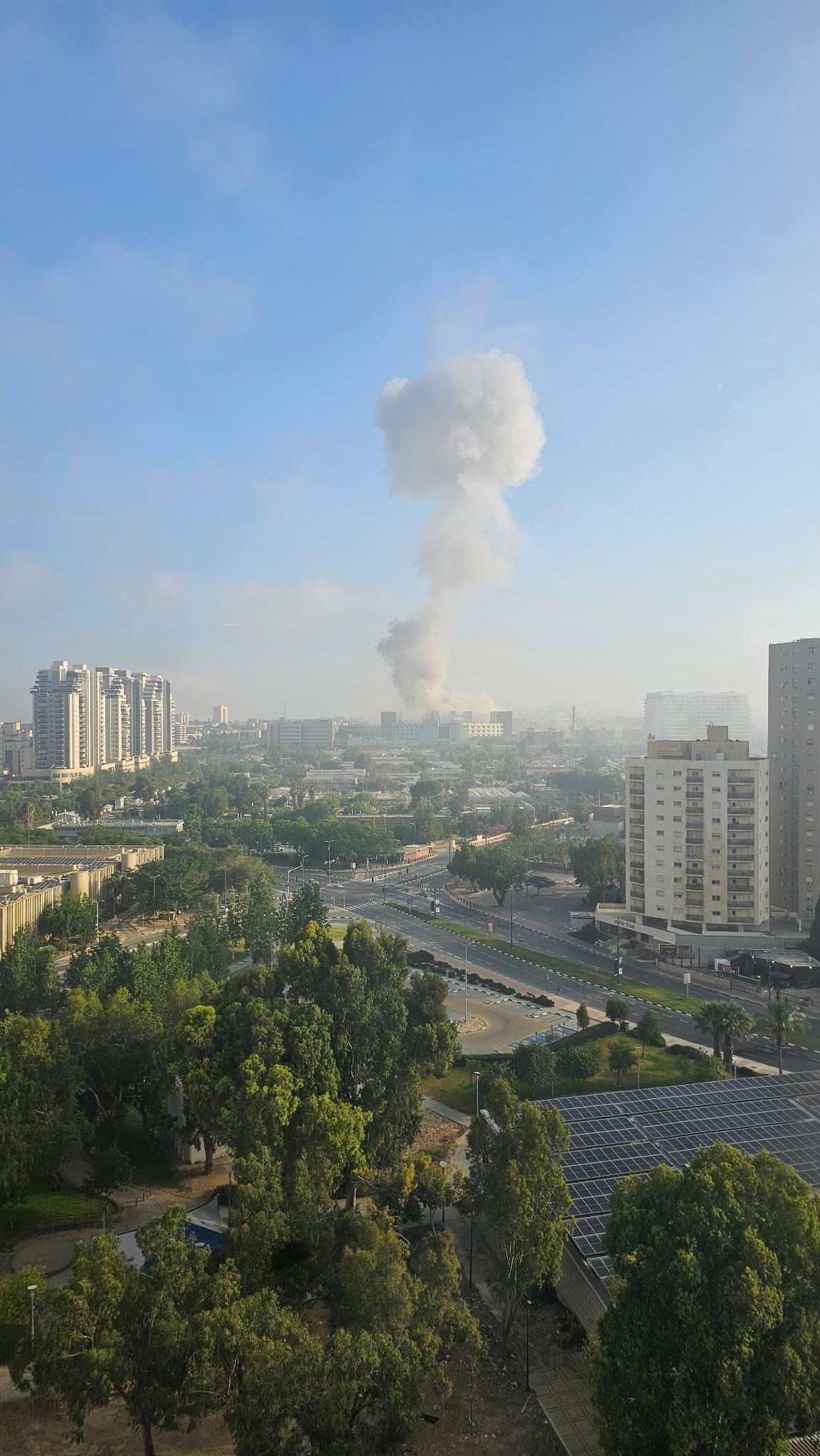
lsrael conducted airstrikes targeting Iran’s Arak heavy water reactor and other strategic locations in Iran, escalating the ongoing conflict. In response, Iran launched missile attacks, with one striking the Soroka Medical Center in southern Israel, which Iran says was intended to target nearby IDF intelligence facilities.
Israeli Airforce targeted the Arak facility, which has been a focal point of concern due to its potential to produce plutonium, a byproduct that could be used in nuclear weapons. Iranian state television reported that the facility had been evacuated before the attack and there was "no radiation danger whatsoever."
The International Atomic Energy Agency (IAEA) confirmed that the reactor was not operational and contained no nuclear material, so no radiological effects were anticipated
Israeli airstrikes also targeted Tehran and other areas in Iran, including military and nuclear-related facilities. The Israel Defense Forces (IDF) claimed to have struck over 170 targets in three days, aiming to cripple Iran’s nuclear program and military infrastructure
Iran launched a retaliatory ballistic missile that struck the Soroka Medical Center in Beersheba, Israel, causing extensive damage and injuring dozens. Iran’s Revolutionary Guard(IRGC) said the intended target was an Israeli military and intelligence headquarters near the hospital, not the medical facility itself.
The target was reportedly the Israeli army’s central command and intelligence base (IDF C4I) and a military intelligence camp located in the Gav-Yam technology park, adjacent to Soroka Hospital in Be’er Sheva.
Thousands of Israeli soldiers are based in that location, which also houses critical systems such as digital command infrastructure, cyber operations, and C4ISR systems.
Iran reportedly used missles with multiple warheads in the latest attck which can disrupt Israeli defense systems. According to senior Iranian Official Mohsen Rezaee, "In just the past 48 hours, you saw that we employed a new tactic, a combination of Fattah and Sejjil missiles and when these are used together, they truly create serious disruption in the enemy’s defense systems."
The Iranian warhead split into some 20 smaller munitions at an altitude of 7 kilometers, creating a larger blast radius on the ground of some 8 kilometers, according to the IDF.
Israel condemned the attack as a war crime, with Defense Minister Israel Katz vowing to hold Iran’s Supreme Leader Ayatollah Ali Khamenei accountable.
However critics point out that the IDF has attacked and destroyed over 36 medical facilities in Gaza since its devastating war with Hamas started, killing women and children.
Iranian missiles also hit a high-rise apartment building in Tel Aviv and other sites in Israel. At least 147 people were injured, with six in serious condition, according to Israeli officials. A total of 271 people were reportedly wounded in the Iranian missile attacks, with 71 sustaining minor injuries at the hospital site.
As the debate rages in the U.S. over American involvement in the war, President Trump is facing backlash from his MAGA supporters who oppose any direct U.S. military action against Iran. It's a reckless war initiated by Israeli Prime Minister Benjamin Netanyah, they argue, and the Jewish state must finish what it started.
"Based on the fact that there is a substantial chance of negotiations that may or may not take place with Iran in the future, I will make my decision whether or not to go within the next two weeks,” Trump said in statement read to reporters at the White House Thursday, by Press Secretary Karoline Leavitt.
Trump reprtedly wants to strike Iran only if U.S. can destroy the Fordow enrichment facility with bunker-busting bombs. The Pentagon concluded earlier this year they don’t go deep enough, and totally destroying Fordow may requires a tactical nuclear weapon.
U.S. Special Envoy Steve Witkoff has reportedly been in regular contact with Iranian Foreign Minister Abbas Araghchi.
==================
As the war enters the fifth day, Israeli airstrikes have hit Iran's state broadcaster during a live news broadcast, marking a significant escalation in the ongoing conflict between Israel and Iran.
The Israeli Air Force has targeted multiple military and nuclear infrastructure sites in Iran, including facilities in Tehran, Isfahan, and Fordow, while Iran has retaliated with missile strikes against Israeli cities such as Tel Aviv and Haifa, killing at least eight people and injuring dozens more.
President Donald Trump, speaking from the G7 summit in Canada, urged Iran to come to the negotiation table, stating that a deal is possible but emphasizing that Iran must act quickly before the situation worsens.
The Israeli airstrike Monday, hit the headquarters of Iran’s state broadcaster (IRIB/IRINN) during a live broadcast, plunging the set into darkness and setting parts of the building on fire. The anchorwoman Sahar Emami was heard describing the sounds of bombing before the explosion hit the studio.
Israel confirmed that its strikes targeted key nuclear and military facilities, including Natanz, Isfahan, and Fordow, aiming to set back Iran’s nuclear program by what Prime Minister Benjamin Netanyahu described as “a very long time.” The Israeli military also issued evacuation warnings for areas near weapons production facilities in Tehran.
An Iranian missile strike hit an oil refinery in Haifa Bay, killing three employees and causing significant damage. The refinery was shut down following the attack. Missiles and drones struck Tel Aviv and Haifa early Monday, killing at least eight people and injuring nearly 100. A school in Bnei Brak was also hit, prompting emergency responses.
Iran reported at least 224 deaths and over 1,200 injuries, while Israel reported between 18 and 24 deaths and over 390 injuries. Both sides have issued evacuation orders for civilian areas near military targets.
President Trump urged Iran to negotiate, stating that a deal is likely but warning that “Iran is foolish not to sign.” In a Truth Social post, he also advised all civilians in Tehran to “immediately evacuate,” triggering panic online and in Iran.
Many critics including prominent MAGA supporters of the president on social media slammed him for the recklessly threatening and insensitive post.
Thousands of Tehran residents fled the capital overnight, with roads leading north to the Caspian Sea jammed with evacuees. Fuel rationing and ATM withdrawal limits were reported as panic spread.
Russia, China and some other countries have advised their citizens to leave Israel.
The U.S. has moved an aircraft carrier and additional military assets to the Middle East in response to the conflict. Defense Secretary Pete Hegseth confirmed the deployment of more defensive capabilities to the region, though specific details were not disclosed.
Trump's handling of the conflict has divided opinion within the MAGA movement, with majority of his supporters adamantly opposed to U.S. involvement in the war especially given that Israeli Prime Minister Benjamin Netanyahu initiated the war while the U.S. was conducting negotiations with Iran.
An Israeli Cabinet member Gila Gamliel on Monday arrogantly said: “We categorically demand that the United States join the war against Iran." Netanyahu told US TV
The Trump administration has denied direct involvement in Israel’s strikes but provided limited support after the president was reportedly convinced of the threat posed by Iran’s nuclear program.
The U.S. has reportedly proposed nuclear and ceasefire talks this week, to the Iranians.
===================
Iran launched a large-scale retaliatory barrage of ballistic missiles late Saturday and into early Sunday, targeting Tel Aviv, Jerusalem, Haifa, and other parts of central Israel, striking residential buildings and infrastructure. This follows Israeli Air Force (IAF) strikes on Iranian targets, including nuclear facilities, military installations, and an oil refinery in the South Pars gas field.
Iran fired approximately 200 ballistic missiles in multiple waves, with some penetrating Israel’s Iron Dome air defense system and hitting densely populated areas such as Tel Aviv, Rishon Lezion, and Ramat Gan.
At least three people were killed and over 200 injured in the attacks, with significant damage reported to residential buildings and public infrastructure. Sirens were heard across northern and central Israel, including in Haifa, prompting civilians to seek shelter as defensive systems attempted to intercept incoming missiles.
Videos online showed explosions and fires in Tel Aviv, with air raid sirens forcing residents into shelters. At least one residential building in Ramat Gan was heavily damaged, with reports of burned-out cars and structural destruction. Missile also reportedly hit Weizmann Institute of Science, a major Israeli research center in Rehovot.
Missiles were intercepted over Jerusalem, with explosions lighting up the sky. No direct hits were reported in Jerusalem, but sirens disrupted normal life.
Iranian missiles reportedly struck an oil refinery in the Haifa Bay area, causing structural damage and fires, though no immediate casualties were confirmed at the refinery. Air raid sirens were also reported in the northern city.
Strikes also hit residential areas in central Israel, with one missile impact site stretching half a block in a city near Tel Aviv (exact location withheld by Israeli military).
Israeli officials confirmed that the IAF conducted extensive strikes on Iranian targets, including the Khondab heavy water reactor, and an oil refinery in Iran’s South Pars gas field, marking the first known Israeli strike on Iran’s oil and gas industry.
IAF strike also targeted the command headquarters of Iran’s Ministry of Defense and the SPND building, according to IRGC's Tasnim. Iran’s Organization of Defensive Innovation and Research (SPND) is the direct successor organization to Iran’s pre-2004 nuclear weapons program, also referred to as the Amad Project, according to the US State Department.
Iran’s Supreme Leader Ayatollah Ali Khamenei vowed a “severe punishment” for Israel’s actions, while Israel’s Defense Minister Israel Katz warned that “Tehran will burn” if Iran continues missile attacks on Israeli civilians.
Israel has reportedly asked the U.S. to join the war against Iran, as Israeli citizens panic over the unprecedented damage to the homeland inflicted by Iranian missile and drone barrage.
Some citizens told local far-left Haaretz newspaper that only intervention by the U..S. will save them from the catastrophe caused by Prime Minister Benjamin Netanyahu's reckless decision to order air strikes on Iran Friday.
However the potential U.S. involvement in the war is very unpopular among President Trump's MAGA supporters, with many prominent American conservative commentators and influencers openly calling out the president for being "complicit" in the war, after his "no new wars" promise to voters during last year's presidential campaign.
Russian President Vladimir Putin reportedly offered to mediate between Israel and Iran, following calls with both leaders.
==================
Israeli air strikes and ground intelligence operations targeted key nuclear and military sites across Iran Friday, including the nuclear facilities in Natanz, Isfahan, and Fordow near Qom, in an operation dubbed "Rising Lion." The strikes began around 0000 UTC, with explosions reported in Tehran, Isfahan, Tabriz, Shiraz, and Kermanshah.
The strikes, confirmed by the Israeli military, were aimed at disrupting Iran's nuclear infrastructure and ballistic missile capabilities. Among the casualties were several high-ranking officials, including General Gholam Ali Rashid, the deputy chief of the general staff of the armed forces, and senior nuclear scientist Fereydoun Abbasi Mohammad Bagheri, the chief of staff of Iran’s Armed Forces, was also killed in the attack.
Iranian state media reported strikes on residential neighborhoods in Tehran, including upscale areas like Qeytariyeh and Niavaran, resulting in civilian casualties, including women and children. There are reports that several Israeli aircraft including an F-35 fighter jet were shot down by Iranian air defense system.
The Israeli strikes also targeted military bases, missile depots, ballistic missile factories, and an underground command center in Tehran, where senior Islamic Revolutionary Guard Corps (IRGC) officials were meeting.
The Natanz uranium enrichment facility, a critical component of Iran’s nuclear program, was significantly damaged. Other nuclear sites at Khondab, Khorramabad, and Arak (heavy water production) were also hit.
“In the past 24 hours, we have taken out top military commanders, senior nuclear scientists, the Islamic regime's most significant enrichment facility and a large portion of its ballistic missile arsenal," Prime Minister Benjamin Netanyahu said in a video message. "More is on the way... The regime does not know what hit them, or what will hit them. It has never been weaker.”
The Israeli Air Force (IAF) launched a large-scale aerial campaign, deploying 200 fighter jets to strike over 100 targets across Iran. The operation was described as a preemptive strike to prevent Iran from acquiring nuclear weapons. The operation involved multiple waves of air strikes, supported by intelligence from the Mossad and Israeli military intelligence. Drones and weapons smuggled into Iran were used to target key personnel and infrastructure.
The Mossad — Israel's equivalent of the CIA — released footage of its operatives carrying out covert operations inside Iran ahead of Israel's historic strike. This is a rare look at the agency's activities, which are mostly secret.
According to a senior Israeli security official, the Mossad took several steps inside Iran to prepare for Israel's preemptive attack. The agency set up a secret explosive drone base inside Iran prior to the attack. Once the strikes started, the drones were activated to destroy surface-to-surface missiles that Israel said posed a threat to its civilians.
Iranian Supreme Leader Ayatollah Ali Khamenei warned Israel to prepare for a "bitter and painful fate." Iran also vowed to respond, accusing the US of complicity in the strikes. Iranian President Masoud Pezeshkian stated that the country would continue to enrich uranium and rebuild any damaged facilities.
Foreign Minister Abbas Araghchi called the attack a “declaration of war” and accused the United States of coordinating with Israel, holding Washington responsible for the consequences.
Iran has started its retaliatory waves of drone and missile strikes against Israel Friday, hitting many targets including near Israel's Defense Ministry headquarters in Tel Aviv. Some of the drones and missiles are being intercepted by Israeli defense systems. Jordanian and Iraqi authorities have also reported intercepting drones and missiles in their airspace.
In a statement, the Iranian Revolutionary Guards Corp, IRGC said: “In the name of Allah, the Most Gracious, the Most Merciful.
"And those who have wronged will know to what [kind of] return they will be returned.
"Following the aggression and aggressive operations launched by the terrorist oppressive Zionist regime and child killer this morning against areas in Islamic Iran, and the martyrdom of a constellation of senior commanders of the armed forces, prominent scientists, and innocent citizens, especially the oppressed children, the Islamic Revolutionary Guard Corps, as the defensive and offensive arm of the Iranian nation, relying on divine power and the wise guidance of the Supreme Leader of the Armed Forces (Supreme Defender), and in response to and with unified support from the noble Iranian people, launched its crushing and precise response against dozens of targets and military centers and air bases of the usurping Zionist regime in the occupied territories.
"Operation True Promise 3 has begun, with the slogan "O Ali ibn Abi Talib (peace be upon him)" at the beginning of the night of Eid al-Ghadir.
"The noble Iranian people will be informed of the details of this operation in a subsequent statement.”
Senior U.S. officials reportedly said that American forces are assisting Israel to shoot down Iranian missiles.
"There are hundreds of thousands of American citizens and other American assets in Israel and the U.S. is working to protect them," the official said in a statement.
There are reportedly two U.S. Navy destroyers, the USS Sullivans and USS Arleigh Burke, in the Eastern Mediterranean. Officials say that the U.S. Army assisting in shooting down incoming Iranian missiles with Patriot Pac-3 missiles and with Thaad.
The US denied involvement in the strikes, with Secretary of State Marco Rubio emphasizing that the US was not involved and urging Iran not to target American interests.
However, President Donald Trump acknowledged that the US had prior knowledge of the operation, and has reportedly reached out to the Iranian leadership to return to the negotiating table for nuclear talks which is scheduled to take place on Sunday.
Russian representative at the UN Security Council calaimed that there was “likely coordination between Israel and British special services” in the attacks on Iran. “Immediately after the Israeli strikes, they sheltered the Israeli aviation which participated in the strikes in their bases in Cyprus," the official said.
There have been reports of nuclear leaks in Iran, however the International Atomic Energy Agency (IAEA) claimed that radiation levels at Natanz remained unchanged